



For two decades, Ron Risher has been a key figure in the Alaskan seafood industry, with experience at Icicle Seafoods and OBI Seafoods.
Risher’s knowledge of the Alaska market has led to him becoming a regular presence on the Global Seafood Market Conference’s salmon panel, where he annually provides updates on the U.S. state's salmon harvest and market.
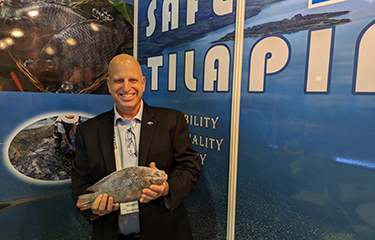
Now, Risher is taking that knowledge to a new company in a new country as the co-president of Grobest, a Taiwanese aquafeed and aquaculture conglomerate. Discussing the move with SeafoodSource during Seafood Expo Asia, which ran from 11 to 13 September in Singapore, Risher said despite the change from wild-caught fisheries to aquaculture and the shift in geography, much of his previous work experience remains relevant in his new job.
“The primary overlap between my role with OBI and Grobest Seafood is in sales and managing our operating and logistics costs for both operations,” Risher said. “Many sectors of both the wild capture and farmed-raised seafood industry are facing similar global challenges with cyclical supply and demand.”
Even before the Covid-19 pandemic normalized working remotely, Risher said his travel schedule often necessitated it, smoothing the transition to working for a Taiwanese company.
“To be honest, I don’t feel like there’s been much of a change in my routine since the transition from nearly 20 years of Icicle and OBI back to working with aquaculture-based products,” he said. “Even before the pandemic, with my travel schedule, I’ve worked remotely and made myself available as much as possible.”
Risher said he’s worked with other family-based companies like Grobest, and the company has given him a “warm welcome.”
“Of course, I also feel a huge weight or responsibility to grow our mutual business operations throughout Asia as well as supporting our partners and maintain my connection to Alaska,” he said.
Risher isn’t stepping into the role on his own. Longtime Grobest President Ron Patton has stayed on as co-president, and Risher said Patton has already begun sharing his knowledge.
“Patton has been a wealth of information from his 20 years with Grobest and many years in the feed and agricultural industries,” Risher said. “He has given me more insight and stories than I can fully appreciate now, and hope to be able to call on him once he retires from the day-to-day operations.”
Grobest's current focus is on expanding its U.S. and E.U. sales of tilapia, warmwater shrimp, and yellowfin tuna. The company is also hoping to capitalize on Risher's knowledge of how to maximize use of underutilized Alaskan groundfish species.
“I’m staying away from the pink and the chum salmon and the pollock and going toward the species that are underutilized, like yellowfin sole,” Risher said. “[Groundfish] has such a large biomass in Alaska, comparable to pollock even, but it still doesn’t get the love and the mass marketing that we’ve seen with the other whitefish species.”
Risher said Grobest will pursue acquisitions to improve its access to additional species and markets beyond what it currently offers.
“We are working on several potential acquisitions to grow our operations and capacity in Asia and the U.S.,” Risher said. “We have expanded some of our reprocessing projects and I’m still exploring potential opportunities in Alaska as well as Vietnam and Indonesia. We are also working on joint ventures for cold storage and further processing in the U.S.”
Risher said Grobest is working to bring a new line of retail pack fillets, which he said will arrive in the U.S. soon. The company is also planning to expand its private-label programs in 2024.
Risher said the relationships he’s developed with packers and processors in places like China, Vietnam, Indonesia, and Thailand will help as Grobest pushes to up its presence in new markets.
Risher also said Grobest will be pushing deeper into high-end value-added species.
“We’d like to do some of that for the U.S., but it’s one of those things that’s a limited market because of the price and has to be geared back to customer demand and buyer demand,” Risher said. “You can’t just dump products into the market. I’ve seen that over and over again over the years, especially when you’re doing special sushi items.”
Looking forward, Risher said he’s “still absorbing” a lot of the information and is assessing how the teams in both the U.S. and E.U. can integrate into the wider organization.
“I’ve been traveling and meeting with many of our operations throughout Asia as well as meeting up with customers. We’ll bring on additional staff for sales and may grow our team as we expand our portfolio to include value-added Alaska and Asian seafood products,” he said.
Photo by Chris Chase/SeafoodSource
