

Disease challenges in its farming segment and lower quotas for its wild-catch operations had a negative impact on Lerøy Seafood Group’s earnings in the third quarter of this year.
Lerøy Seafood CEO Henning Beltestad confirmed that at the end of Q3 and beginning of Q4, the company has faced infectious salmon anemia (ISA) disease issues at some grow-out sites. These have resulted in lower production levels than expected and will affect the expected harvest volumes in 2023 and 2024. At the same time, this year’s fishing quotas have been lower than in 2022, and will be lower still in 2024, he said.
According to LSG’s Q3 2023 report, driven by strong and rising prices, partly because of the weak Norwegian kroner, its revenues for the period increased 8 percent year-on-year to a Q3 record of NOK 8 billion (USD 721 million, EUR 677.2 million), while its operating EBIT fell 24 percent to NOK 631 million (USD 56.9 million, EUR 53.4 million). That followed up on a record-breaking Q2 2023 for the company.
Presenting the Bergen, Norway-headquartered Q3 2023 results, Beltestad said that its farming operations were affected by one-time effects related to the early harvest of fish with detected infectious salmon anemia (ISA). Comprising the three Norwegian regions of Lerøy Aurora in Troms and Finnmark, Lerøy Midt in Nordmøre and Trøndelag, and Lerøy Sjøtroll located in Vestland, the segment reported operating earnings before interest and taxes (EBIT) of NOK 566 million (USD 51 million, EUR 47.9 million) in Q3 2023, compared with NOK 813 million (USD 73.3 million, EUR 68.8 million) a year previously.
Lerøy’s Q3 slaughter volumes of salmon and trout decreased 4 percent from 2022 to 53,876 gutted weight tonnage (GWT), while its EBIT per kilogram decreased from NOK 14.50 (USD 1.31, EUR 1.23) to NOK 10.50 (USD 0.95, EUR 0.89).
The company received an average spot price for salmon in the three-month period of NOK 77.10 (USD 6.95, EUR 6.53) per kilo, compared with NOK 104.80 (USD 9.44, EUR 8.87) in Q2 2023, and NOK 68.70 (USD 6.19, EUR 5.82) in Q3 2022.
Its salmonid harvest volume, including jointly controlled operations, is expected to be 169,500 GWT in 2023, rising to 193,500 GWT in 2024.
Beltestad said that to achieve its goals for its aquaculture operations for 2025, centered on achieving a harvest volume of 205,000 GWT, a range of measures have been implemented and investments made that focus on increased smolt quality and new farming technologies that, among other things, counter sea-lice challenges.
“We have great confidence in these measures, and their effects are expected to gradually become apparent in the form of higher growth through 2024,” he said.
Within its wild-catch segment, Lerøy Havfisk's total catch volume for the quarter totaled 14,433 metric tons (MT), compared with 14,862 MT in Q3 2022. Its main catch species were cod (3,455 MT), haddock (177 MT), redfish (1,001 MT), saithe (4,489 MT), and shrimp (4,390 MT). Compared with Q3 2022, the average price for cod increased by 7 percent, while haddock and saithe prices fell 30 percent and 24 percent, respectively.
From an operational level, the segment’s efficiency in the fishery was down compared to other quarters, mainly because of lower volumes of cod and increased shrimp fishing, according to Beltestad.
“For the year to date, we’ve had a higher catch volume of 63,400 MT compared to 58,600 MT last year, so we’ve had a really good performance – catching other volumes when the quota for cod has been going down,” he said.
Including the Lerøy Norway Seafoods (LNWS) whitefish processing operations, the segment reported an operating loss of NOK 38 million (USD 3.4 million, EUR 3.2 million) for Q3 2023, compared with a profit of NOK 27 million (USD 2.4 million, EUR 2.3 million) in the same period of last year.
Norway’s 2024 quotas will see a 20 percent lower cod catch and a 17 percent less haddock next year.
Meanwhile, LSG’s downstream activities – its VAP, Sales, and Distribution (VAPS&D) division – delivered significantly better earnings than in Q3 2022. Revenues for the period increased NOK 567 million (USD 51.1 million, EUR 48 million) to NOK 7.68 billion (USD 692.1 million, EUR 650.1 million), while its operating EBIT climbed NOK 100 million (USD 9 million, EUR 8.5 million) to NOK 163 million (USD 14.7 million, EUR 13.8 million), with the report advising that the seafood value chain has adapted to higher price levels.
“As of today, we are expecting a profitability in the fourth quarter in line or higher than for the fourth-quarter 2022. And we significant potential for improvement in some regions,” Beltestad said.
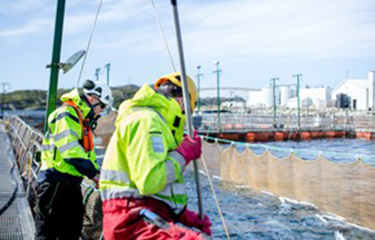
Photo courtesy of Lerøy Seafood
