



Bergen, Norway-based Lerøy Seafood Group has swallowed a one-off cost of NOK 1.7 billion (USD 160.2 million, EUR 147.6 million) to implement Norway’s salmon farming resource rent tax, adopted in May 2023.
Lerøy Seafood Chief Financial Officer Sjur Malm said the firm paid NOK 2 billion (USD 188.5 million, EUR 173.6 million) in taxes and fees in 2022, but that figure is likely to grow significantly as a result of the tax, resulting in reduced operating cash flow. Producing an accurate estimate of how much the tax’s running costs will amount to is not currently feasible, Malm said, as work still needs to be done to calculate the value creation at its sea-based phase of salmon and trout production in Norway, the metric upon which the tax is based.
Speaking at the company’s presentation of its Q2 2023 results, Malm said historically, Lerøy Seafood measured profitability in its farming segment as a whole and traditionally assessed goods and services used through the value chain by their costs rather than focusing on the value creation at each step. However, with the new resource rent tax only applicable to the sea phase – not the full value chain – it now must shift its valuation measurement processes.
Malm said Lerøy Seafood may have to shift strategies as a result of the tax, saying it has hurt the ability of the company – and the larger salmon-farming industry in Norway – to invest in growth and development. To illustrate the “substantial ripple effect” that the new tax could have, Malm highlighted the fact that in 2022, LSG acquired NOK 19 billion (USD 1.8 billion, EUR 1.6 billion) worth of goods and services from some 5,100 suppliers across Norway.
“It doesn’t make sense to withdraw investment funds from coastal industries and transfer them into the central government,” he said. “We fear that the long-term consequences will be negative when it comes to value creation.”
The tax aside, driven by strong prices partly due to a weak Norwegian kroner, Lerøy Seafood posted 17 percent growth in revenue year over year in Q2 2023 to a record NOK 7.67 billion (USD 722.8 million, EUR 665.8 million), while its operating profit before fair-value adjustments climbed 2 percent to NOK 950 million (USD 89.5 million, EUR 82.5 million).
However, price inflation on seafood products and a challenging situation facing its farming segment in the second half of 2022 resulted in low harvest weights and a low harvest volume in the first half of this year.
LSG’s farming segment – comprising the three Norwegian operations of Lerøy Aurora in Troms and Finnmark, Lerøy Midt in Nordmøre and Trøndelag, and Lerøy Sjøtroll located in Vestland – reported operating earnings before interest and taxes (EBIT) of NOK 767 million (USD 72.3 million, EUR 66.6 million) in Q2, compared with NOK 970 million (USD 91.4 million, EUR 84.2 million) a year previously.
Its Q2 slaughter volumes of salmon and trout gutted weight tonnage (GWT) decreased 11 percent from Q2 2022 to 29,659 GWT, while its EBIT per kilogram decreased from NOK 29.30 (USD 2.76, EUR 2.54) to NOK 25.90 (USD 2.44, EUR 2.25).
The average price it achieved for salmon in the three-month period was NOK 104.80 (USD 9.88, EUR 9.10) per kilogram, compared with NOK 103.70 (USD 9.78, EUR 9) in Q1 2023 and NOK 105.40 (USD 9.94, EUR 9.15) in Q2 2022.
Including its business activity from its joint ventures, LSG estimated it will achieve a total salmonid harvest of 181,500 GWT for the full year 2023, down from 193,600 GWT in 2022. It attributed the drop to biological challenges at both Lerøy Sjøtroll and its 50 percent-owned Scottish Sea Farms. It confirmed that two Lerøy Sjøtroll sites have suffered from infectious salmon anaemia (ISA) so far in the third quarter. It said a forced harvest with low average weights may significantly impact its cost and price realization, as well as volume, with a likely negative result impact of around NOK 200 million (USD 18.9 million, EUR 17.4 million).
LSG CEO Henning Beltestad said his company’s farming segment has seen significant cost increases year over year, particularly in regard to feed.
LSG’s wild catch segment, on the other hand, performed well in Q2, with subsidiary Lerøy Havfisk, which it acquired in 2016, recording a catch volume for the quarter totaling 23,709 metric tons (MT), compared with 18,649 MT in Q2 2022. Its redfish catch totaled 10,288 MT, its shrimp haul reached 4,619 MT, its cod catch hit 3,108 MT, its catch of haddock was 2,265 MT, and its saithe catch was 2,089 MT. Compared with Q2 2022, its average price for cod increased by 2 percent, while its haddock and shrimp prices fell 25 percent and 14 percent, respectively.
Including its Lerøy Norway Seafoods (LNWS) whitefish processing operations, the segment reported an EBIT of NOK 99 million (USD 9.3 million, EUR 8.6 million) for Q2 2023, compared with NOK 93 million (USD 8.8 million, EUR 8.1 million) in the same period of 2022.
Beltestad said it had been “a very good quarter” for the segment and that there continues to be year-over-year profit growth, thanks to improvements made in LSG’s land-based operations. Cost reduction measures carried out with LSG’s trawl fleet have also helped, he said.
Also in the quarter, LSG’s value-added processing, sales, and distribution (VAPS&D) division posted record revenues of NOK 7.3 billion (USD 688.3 million, EUR 633.7 million), largely thanks to higher prices.
“There’s been a significant improvement in profitability year over year with an operation EBIT of NOK 113 million [USD 10.7 million, EUR 9.8 million], compared with [losses of] NOK 64 million [USD 6 million, EUR 5.6 million] in the second quarter last year,” Beltestad said. “We have been handling the fluctuation in prices in a much better way this year.”
Looking ahead, the resource tax “adds uncertainty” to both LSG’s farming and VAPS&D segments, he said.
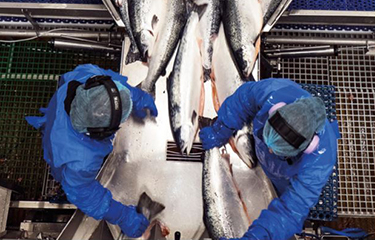
Photo courtesy of Lerøy Seafood
