


Molde, Norway-headquartered Salmon Evolution posted higher losses in 2022, but said it has achieved proof of concept for its flowthrough salmon-farming model.
Established in 2017, Salmon Evolution is using proprietary flowthrough technology for a salmon farm being built in an abandoned quarry on the west coast of Norway that it expects will eventually produce 50,000 metric tons (MT) of Atlantic salmon annually. The first phase of the farm – eight out of 12 tanks in total – came into operation in March 2022 and the company harvested its first fish in November 2022. The farm’s first phase has an annual production capacity of 7,900 MT head-on gutted salmon.
The company posted worse year-over-year operational earnings before interest, taxes, depreciation, and amortization (EBITDA) and operating profit in both Q4 2022 and FY 2022, according to results released 8 February, 2023. Its Q4 2022 operating income was NOK 28.4 million (USD 2.8 million, EUR 2.6 million) and its FY 2022 operating income totaled NOK 47.7 million (USD 4.6 million, EUR 4.3 million). Its operational EBITDA for the quarters was a loss of NOK 22.6 million (USD , EUR ) and for the full year was NOK 68.5 million (USD 6.6 million, EUR 6.2 million). It posted a loss of NOK 6.5 million (USD 630,000, EUR 588,000) in Q4 – down from NOK 11.7 million (USD 1.2 million, EUR 1.1 million) in Q4 2021 – and a loss of NOK 32.7 million (USD 3.2 million, EUR 3 million) for 2022, up from NOK 27 million (USD 2.6 million, EUR 2.4 million) in 2021.
“2022 was a step change year for Salmon Evolution starting with the batch one smolt release in March as per the original timeline and rounded off by fully harvesting out our first batch with excellent results,” the company said in a release. “Through this great achievement, the company has demonstrated that it is possible to produce salmon on land, all the way to full harvest weight, at an industrial scale, with strong biological performance and with the end result being an excellent quality product.”
Salmon Evolution now has 60 full-time employees and a market capitalization of USD 300 million (EUR 280 million), according to CEO Trond Håkon Schaug-Pettersen, who was promoted from CFO to run the company in January 2023.
“The company is very satisfied with the biological results seen in 2022 and see the results achieved as a clear proof of concept as to the assumptions in our production plan,” he said. “Although taking a facility like this into operation is a huge task that involve a lot of learning and tuning in the beginning, the biological performance has exceeded expectations. Furthermore, the company is satisfied to see that the mortality levels have been very low, with the latest batches even outperforming both batch one and two.”
The company harvested 340 metric tons of salmon in its first batch, with an average fish weight of 3.75 kilograms head-on, gutted, providing the firm an eight-month production cycle benchmark.
“The harvest showed a strong product quality, confirmed through an industry leading superior share of 96 percent for batch one as a whole. The average realized price for batch one ended at NOK 75 [USD 7.27, EUR 6.78] per kilogram and NOK 78 [USD 7.56, EUR 7.05] per kilogram for superior 3+ kilogram HOG, representing a NOK 3.00 [USD 0.29, EUR 0.27] per kilogram premium to corresponding Nasdaq prices,” Schaug-Pettersen said.
In the fourth quarter, Salmon Evolution split and graded its second batch and stocked a third batch of 200,000 smolt in October and fourth batch of 265,000 smolt in December.
“Going forward, the company plans to stock full-size [260-gram] batches of smolt at Indre Harøy every second month,” Schaug-Pettersen said.
All batches have thus far seen “very low” mortality levels, even at higher densities, he said.
“For batch two, the accumulated mortality stood at 1.2 percent per 31 January, 2023, clearly outperforming the levels seen for batch one. For batch three and four, mortality levels are even lower, demonstrating the benefits of having a controlled environment with minimal manual handling of the salmon,” he said.
Salmon Evolution plans to harvest its second batch in Q2 2023 and expects to reach steady-state production levels by Q3 2023. Schaug-Pettersen has a positive outlook for both the short- and long-term.
“Going into 2023, most analysts expect low single digit global supply growth which should support a scenario with strong salmon prices. With Salmon Evolution now in the process of ramping up production, the Company should be in a good position to benefit from this over the course of 2023,” he said. Looking further ahead, the company continues to see a significant demand growth potential for salmon and the company remains firm in its belief that land-based farming will need to play an important role alongside conventional farming for the industry to be able utilize the demand potential. After almost one year of successful farming operations and with phase one expected to be completed during the first quarter, the company is in a unique position to execute on its growth plan and solidifying its position as the global leader within land-based salmon farming.”
The first phase of the farm’s development will be completed in Q1 2023 with an estimated capex of NOK 1.56 billion (USD 151 million, EUR 141 million). Salmon Evolution is studying its first phase of development to aim for cost savings in its second phase, which it hopes to begin once it obtains financing. It hopes to complete the second phase by Q1 2025, according to a timeline, and that phase will also include 12 tanks with a total production volume capacity of 7,900 metric tons.
“The company is currently in advanced discussions with banks for debt financing of phase two. The feedback from banks has been very positive and the company expects both significantly higher leverage for phase two compared to phase one as well as improved overall terms and cost,” Schaug-Pettersen said.
Salmon Evolution said its K Smart joint venture with Seoul, South Korea-based Dongwon Industries, which was finalized in March 2021, is now working on design and engineering of its 16,800 MT-capacity land-based salmon farm in Yangyang, Gangwon-do, South Korea, and a grow-out facility designed by Billund Aquaculture in Jeongseon, South Korea. The JV expects “clarification on several key permits expected over the coming months, allowing for construction start of grow-out facility during 2023.” Dongwon has provided NOK 50 million (USD 5.7 million, EUR 5.1 million) in investment in Salmon Evolution in exchange for a 9.7 percent stake in the company.
And early in 2023, Salmon Evolution revealed has initiated the process of establishing a land-based salmon farming operation in North America with a planned annual capacity of 31,500 metric tons. To facilitate the expansion, the company has established a U.S. corporate entity and is pursuing a partnership strategy, it said.
“Salmon Evolution continues to evaluate selected identified potential production sites in North America, both on the U.S. and Canadian side of the border. As part of the site verification processes which include fatal flaws analyses of both water, biological, technical and regulatory aspects, the company is currently in dialogue with various stakeholders, both public and private. The company expects to use the next quarters for such site selection and initial site verifications,” it said. “It is expected that site verification and relevant regulatory approval processes will take around three years, allowing for construction start in 2025 or 2026.”
The company has available liquidity of NOK 400 million (USD 38.8 million, EUR 36.2 million), including committed undrawn credit facilities. It achieved a successful private placement in April 2022, raising NOK 300 million (USD 34 million, EUR 31 million).
It said it expects its farming operations to turn a profit by Q2 2023 and to achieve steady-state production by late Q3 2023.
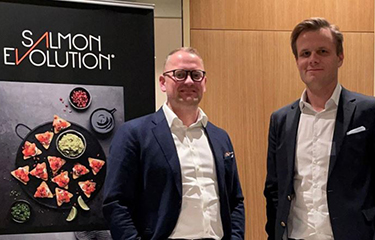
Photo courtesy of Salmon Evolution
