




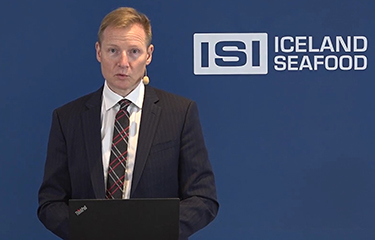
High inflation and input costs combined to negatively affect the Q1 2023 results of Reykjavik-headquartered Iceland Seafood International (ISI).
In particular, the high price of salmon in the period impacted ISI’s operations in Ireland and Spain, while the up-for-sale business in the United Kingdom, Iceland Seafood U.K., continues to dent the company’s income, according to ISI CEO Bjarni Ármannsson.
ISI saw its total group sales rise 23 percent year-over-year to EUR 123.1 million (USD 135 million), driven by positive sales numbers within both its Value Added Southern Europe (VA S-Europe) division and Sales & Distribution (S&D) division, especially in the pre-Easter period.
VA S-Europe’s sales for the quarter totaled EUR 66 million (USD 72.4 million), an increase of 22 percent from last year. The division’s normalized profit before tax of EUR 1 million (USD 1.1 million) was EUR 1.6 million (USD 1.8 million) down compared to Q1 2022.
March was a record sales month for Iceland Seafood Iberica, driven by solid sales of both cod products and Argentinian shrimp. The latter was largely thanks to a 70 percent production volume increase. However, the division's margins suffered from challenging market situations and a decrease in sales prices, the company reported.
Ármannsson confirmed the steep increase in salmon prices made the quarter a difficult one for ISI's Ahumados Dominguez business. He said the company is taking action to further integrate the subsidiary's operations with IS Iberica, which he said should reduce costs and improve efficiency.
With Iceland Seafood U.K. classified as an asset held for sale, the Value Added Northern Europe (VA N-Europe) division consists solely of the Oceanpath operation in Ireland. For this business, high salmon prices offset the impact of the quarter’s lower sales volume, leading to a slight growth in sales.
Consequently, its loss before tax was EUR 200,000 (USD 219,000) compared with EUR 400,000 (USD 438,000) a year previously. ISI said its outlook for the remainder of the year is good, as salmon prices are likely to stabilize at a lower level than their previous highs.
Meanwhile, the U.K. division’s loss of EUR 2.5 million (USD 2.7 million) was in line with the company's budgeted expectations for the period. Ármannsson confirmed ISI has measures to improve U.K. division's operations, but acknowledged it has seen its volumes hit by substantial increases in consumer prices in the U.K. market. As such, ISI’s revised management is assuming it won’t reach positive earnings before interest and taxes (EBIT) until Q4 2023. It has, therefore, forecast a loss before tax (PBT) of GBP 4 million to GBP 4.5 million (USD 5 million to USD 5.7 million, EUR 4.6 million to EUR 5.2 million).
“It’s fair to say, these were relatively disappointing results,” Ármannsson said. “First of all, we knew we had an uphill battle in the U.K.; Secondly, we were fighting high input prices, especially on salmon; [thirdly], we had a difficult season in Argentina with a good level of production but low margins; and then volumes are down generally and with increased cost levels. Although unit prices may have decreased, the number of units also going down means that our overall margin is going down. It means that our overall loss for the quarter was about EUR 2.2 million [USD 2.4 million], which is significant.”
The disappointing quarter will be followed by lower profits than initially expected, he said.
“We are also announcing that our estimates for the year are also lower," Ármannsson said. "We’ve reduced the estimated profitability outlook from EUR 10 million to EUR14 million [USD 11 million to USD 15.4 million] to EUR 7.5 million to EUR 11.5 million [USD 8.2 million to USD 12.6 million], and we have also reduced the forecast for the U.K.”
Despite the negative numbers, Ármannsson said ISI took some other positive steps in the last quarter. These included the expansion of its Barcelona facilities and the installation of solar power at the site as well as in Madrid, which will provide between 30 percent and 40 percent of the company’s electricity. It also kickstarted a waste-recycling program in Argentina, which should have both environmental and commercial benefits.
“We see a lot of opportunity in being close to the customer, close to the market, and [we] know that we need to invest in our brands, in our sustainability matters, which we are doing, as well as [the] automation of our processing equipment,” he said.
Ármannsson said the 2023 Seafood Expo Global show in Barcelona had been successful for ISI.
“That was the first sign in my mind of the normality after Covid that we are facing and the good opportunities [that exist] that we could discuss there with our suppliers, our customers, our financiers, and other stakeholders,” he said. “So, despite a difficult quarter, we are optimistic about the future. We believe in our people, our relationships, and in our strengths.”
Photo courtesy of Iceland Seafood International
