






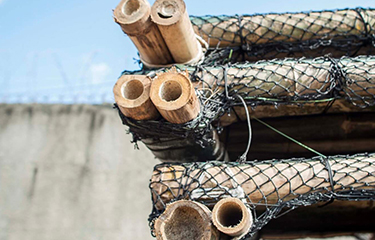
Biodegradable drifting fish aggregating devices (dFADs), though more environmentally friendly than traditional models, are hindered by shorter lifespans than petroleum-plastic devices, but a new report from the International Seafood Sustainability Foundation (ISSF) highlighting a new dFAD design may offer a solution.
The ISSF, a U.S.-based globally focused NGO that centers on tuna sustainability, released a report titled “Biodegradable drifting fish aggregating devices: Current status and future prospects” in July to determine the state of biodegradable dFAD innovation and set recommendations for tuna regional fishery management organizations (tRFMOs) aiming to require 100 percent biodegradable dFAD use in the future.
Fishers deploy dFADs to increase their catch, as tuna and other pelagic species aggregate around these floating items in the ocean. Released by vessels, dFADs contain a satellite-transmitting GPS and a buoy equipped with an echosounder to float with ocean currents and alert fishing vessels on biomass estimates.
“Fishers maintain and repair their dFADs at sea and like to maintain a given number at sea to be used by themselves or by other vessels from the same company,” ISSF Senior Scientist Gala Moreno, who is also a credited author on the report, said.
Currently, dFADs are typically made out of durable synthetic materials such as nylon nets, PVC and EVA plastics, and metallic rafts and weights.
Due to the drifting nature of dFADs, an estimated 7 percent to 20 percent of deployed dFADs become stranded, according to Moreno. The Marine Conservation Institute added to this estimate, stating that about 60 percent of the 50,000 to 121,000 dFADs deployed annually end up lost, abandoned, discarded, or stolen.
“Marine litter – which includes abandoned dFADs – can be harmful in numerous ways. The study specifically cites the example of dFADs getting stuck in coral reefs, which are sensitive ecosystems that can be disrupted by FAD nylon netting draping itself over it,” Moreno said. “And when traditional dFADs do end up starting to finally break down, they can introduce toxic byproducts, microplastics, [and more] into the marine ecosystem that they’ve ended up in.”
To mitigate marine litter without completely eliminating dFADs from the ocean, the ISSF recommends devices made out of biodegradable materials that can reduce the long-term accumulation of lost and abandoned dFAD materials.
However, some are hesitant to adopt biodegradable dFADs due to these devices having a shorter lifespan than fishers require and the low availability of biodegradable materials, such as cotton ropes and canvas, in remote locations.
The ISSF, therefore, highlighted the JellyFAD, a new dFAD design, in its report. The JellyFAD mostly comprises biodegradable materials, such as bamboo canes, cotton ropes, and canvas.
“The study found that these materials would retain their resistance to breaking for over one year,” Moreno said.
According to Moreno, switching to JellyFAD use can cut the amount of plastic used dramatically. Whereas conventional, nonbiodegradable FADs use between 30 to 150 kilograms of plastic flotation, JellyFADs use a maximum of 30 kilograms.
“That figure alone is a significant difference, and multiplying that by the tens of thousands of FADs deployed each year really shows what kind of difference we can make here,” Moreno said.
She went on to explain that progress on the new device has been promising, with a U.S. purse-seine fleet and other stakeholders in American Samoa, funded by NOAA, trialing the JellyFAD.
“The feedback from these fishers and nearly all fisheries we have worked with is good. They are fishing on the JellyFADs deployed by the project, and these FADs in trial are performing well with them,” Moreno said. “Cooperation with fishers is an essential piece of our efforts to promote the use of these new tools.”
This is coming just in time, as many tRFMOs, including the Indian Ocean Tuna Commission (IOTC), have recommendations and resolutions implemented to gradually replace current dFADs with non-entangling and biodegradable dFADs, according to the ISSF.
To help with this process, the ISSF has several recommendations to ensure these transitions are smooth.
“First, there is an urgent need for a harmonized definition for biodegradable FAD materials so the industry can establish guidelines, standards, and a timeline for biodegradable dFADs,” Moreno said. “Second, there is a need to start deploying a given percentage of FADs – about 20 percent – made with organic materials so that fishers can learn from the trials and systematically use them. And third, there needs to be updated data collection programs to track industry utilization of biodegradable materials more accurately and consistently.”
Beyond biodegradable FADs, the ISSF also recommends other actions to reduce the marine impact of dFADs, including retrieval programs. Recent research proposes that 20 percent of lost, abandoned, or discarded dFADS pass within 50 kilometers of major ports, making coastal dFAD recovery followed by a way to transport and properly dispose collected dFADs feasible.
“It is important to prioritize coastal areas for retrieval, considering vulnerable ecosystems, the number of FADs that arrive, or essential habitats for vulnerable species, such as sea turtles. It is also very important to implement best practices to minimize FAD loss and abandonment by fishers,” Moreno said.
The ISSF, while optimistic about innovations such as the JellyFAD, signaled that further research is needed to solve issues related to practical materials and technical designs of biodegradable dFADS, with large-scale, industry-wide application as the ultimate goal.
Photo courtesy of ISSF/Nando Rivero
