






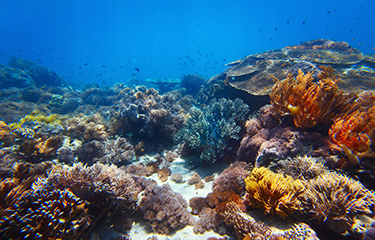
Small-scale fisheries in Africa and Asia, where accurate stock predictions are often too expensive to conduct, are underperforming relative to their maximum sustained yields due to undue strain from overfishing, a new study published in Marine Policy has found.
African countries, in particular, are becoming net importers rather than exporters as fishery yields are declining at an estimated 1 million metric tons (MT) per year. Human, environmental, geographical, and ecological factors impact fish biomass and yields, the complexity of which makes it challenging to estimate.
However, a new artificial intelligence (AI) pilot tool managed by the Wildlife Conservation Society (WCS) that, with limited data, can quickly and accurately estimate coastal fish stocks in data-poor areas aims to mitigate the issue and more clearly estimate fish biomass in these types of fisheries.
“People are fishing without knowing the state of their fishery and what the potential is for sustainable fishing. They often do not know if they are overfishing or underfishing in the coarsest terms,” WCS Conservation Biologist and Lead Study Author Tim McClanahan said. “This is particularly true in tropical fisheries where the species of fish are many, the ecosystems are complex, and science is insufficient to answer these questions.”
Applied to Western Indian Ocean coral reefs using biomass data from past research, the AI model produced an 85 percent accurate prediction for fish census biomass data, which in turn, allows fishers to connect overfishing with their inability to meet maximum sustainable yield, as well as lost catch and income.
“The 85 percent we achieved is as high as you can expect, but the question is over how large an area can you use this model – just nearby sites or perhaps the whole ocean? The farther away from your data the model is predicting, the weaker the predictions. But, in many cases poor predictions are better than no predictions,” McClanahan said.
According to the WCS, stock assessments typically employed by developed countries are expensive and labor-intensive, making them nearly impossible for fisheries in countries like Africa and Asia, which have the highest percentage of small-scale fisheries relying on nearshore ecosystems for income and food, to conduct.
Estimating fish biomass is also an important indicator of the health of a coral reef, according to McClanahan, and this data has the potential for use by local and national governments to make informed decisions about ocean resources. This also allows fishers, too, to better manage their efforts and ensure they’re maximizing both their time and efforts.
“I think there are two important results [from the study]. One is that you can predict fish stocks on large scales with modest amounts of field data and use intelligent software. The second is the amount of food, nutrition, and money being lost by not having and working toward benchmarks for sustainability,” McClanahan said.
The study estimated that Mozambique, Kenya, and Tanzania – all of which border the Western Indian Ocean – suffer an export market value loss somewhere between USD 53 million to USD 175 million (EUR 48 million to EUR 160 million) annually due to the overfishing of reefs. Fifty-seven percent of Kenyan reefs suffer from severe overfishing, and 79 percent experience basic levels of overfishing.
“The research here … allows users to adjust their fishing behaviors and management to get long-term optimal yields rather than the current focus on short-term yields at the expense of the fish stocks. It removes some of the mystery that has been problematic for managing fisheries,” McClanahan said.
The study, which took several years to complete and received grant funding from The Tiffany & Co. Foundation, the John D. Catherine T. MacArthur Foundation, the Bloomberg Ocean Initiative, the U.K. Darwin Initiative, and the Western Indian Ocean Marine Science Association’s Marine Science for Management Program, employed a multivariate machine learning model to make predictions.
Machine learning is a subfield of AI that entails the construction of a model to make predictions based on a known set of input data and responses. The WCS explained that with further development, the tool would allow for the input of seven data points to accurately predict fish stocks in nearshore ecosystems.
Sorted by importance, the seven variables – consisting of three human-influenced, two environmental, and two geographic variables – are depth, travel time from land to reef, fisheries management restrictions, country of origin, sea-surface temperature, reef area around the site, and mean net primary productivity of the ocean water, according to McClanahan.
“Machine learning looks at all possible combinations of variables and quantities, which would not be possible by the human mind, so you have to use a computer to solve all possibilities and eliminate the weakest ones. We tried 15 variables and found that seven helped to make good predictions. When these seven were combined in the right order, the strongest predictions were made,” McClanahan said.
The model referenced biomass data collected from 2005 to 2019 and estimated 591 of 10,800 cells – about 6.25 square kilometers each – in the Western Indian Ocean. That known data helped to produce unknown biomass estimates for the rest of the cells with 85 percent accuracy using extrapolation.
The algorithm then filled in biomass in locations with no data, and researchers used recovery rate information from previous studies to determine the income relative to the maximum obtainable catch to determine fishers’ financial losses.
The study referenced data from previous years, but climate change is likely to change marine animal biomass and, therefore, cause changes in the dominance of target species.
After studying the data the AI model created, the study’s researchers recommend a halt to fish in limited locations to recover fish populations, which could lead to increased fisheries production in the long term. In other areas, the researchers recommend that fishers follow common guidelines of 50 MT yield per square mile annually.
“There are various options, and the question is how fast you want your fish to recover and what are the tradeoffs now in terms of recovery and food and income now versus in the long term,” McClanahan said. “The problem now becomes more about human behavior than ignorance.”
Photo courtesy of Dudarev Mikhail/Shutterstock
