


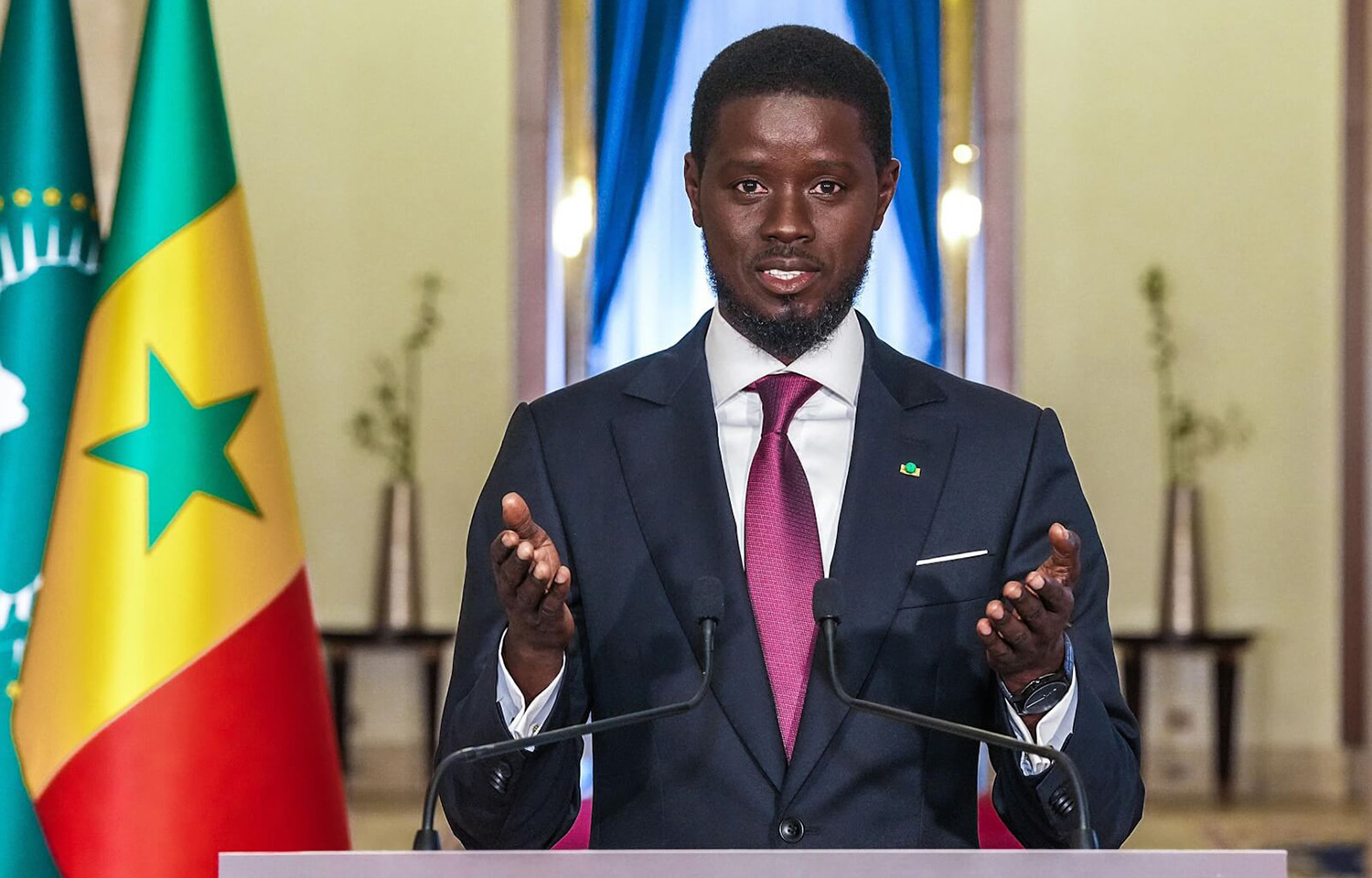
Senegal President Bassirou Diomaye Faye is proposing a review of fisheries agreements the West African country has signed with foreign entities to ensure the deals are more responsive to overfishing and its impact on small-scale fishers.
Faye, who was sworn in on 2 May 2024, said another goal of auditing the country’s maritime fisheries regulations is curbing IUU fishing that has proliferated along Senegal’s coastal waters.
A 2022 Environmental Justice Foundation report found that illegal fishing in Senegal “lets some trawlers catch vast amounts of fish, depleting vital populations and outcompeting small-scale local fishers who play by the rules.” It estimated Senegal loses an estimated USD 272 million (EUR 252 million) to IUU fishing annually.
Faye, a former tax inspector, told European Council President Charles Michel in early May 2024 that his government’s plan to audit fisheries agreements, licenses, and regulations will not only give small-scale fishers a say in the country’s fishing industry, which is mainly dominated by industrial fishers, but also ensure sustainable exploitation of marine resources.
Although he did not give exact timelines, Faye said he would like the process to conclude before the expiration of the current fisheries protocol in November 2024.
Michel responded by saying Europe is ready to evaluate its partnership with Senegal, especially in the fisheries sector, by “looking at the facts and seeing how we can, if necessary, make improvements on both sides to address a number of legitimate concerns.”
“Indeed, we believe that the E.U.’s responsibility is to be a loyal, reliable partner, with no hidden agenda because we have a very objective interest in Senegal being able to meet the challenges it faces: the challenge of development, economic emergence, and improved living conditions for the people,” he said.
Senegal first signed a fisheries agreement with the E.U. in 1979, which was implemented through a series of protocols that gave E.U. vessels access to Senegal’s marine waters until 2006. The deal was then amended in 2014 and restructured into a five-year agreement that mainly concerned tuna but also featured stipulations on black hake.
Both the E.U. and Senegal signed a new protocol in November 2019, providing fishing opportunities for tuna seiners, pole-and-line vessels, and longliners from Spain, Portugal, and France. The EUR 1.7 million (USD 1.8 million) agreement includes EUR 800,000 (USD 857,000) in cash, with the remaining amount provided to programs that support the country's fisheries management policy.
“The fisheries agreement with Senegal is a central piece of the network of E.U. agreements in West Africa, which also includes neighboring Mauritania, Cape Verde, The Gambia, and Guinea-Bissau,” the E.U. Parliament said.
The deal also included financial contributions and sectoral support for the implementation of Senegal's fisheries policy, such as improving fisheries control, developing fisheries research and data collection, and providing health certifications for fisheries products.
However, in a 2023 report, the Food and Agriculture Organization of the United Nations attributed some of Senegal’s fishing sector troubles with larger countries exploiting its marine resources.
“Since the world’s leading fishing powers have emptied their own waters, the problem of industrial overfishing is being exported to distant seas,” FAO said.
The E.U. has offered to help Senegal better protect its waters from IUU through a proposed deployment of the E.U. border agency, Frontex, to its territorial waters, even as it issued Senegal a yellow card warning in May 2024. In 2022, the Spanish Fisheries Confederation (CEPESCA) accused Senegal of refusing to issue it fishing permits, in violation of the E.U. agreement.
Accountability.Fish Global Director Ryan Orgera, whose non-governmental organization has called for greater transparency in bilateral fishery access deals, said the both the E.U. and Senegal should publicize the details of any agreement they reach moving forward.
“I am pleased with President Faye’s and [Senegal] Minister for Fisheries Fatou Diouf’s recent move to make Senegal’s fisheries sector more transparent in agreeing to publish vessel ownership – an important step in the work toward accountable fisheries governance,” he told SeafoodSource. "It is not a well-kept secret that developing economies have received raw deals – almost universally. West Africa depends on marine wildlife to feed many millions of people; anything they can do to domesticate their national catch will benefit their people. I would specifically applaud Senegal’s desire to renegotiate fisheries agreements as long as they ensure that all the principles of transparency and accountability … are strictly and expressly laid out in any future agreement.”
Greenpeace Africa Senior Ocean Campaign Manager Aliou Ba told SeafoodSource that, regardless of the audit, he does not think Senegal will withdraw from the E.U. deal before it expires in November. But he echoed Orgera’s claim that international fishery access deals are often not fair to African countries.
