






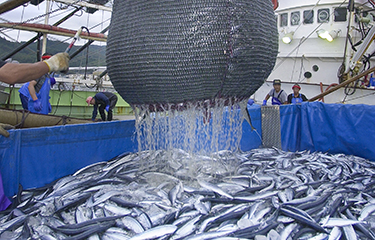
A new report by the Sustainable Fisheries Partnership on global reduction fisheries found that multiple fisheries in South America – some among the world’s largest – are either stagnant or declining.
The new report found that three South American fisheries – the Southern Peruvian anchoveta fishery, Los Lagos Chile Anchoveta fishery, and the Central-South Chile Araucanian herring fisheries all saw drops in performance. The SFP report rated all three as “poorly managed” and placed them in the lowest sustainability category.
The decline in performance in South America comes as Europe is beginning to see improvements, SFP Program Director Dave Martin said in a release.
“Six months ago, our last report recognized rebounds and the industry’s role in supporting improvements in key European reduction fisheries. And, in this new report we see two more European fisheries regaining lost ground,” Martin said. “But South America is headed in the opposite direction. We hope this will motivate industry, science, government and other stakeholders to come together to reverse this trend.”
Reduction fisheries mainly target species that are not typically used for direct human consumption. The fisheries catch and process the species – such as anchoveta – into other products such as fishmeal or fish oil.
The SFP review, the report said, only focused on stocks used mainly for fishmeal and fish oil, regardless of taxonomic group. This report, it said, did not include smaller stocks in the Northeast Atlantic like sandeels and sprat that were available in the previous report.
The new report found that two European fisheries – European sprat in the North Sea, Skagerrak and Kattegat; and Sandeels nei, Dogger Bank Area – saw improvement compared to last year.
The SFP changed the rating for European sprat from B2, or “reasonably managed,” to B1, “reasonably managed fisheries with stock in good condition.”
“The perception of the stock health is more optimistic than last year,” the SFP said. “Per the most recent assessment, there was stronger recruitment in 2022 compared to previous years, and the estimated spawning biomass in 2023 is above MSY Bescapement.”
MSY Bescapement is the value, defined by the International Council for the Exploration of Seas, below which a stock is considered to have reduced reproductive capacity.
The assessment of the second improved stock, Sandeels nei, found that recent catches are within defined catch limits.
“A formal management plan is still lacking, but in recent years the E.U. has used real-time monitoring for setting TACs within the fishing year,” the SFP said. “The recent drop in the catch limits and fishing mortality has allowed the stock to recover, and the spawning biomass in 2023 is estimated to be slightly above target levels.”
Two of the three stocks that saw decreased performance in South America, meanwhile, dropped significantly. The Araucanian herring fishery dropped from “B1,” or reasonably managed with stock in good condition, all the way to “C”, a poorly managed fishery.
The stock, according to SFP, is harvested in a mixed fishery targeting anchoveta, and the current management approach has “proven ineffective at reducing catch limits when scientific evidence suggests so.”
“For instance, in 2023, this resulted in a set TAC [total allowable catch] significantly exceeding the recommended range of the advised biological catch (ABC) for this stock,” the SFP said. “This ongoing challenge implies that certain measures in the management plan are not being adequately implemented, potentially undermining the long-term sustainability of one of the stocks and the fishery.”
The second stock that saw a large drop in performance was the anchoveta fishery in the Chile Valparaiso and Los Lagos regions. It too dropped in performance from “B1” to “C”, and is the anchoveta fishery that is targeted as part of the mixed fishery targeting Araucanian herring.
The fishery, SFP said, is facing shortcomings in its current management approach allowing the stock’s condition to decline.
“This persistent issue has resulted in certain measures in the management plan not being adequately implemented, potentially undermining the long-term sustainability of one the stocks and fishery,” the SFP said.
The third fishery that saw declines, meanwhile, was already considered a poorly managed fishery, and the lower performance only made things worse. It is facing many of the same issues as the other fisheries that declined, SFP said.
The South American reduction fisheries are among the world’s largest, but the declining fisheries in question are relatively small compared to the region’s largest reduction fishery – the Peruvian North-Central anchoveta fishery. According to SFP, the three problematic fisheries combined make up a little over 10 percent of the total reviewed, compared to the 67 percent made up by the north-central fishery.
Still, the deterioration of the fisheries requires action, Martin said.
“There is a clear need for industry, governments, scientists and others to redouble efforts to support and deliver sustainable fisheries,” he said.
Photo courtesy of KPG-Payless/Shutterstock
