






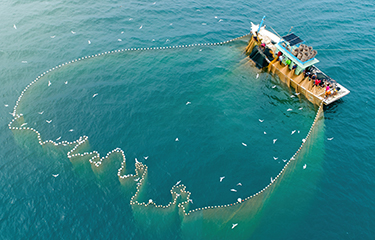
London, U.K.-based nonprofit Planet Tracker has propsoed a new financial system it said could help combat overfishing while allowing investors to fulfill established environmental, social, and governance (ESG) goals.
A September report from Planet Tracker, “Fishing for a Recovery,” introduces a system the nonprofit has dubbed blue recovery bonds, in which the bonds offer upfront capital investment to a fishery in exchange for a temporary reduction in fishing. Once stocks recover, fisheries repay the invested capital, along with interest.
“Fishers have an interest in the health of the waters they fish from. This instrument allows them to invest in the future of their fishery without paying for that investment upfront themselves,” Planet Tracker Oceans Program Head François Mosnier said. “The goal is for the bond to provide a ‘reset’ button so that fishing can resume sustainably, improving livelihoods and ocean health.”
The nonprofit’s Ocean Program, which Mosnier oversees, aims to direct financial investments toward the sustainable management of natural resources.
With 35.1 percent of global fisheries already overfished, according to the Food and Agriculture Organization (FAO), and an anticipated increase in seafood demand from 157.4 million metric tons (MT) in 2020 to 267.5 million MT by 2050, the recovery of fish stocks has increasingly become a global priority in safeguarding food security, Mosnier said.
“Our primary focus is to understand which fisheries would be interested by this initiative,” Mosnier said. “We invite anyone who cares about their fisheries to try our interactive assessment tool to understand more about this potential funding idea and to contact us for further discussion.”
The general framework of exchanging upfront capital for a temporary reduction in fishing would remain consistent from fishery to fishery, but exact logistics would vary depending on each contract signed. Success, according to Mosnier, includes a recovery in fish populations, with specific details on species, locations, and extent of recovery outlined in a predetermined restoration plan that’s unique to each deal.
“If stocks fail to recover because of companies not respecting the rules (e.g., by engaging in illegal, unreported, and unregulated fishing), these companies should, in my view, pay for the cost of failure, typically by refunding at least part of the capital provided,” Mosnier said. “If stocks fail to recover for another reason, investors are the ones who should bear the risk in my view, but this is all of course subject to negotiation between the different parties.”
To ensure success and limit the risks investors take on, Mosnier said it’s important to outline contingency plans and proactively mitigate anticipated challenges. These proactive measures may include securing a suitable bond issuer agreement, defining effective measurements of success, implementing appropriate monitoring technology, outlining how to properly enforce performance, and considering adverse social and economic consequences on supply chains.
“Because investors bear the risk of failure from the moment capital is provided, it would make sense for interest to be calculated from the moment that capital is deployed,” Mosnier said. “However, the bond can be structured differently, for instance via a flat fee agreed in advance based on the level of recovery of fish populations.”
An ideal scenario, according to Mosnier, is one where fishing companies gain more after stocks recover compared to maintaining existing conditions.
The Planet Tracker report highlighted 65 fisheries, comprising 22 percent of the 295 global fisheries considered, that were strong candidates for recovery bonds, meaning their fish stocks could recover with upfront capital and improved management.
Strong candidates typically entail “a fishery with a limited number of jurisdictions to reduce the complexity of a deal, and a fishery big enough for a deal to make sense financially,” Mosnier said.
Among the 65 selected fisheries, five were in the Indian Ocean, 36 in the North Atlantic, 15 in the North Pacific, eight in the South Pacific, and one in the South Atlantic.
Though some fisheries are more suited to deals than others, challenges remain no matter the fishery. A notable challenge involves considering the impact on downstream processors and retailers relying on these fish stocks, which plays a crucial role in evaluating the suitability of fisheries for blue recovery bonds.
“That is why we are looking for fisheries where downstream supply chains are not severely dependent on the species whose volumes will be reduced for a while or for those where processors are big enough to bear a temporary reduction in volumes,” Mosnier said.
Providing evidence that these types of deals can work, Mosnier pointed to communities of fishers near Valparaiso, Chile, that have already allocated 19 percent of an area they typically fish for marine conservation, prioritizing long-term gains over short-term sacrifices.
“[This was] a difficult decision that cost them money initially, but it quickly paid off with a rapid increase in abundance and size of fish species,” Mosnier said. “We believe fishers should not pay from their own pocket to set up these regenerative initiatives. This is what sustainable finance is there for.”
Photo courtesy of Kemang Hakim/Shutterstock
