






Two major Japanese supermarket chains – JCCU and Seven & i Group – have expanded the certifications they accept when purchasing seafood products beyond Marine Stewardship Council (MSC) and Aquaculture Stewardship Council (ASC) credentials, with both now welcoming any seafood products bearing a certification recognized by the Global Sustainable Seafood Initiative (GSSI).
One certification trying to take advantage of this less restrictive purchasing policy is the Juneau, Alaska, U.S.A.-based Responsible Fisheries Management (RFM) credential, which aims to use this change to establish more widespread awareness in Japan thanks to its GSSI recognition.
“One of the greatest benefits of GSSI has been the opportunity for major global retailers and seafood companies to modify their procurement policies to allow for seafood from GSSI-recognized schemes,” Susan Marks, a sustainability and chain of custody advisor for the RFM program, said.
In 2016, RFM became the first seafood sustainability credential to receive GSSI certification, and seven years later, it became the first to achieve re-recognition status under the updated Version 2.0 of GSSI’s Global Benchmark Tool, which it secured in June 2023.
Since then, the program has aimed to extend its customer base by penetrating new markets. To do so, it has instituted several measures and initiatives such as a collaboration the RFM initiated with the Global Seafood Alliance (GSA) in March 2023.
“It has long been the goal of RFM to expand beyond Alaska,” Certified Seafood Collaborative Chairman Mark Fina said in a press release at the time of the collaboration’s announcement. “We believe GSA can assist RFM in realizing marketing opportunities and introducing fisheries to the RFM program.”
Among other countries, Japan has been a priority market of the RFM program for over five years, as the nation consistently ranks highly in terms of global seafood consumption per capita and interest in sustainable food options has swelled in the country.
“The RFM program has been strategically focusing on the Japanese market since 2018, when the Tokyo Olympics created a new interest and awareness around sustainable seafood,” Marks said. “Since then, members of the RFM team have made multiple trips to Japan for speaking engagements, outreach, and business meetings. We’ve had some great media coverage, and the industry has been very receptive to learning more about RFM.”
That work appears to be paying off.
According to a September 2022 survey of Japanese consumers commissioned by the Alaska Seafood Marketing Institute – which originally owned the certification program before the Certified Seafood Collaborative took it over in 2020 – 83.8 percent of respondents said they would be willing to buy a product if it had “Made in Alaska” written on the product. If a product had a “logo certifying that the seafood is from Alaska” affixed to it, 80.5 percent of Japanese consumers said they would be willing to buy it.
The recent moves made by chains such as JCCU and Seven & i to widen their seafood purchasing options to align with previously established eco-label goals have further allowed the program to get its products in front of Japanese consumers.
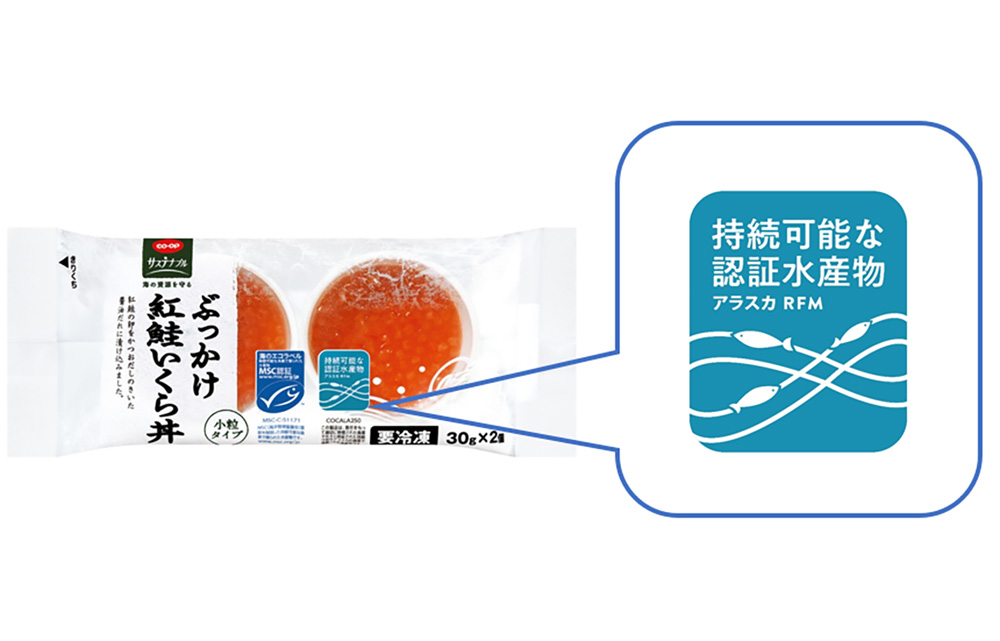
In April 2023, JCCU launched private-brand products manufactured in Japan that feature the Alaska RFM certified eco-label. The items – a sockeye salmon roe bowl and a sockeye salmon fillet – carry both MSC and Alaska RFM logos. Marks said that there are a couple of benefits of having products that feature double certification.
“Some who are participating see it as insurance [in case one credential is suspended], while others feel that they need it for the markets they sell to,” she said. “One of [RFM’s] main goals is to continue educating the market and continue to add fisheries and fishery products via chain of custody to the program so that in the near future, a fishery using just RFM has all of its market access needs fulfilled.”
Market access continues to grow more plausible as awareness of certifications outside of a few traditionally dominant credentials grows, and due to initiatives like those established in Japan, the RFM program has its sights set on further growth.
“As RFM certifies more fisheries in North America and more companies in Japan become certified for RFM chain of custody, we anticipate the number of RFM-labeled products to grow,” Marks said.
Photo courtesy of JCCU
