

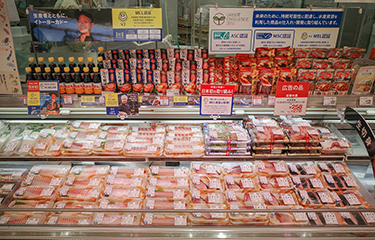
A handful of Japanese supermarket chains, including AEON, the Japan Consumers’ Cooperative Union (JCCU), and Seven & i Holdings, have been early adopters in the country of procuring and marketing eco-labeled seafood products – with the latter two companies setting specific sales targets.
In 2018, JCCU set a goal that Marine Stewardship Council (MSC)- and Aquaculture Stewardship Council (ASC)-certified product sales would comprise 20 percent of total seafood sales by 2020. Even though the company fell short of this target, in 2021, the cooperative raised the objective to 50 percent or more by 2030.
Seven & i Holdings, which is based in Tokyo, has set similar goals for its subsidiaries. Seven & i Holdings owns the major supermarket chain Ito-Yokado, the regional supermarket chain York-Benimaru, the convenience store chain 7-Eleven; and operates Japanese locations of the restaurant chain Denny’s.
In the company’s Green Challenge 2050, originally formulated in 2019, the company set targets for carbon dioxide emissions, reducing plastic use and food loss, and attaining sustainable products. For marine-product procurement in particular, the goal is that 50 percent of the company’s house-brand products will be sustainably sourced by 2030 and 100 percent will be by 2050.
Yuuto Mabuchi, who oversees the procurement of fresh fish within the company’s Seven Premium Development Strategy Department, told SeafoodSource that MSC and ASC standards were originally the dominant credentials among eco-labels, but as more sustainability schemes have received recognition from the Global Sustainable Seafood Initiative (GSSI), the company’s eco-labeled offerings have become more diverse.
“In particular, the percentage of MEL [Japan’s Marine Eco-Label] [products] is increasing. Of the marine products sold under the company’s house brand – Seven Premium – MSC-certified products accounted for 8.1 percent and ASC accounted for about 3 percent,” he said, referring to data that covered fiscal year 2022.
Besides MSC, ASC, and MEL standards, Seven & i considers many Alaska-origin products to be sustainably managed and works closely with the Alaska Seafood Marketing Institute (ASMI) to market Responsible Fisheries Management-certified products labeled with ASMI’s “Alaska Seafood – Wild, Natural & Sustainable” logo. The company’s Ito-Yokado supermarket chain sells black cod, red salmon, and salted salmon roe labeled with the mark.
Many fisheries in Alaska receive certification through the RFM scheme operated by the Certified Seafood Collaborative (CSC), based in the state capital of Juneau, and stores that offer related products must obtain chain of custody certification when repacking such products in their stores.
While the number of eco-labeled items is increasing over time, Mabuchi believes the movement is not solely consumer-driven in Japan. Rather, Seven & i is primarily promoting it as a form of corporate social responsibility, he said.
“In a survey asking whether consumers would be willing to pay more for eco-labeled seafood, the majority said they would, but in reality, consumers tend to focus on price," Mabuchi said.
The company said that it tries educate consumers on the meaning of eco-labels and the different certification schemes they might see on products.
For example, a sign displayed in the fish section of Seven & i supermarkets informs consumers about the company’s Green Challenge 2050 commitments. The sign says, “For the future, we are working to purchase and develop products that use marine resources with consideration for sustainability” and explains the MSC, ASC, and MEL eco-labels. They also promote the programs on their website and via YouTube.
As director of freshfish procurement for Seven & i, Mabuchi said he wants to consult with Japanese fishermen and aquaculturists to encourage them to get involved in sustainable seafood certification programs, which would help the company introduce more domestic products to consumers in the future.
“They make their living from the marine environment, so they care deeply about it. But, I think dealing with the paperwork and the mechanics of certification has raised the bar for them," he said.
The company has also been promoting its sustainability efforts at industry events. Ayako Suzuki, the sustainability promotion department officer in the company’s ESG Development Division, presented Seven & i’s environmental efforts – including the Green Challenge 2050 commitments – at this year’s Tokyo Sustainable Seafood Summit (TSSS).
TSSS, which ran this year from 17 to 19 October in Tokyo, is Asia’s largest sustainable seafood event, representing an ideal spot for companies to share ideas and have their sustainability efforts publicly recognized.
Photo courtesy of Seven & i Holdings
