





Thailand has proposed a reversal of a series of fisheries reforms it implemented over the past eight years.
The move has ignited concern among NGOs and international representatives who fear the lawlessness and lack of oversight that once defined the country’s fishing sector may return. In a letter issued in October 2023, a coalition of 84 civil society organizations, including the Environmental Justice Foundation, Greenpeace, Conservation International, Oxfam, and Oceana collectively urged Thai Prime Minister Srettha Thavisin to oppose any rollback.
The organizations warned Thavisin the issue will likely be raised in forthcoming discussions between the E.U. and Thailand regarding a potential free trade agreement (FTA). The NGOs recommend the Thai government reject any rollbacks of laws and policies preventing at-sea transshipment, at-sea crew transfers, child labor, unscrupulous payments, and other behavior related to illegal, unreported, and unregulated (IUU) fishing.
“Thailand can’t afford for its fisheries to return to the state they were in before the reforms. Following decades of unscrupulous operators fishing unsustainably and abusing their workers, hard-won reforms have meant that marine ecosystems in Thailand have started to recover and human rights abuses are decreasing,” Environmental Justice Foundation CEO Steve Trent said. “However, it will take very little to reverse this good work, and the deregulations now being proposed will ensure that Thailand’s fish populations are decimated and the safety of its fisheries workforce jeopardized once again.”
Fishers in the country, meanwhile, have argued the stringent regulations incorporated into the country’s fisheries law of 2015, which aims to combat IUU fishing within Thailand, are negatively affecting their livelihoods. The National Fishing Association of Thailand has pushed for a bevy of reforms, including a return to day-rate fisher salaries, permitting child labor, and weakening punitive measures designed to deter IUU fishing, among other measures.
In the lead-up to Thailand’s May 2023 election, several major political parties in the country, including the victorious Move Forward party and Thavisin’s Pheu Thai party pledged to reduce regulations on the fishing sector. In September 2023, Thai Minister of Agriculture and Cooperatives Thammanat Prompow said it had set up a committee to study the association’s concerns, according to the Bangkok Post. Prompow said the committee also plans to engage with international organizations, including the United Nations Food and Agriculture Organization, to ensure any proposed changes do not compromise Thailand’s commitment to combating IUU fishing.
Proponents of deregulation argue that the E.U. market comprises just 5.6 percent of Thailand’s seafood exports, implying that an E.U. export ban or the inability to secure an FTA with the bloc may not significantly jeopardize the country’s seafood industry, which brought in USD 2.3 billion (EUR 2.1 billion) via exports in 2022.
Prior to the 2015 imposition of its more stringent fisheries law, Thailand’s fishing industry operated under outdated and inadequate regulations, with weak oversight and lenient penalties for unethical vessel operators, resulting in widespread violations of environmental laws and labor rights. Nearly 60 percent of migrant fishing crew members reported witnessing executions at sea, according to a 2009 report from the United Nations Interagency Project on Human Trafficking. And interviews with Thai fishing crew members conducted between 2009 and 2014 revealed 80 percent of crew members on Thai fishing vessels reported never experiencing a sense of freedom, and 68 percent reported instances of sexual or physical violence. These findings were supported by reports from other United Nations agencies and academic sources.
Consequently, in 2014, the U.S. Department of State downgraded Thailand to Tier 3 in its annual Trafficking in Persons (TIP) report – its lowest possible rating – and in 2015, the European Commission (E.C.) issued a yellow card warning to Thailand – a move that recognizes trading partners falling short in combating IUU fishing.
Following significant efforts by the Thai government to address labor issues and combat IUU fishing, the E.C. removed its yellow card in January 2019. In 2016, the U.S. State Department upgraded Thailand to the Tier 2 watchlist rating in its TIP report, and its rating has fluctuated between Tier 2 and the Tier 2 watchlist since.
However, the stringent measures implemented by the Thai government in response to international warnings stirred up intense opposition from affected fishers, eventually causing the Thai government to ease some anti-IUU regulations and provide compensation to fishers whose vessels received fishing bans stemming from noncompliance with the new restrictions.
In 2020, fearing that reforms would be rolled back, several retailers and seafood buyers sourcing products from Thailand called on the nation to preserve key fisheries regulations, which it has largely done through the present.
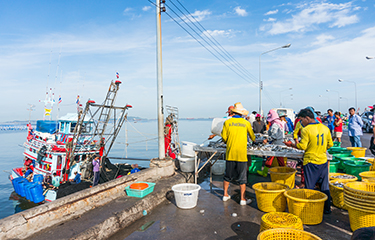
Photo courtesy of Phollapat.cheechang/Shutterstock
