




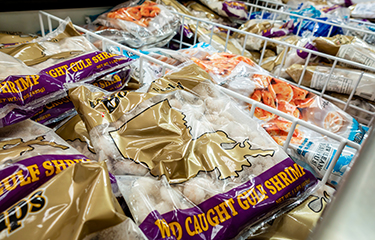
The American Shrimp Processors Association (ASPA) announced on 28 April it will pursue Marine Stewardship Council (MSC) and Certified Seafood Collaborative (CSC) Responsible Fisheries Management certification of the U.S. Gulf of Mexico fishery.
ASPA has contracted with certification body Global Trust Certification to conduct sustainability assessments of the entire Gulf of Mexico shrimp fishery for both eco-labels.
"This isn't just about a label. We know sustainability is important. It's important for our customers, for our members, and for the futures of generations of hardworking fishermen,” ASPA President Rey Pearson said in a press release.
Founded in 1964, ASPA represents and promotes the interests of the domestic, U.S. wild-caught, warm-water shrimp processing industry along the U.S. Gulf Coast with members from the U.S. states of Texas, Louisiana, Mississippi, Alabama, and Florida. It has the mission of bringing awareness of the benefits of U.S. domestic wild-caught warm-water shrimp to the U.S. retail and foodservice sectors. ASPA members collectively are responsible for more than 13,000 jobs and more than USD 30 million (EUR 27 million) in annual wages.
“Achieving certification will allow ASPA to assure its retail and foodservice clients and the consuming public that wild-caught [U.S.] Gulf [of Mexico] shrimp are sustainably sourced, ensuring the long-term biological, ecological, and socioeconomic viability of the fishery,” ASPA President Rey Pearson said. “On behalf of the entire Gulf of Mexico fishery, ASPA is committed to achieving and maintaining certifications for many years to come.”
The assessments will cover brown, white, and pink shrimp in federal waters and the state waters of Texas, Louisiana, Mississippi, Alabama, and the west coast of Florida, caught with otter-trawls, skimmers, and butterfly nets, according to Pearson.
The Marine Stewardship Council certification is one of the oldest eco-labels in the seafood industry, having recently celebrated its 25th anniversary. RFM is a third-party certification program for wild-capture fisheries founded in 2010 and benchmarked by the Global Sustainable Seafood Initiative in 2016.
"Many members of our industry – with the assistance of many talented governmental and non-governmental representatives, as well as various participants in the retail and foodservice sectors – have collectively worked hard to get to where we are today,” ASPA Sustainability Committee Chair Kristen Baumer said. “This day has been a long time coming and we are all excited to work with Global Trust this year to achieve both certifications."
In late April, NOAA estimated 4.3 million pounds of shrimp were caught in the Gulf of Mexico and South Atlantic in January 2023, down from 6.6 million pounds in January 2022.
Last Thursday, the Fishery Monitoring Branch of the National Oceanic and Atmospheric Administration (NOAA) Fisheries’ Southeast Fisheries Science Center released preliminary shrimp landings data from the Gulf of Mexico and the South Atlantic for January 2023. Prices for gulf shrimp are down significantly year-over-year, dropping to an average of USD 2.89 (EUR 2.63) per pound for 31-35 count shrimp in January 2023, down from USD 4.37 (EUR 3.98) in January 2022. For 36-40 coun shrimp, ex-vessel prices dropped to USD 2.68 (EUR 2.44) in January 2023 from USD 3.82 (EUR 3.48) a year prior, according to the Southern Shrimp Alliance, which tracks and compiles data on the fishery.
Photo courtesy of Dr. Victor Wong/Shutterstock
