






Embarking on a business trip in 2013 to South Pacific, Pescavore co-founders Clarice and Matt Owens had yet to realize they would return to create a product that would seek to make an impact in the seafood snacking marketplace.
In the Marshall Islands, Matt and Clarice Owens ate dried marlin made by families on of the Islands’ Marine Resource Authority. They returned home to the U.S. state of California to ponder the question of why the USD 3.5 billion (EUR 3.5 billion) meat snack industry does not rely on seafood for a more-significant portion of its sales.
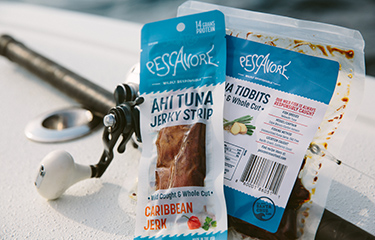
The couple got to work cultivating the first-of-its-kind snackable seafood, using tuna sourced from U.S. waters, from a fishing fleet based in San Pedro, California. Each of the 1.5-ounce, single-serve jerky strips are made utilizing responsibly caught seafood, premium marinades, whole cuts, and a unique natural wood smoking process, according to the company.
Each strip contains 14 to 15 grams of protein, with significantly less sodium and sugar than traditional jerky. Similarly, in comparison to traditional jerky, Pescavore’s strips contain 450 percent more omega-3 fatty acids and a 95 percent lower carbon footprint in comparison to traditional meat jerky.
“Our ambition is to find a home for a high-quality yet affordable seafood alternative everywhere meat snacks are sold,” Clarice Owens said. Clarice Owens said ensuring the sustainability of all Pescavore’s products is a priority for the company, and that customers can be assured of the sustainability of the American-sourced tuna it uses to make its Pescavore jerky.
“We are very fortunate in America to have strong, science-based regulations in place to help prevent environmental impacts like overfishing and bycatch. But the domestic fisheries sector is underinvested,” she said.
By working with locally sourced fisheries, Owens said she hopes to help the U.S. fishing industry, which has struggled to maintain its position in the Pacific’s tuna fisheries against fierce competition from other nations.
“Pescavore is a market-based strategy to holistically address these issues by creating exciting new products in new high-value markets that can return value to domestic fisheries participants,” she said. Pescavore recently opened its first Seafood Invocation Center in Santa Cruz, California, where the company conducts its processing and research and development, focusing on creating products from species other than tuna, expanding its product formats, and introducing plant-based analogs to its line of seafood-themed jerkies.
Photo courtesy of Pescavore
