






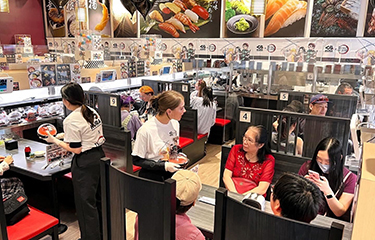
Japan’s major sushi chains have seen their costs outstrip their own price increases in recent months.
Akindo Sushiro Co., a subsidiary of Kumamoto City-based Food and Life Companies, implemented a price hike on 1 October. Its competitor, Kura Sushi, based in Sakai City, Osaka Prefecture, followed suit. While these price increases were in the range of 5 to 10 percent, material costs have gone up much faster. The government’s consumer price index reports indicate fish and seafood rose the most among all retail food costs, up 13.9 percent year-on-year in October.
In financial results for its fiscal year ending in October 2022, released on 12 December, Kura Sushi reported an operating loss of JPY 1.1 billion (USD 7.9 million, EUR 7.5 million), an improvement from a loss of JPY 2.4 billion (USD 17.4 million, EUR 16.5 million) in FY 2021.
“Although we recovered from losses in the first half of the year, when inflation had a strong impact in the second half of the year, it was difficult to absorb everything," the report said.
Sales were up in all of its major markets – Japan, the U.S., and Taiwan – and consolidated sales rose 23.9 percent to a record high of JPY 183 billion (USD 1.3 billion, EUR 1.2 billion).
Kura Sushi's net income attributable to shareholders of the parent company fell by 60.8 percent, and ordinary profit fell by 22.6 percent to JPY 2.4 billion (USD 17.4 million, EUR 16.5 million). By region, Kura Sushi's ordinary profits fell by 73.8 percent in Japan, and the USA segment narrowly fell into the red. Taiwan was the bright spot, moving from a loss to a JPY 1.4 billion (USD 10.1 million, EUR 9.6 million) ordinary profit, which the company attributed to aggressive store openings and collaborations involving popular anime characters.
The company spent heavily to open new shops and to renovate older ones, increasing its total number of restaurants from 125 to 152.
Inbound tourists to Japan jumped from nearly zero in February to around 150,000 in April, then shot up to 500,000 in October, as the country as lifted its Covid-19-related visa restrictions and testing requirements. Kura said it expects to capture some of this business at its flagship stores in Japan’s big cities.
Moving forward, the company plans to lower its procurement costs by buying directly from fishing ports nationwide, digitizing its stores through the introduction of contactless ordering and payment systems, and by growing its overseas subsidiaries.
Rotary sushi competitor Sushiro's parent company, Food & Life Companies, fared better and stayed in the black, but was still squeezed by higher costs. The company, which ended its fiscal year in September, reported that its operating profit declined by 55.5 percent on higher sales, which were up 16.8 percent. The consolidated profit was JPY 5.7 billion (USD 41 million, EUR 39.2 million), a decline of 59.3 percent.
“The restaurant sector also continued to face challenging conditions due to the rise in resource prices with the Russian invasion of Ukraine, the depreciation in the yen, soaring prices of various commodities, the arrival of the seventh wave of COVID-19 and other factors,” the report said.
Photo courtesy of Kura Sushi USA/LinkedIn
