






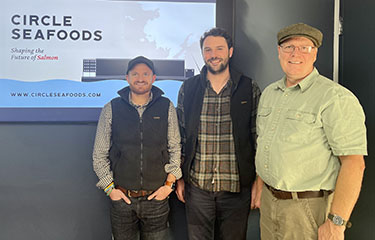
Circle Seafoods and Northline Seafoods are hard at work building out floating processors they plan to debut in time for Alaska’s salmon runs in 2024.
Northline Seafoods is building the Hannah in Bellingham, Washington, U.S.A. to buy, process, ship, and store salmon caught in Bristol Bay on a single vertically integrated platform. The vessel, which is being constructed from an existing barge hull that was towed from the U.S. Gulf of Mexico to Washington, is now over 50 percent complete, according to Northline Seafoods CEO Ben Blakey. Blakey told SeafoodSource in December 2022 the vessel will conduct primary processing when in operation and bring its frozen harvest to Washington state for secondary processing after the season is over.
“Our plan is to keep the pace of reprocessing more controlled, completing it throughout the course of the year, aiming for 50,000 pounds a day instead of trying to fillet a million pounds a day. That way, it’s far easier to control our costs and our timing and improve our yields, so we end up with a higher percentage of usable product that's better-created and easier to meet the specs the customer has asked for,” Blakey told SeafoodSource in December 2022.
Northline suffered a setback in 2020, after its prototype SM-3 vessel broke free from its mooring and beached in Ekuk, Alaska, in Bristol Bay. While the vessel was salvaged, the accident caused USD 4.5 million (EUR 4.1 million) in damage, and with the insurance payout, Northline decided to convert its salvaged vessel into an ice barge and build a new, larger floating processor – the idea that eventually germinated into the Hannah.
Blakey said the company’s leadership remains convinced of the need for an innovative solution like the Hannah in Bristol Bay, for a number of reasons.
“There's upfront challenges of just getting such large workforces up into the bay, and the expense and challenge of producing products that are consistent and trusted by customers,” he said. “We can add value later when we have more time, but we need to streamline operations in the bay to focus on quality retention and value preservation. And that basically allows us to target the products we produce specific to our customers’ needs and when they need them.”
Northline Seafoods is planning to operate the Hannah off Clark’s Point in the Nushagak district, in tandem with the SM-3, which has a 400,000-pound capacity and will be buying fish on the east side of Bristol Bay.
“Both barges will be connected by tenders, so we will be servicing other districts with standard tenders as well,” Blakey said.
The difficult 2023 salmon season, marred by low prices and cratering markets, has not deterred Blakey – rather, it convinced him of the need for innovation.
“This season was not just hard on fishermen; it was hard on processors. We're hoping that we can kind of give an example of what can be done to improve things,” he said. “Honestly, what happened this past summer reinforces the need for change. The fishermen know that and the processors know that. And we hope to be that change.”
Pat Glaab, Northline’s former CEO, is now the CEO of Circle Seafoods, leading the company along with co-founders Charlie Campbell and Eren Shultz. Founded in 2022, Circle Seafood has the tagline “the economics of wild salmon are broken.”
“We published a list of 20 things that can be done to improve the value of the fishery [because] It's important for people to know there are knowable and tested solutions out there to the problems the fishery faced this past summer,” Campbell told SeafoodSource. “There's a real disconnect between fishermen and their understanding of processing as a business, and a general sense of doom and gloom in the industry, but I don't think it needs to be that way. There’s a positive path forward in the short term and in the long term, and we're going to work exceedingly hard to deliver that next year and into the future.”
Campbell acknowledged Circle Seafood’s vision is similar to Northline’s.
“Our long-term vision is to increase the value of the fishery by deploying innovative barges where we freeze salmon right on the water hours after they're caught. We freeze them round, fill up our cold storage, which can hold 10 to 12 million pounds of salmon and store them at negative 40 degrees, and then tug it all down to the lower 48, where we can process it on demand,” he said. “Our model is freeze round first and then combine the primary and secondary processing later. So if you’re Whole Foods, you can ask for 100,000 pounds delivered every single week and we can manufacture it to the specs you want over the course of the year – similar to how other goods are manufactured.”
Campbell’s biggest concern is the complexity of building a floating processor, but he said Glaab’s long history in constructing processing facilities for big Alaska players – like Silver Bay Seafoods and Leader Creek Fisheries, and the initial Northline barge – is a major advantage.
“But there’s no way of looking around the fact that it’s a big build with a lot of moving parts, and we’re on a short timeline,” he said. “There have been many new seafood processors in Alaska that haven't worked out. They make a lot of promises the first year and then don't show up the second year, and that really hurts fishermen, and so fishermen understandably have a lot of hesitation around working with a new processor. By being well capitalized, having lots of experience in the industry, and hopenly and honestly communicating with fishermen, we are different.”
Campbell said Circle Seafoods’ leadership team is confident enough in their model that they plan to build six barges as quickly as possible, each eventually with 1.5 million pounds of daily freezing capacity, to bring the solution to market at scale. Campbell said Circle Seafoods’ first barge arrived in Aberdeen, Washington, U.S.A. in mid-November and its conversion has begun, with the goal of having the vessel ready to operate in Southeast Alaska for the 2024 season.
“It's a later season than Bristol Bay, so that gives us a little more cushion on getting the construction done in time. But also, I think we can do something really interesting with pink salmon. If you ask anyone who has had salmon off the boat in Alaska, they’ll tell you it’s their favorite. It’s very delicate and its quality is easily destroyed, and because the supply chain is imperfect, it doesn’t show up to market very well,” Campbell said. He said he would also like to explore opportunities with chum salmon and roe.
In May 2022, Circle Seafoods proposed a funding partnership with the Bristol Bay Regional Seafood Development Association, but rescinded the offer after receiving a tepid response from BBRSDA-affiliated fishermen, albeit on a short timeline. Campbell confirmed the company subsequently found other sources of funding, but is still interested in potential partnerships with existing processors to realize its vision of operating a fleet of floating processors in Alaska.
“I really believe that there's a lot of synergies to be had, as long as we're putting the fishermen first. We want to give them better options and better coverage,” he said. “We would be very open to working with a partner where they contract to have us operate a barge in a location that’s difficult to service. We can suck up those fish and that saves them operating costs in certain areas.”
Circle Seafoods’ business model is sound enough to be successful in any economic climate, according to Campbell – even if it faced a repeat scenario of the catastrophic 2023 season. Using a floating processor can save up to USD 0.28 (EUR 0.26) per pound of salmon on shipping, and can reduce the number of tenders needed, he said.
“At any prevailing market conditions, we'll be OK. These conditions created a great time for us to enter the market. Fishermen need a processor, but they’re looking for new solutions, so I feel really confident in our ability to get fleet,” he said. “I'm more worried the future of the fishermen if prices stay at [2023] levels. It’s not a sustainable business model for them. That’s why we are so adamant about improving the value of the fishery, is to give fishermen a fair shake so their livelihoods can improve.”
The most important partnership Circle Seafoods is focused on is that with its fishermen, Campbell said.
“We think more competition is a healthy thing for the industry and maximizing the value of the resource; it pushes people to innovate and to improve. It forces everybody to be better. At the end of the day, [wild Alaska salmon] is a limited resource. So to some degree, it is a zero-sum game in processing, and ultimately, we're in the business of throughput – that’s our key metric to success," he said. “To achieve the best outcome, we need to do what's best by fishermen, and in our mind, there’s no path forward if we can’t all work together in a positive way that's all aboveboard. We’re going to put fishermen first, and we’ve extended an open invitation for fishermen to come talk to us to learn about our plan. We’re in this together, and the better we can understand each other, the more successful will be in partnership.”
Photo courtesy of Circle Seafoods
