




Robotic waiters that can serve food, clean tables and floors, and display menu specials are catching the attention of Japan’s big sushi chains.
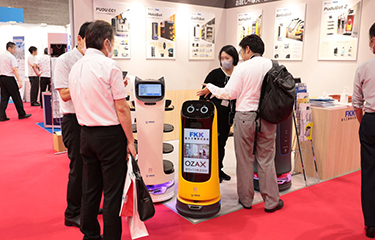
Column-shaped “robowaiters” made by Shenzhen, China-based Pudu Robotics were the center of attention at the Hoteres Japan trade show, which took place mid-summer in Osaka, signaling the continuance of a nationwide push that started during the Covid-19 pandemic to introduce more technology that encourages contactless dining around Japan. The trade show focuses on the Japanese hotel and restaurant industries, and the digitization of the restaurant industry was a prevalent theme at the show’s 16th edition.
Tokyo-based Fuji Industry Co. is the national Japanese representative for Pudu Robotics. The company and its subsidiary, Ozax Corporation, displayed several Pudu models at the show including the popular cat-themed robot, BellaBot, and a model with a large screen on the front called KettyBot, which can display menu specials or other messaging to customers.
Advertised prices of the two models in the U.S. have hovered around USD 16,000 (EUR 15,000) and USD 12,000 (EUR 11,000), respectively.
The other company showing off Pudu robots was Tokyo-based Japan Retail System, displaying other models such as the Holabot, which has a 60-kilogram weight capacity to bus dirty dishes when clearing tables, as well as the PuduBot – a simpler serving and delivery robot.
While Pudu Robotics makes the machines, these companies sell the robots and offer consultation services to buyers, such as surveying store layouts, steps, slopes, and aisle widths; demonstrating how the machines work; and conducting trial runs. After a sale, they also guide staff on the initial settings and operation of each robot and provide other after-sales services upon request.
Japan’s largest franchise restaurant operator, Tokyo-based Skylark, has implemented around 3,000 such robots in its Skylark and Gusto family restaurants, as well as its Shabuyo hotpot restaurants. Once loaded with plates of food by the staff, the robots navigate to their assigned tables, stopping for or going around customers moving in the aisles by using built-in sensors.
The BellaBot speaks to diners to tell them to unload their meal from the trays on which they come. When it sensesits trays are empty, it returns to the loading area.
Technology in this sphere was prevalent prior to the Covid-19 pandemic but rapidly advanced during the pandemic in Japan as a measure to reduce close contact between staff members and customers. Such contactless dining and payment systems include tablet-based ordering systems, touchless cash registers using smartphone applications such as PayPay, and robot servers.
Family restaurants have been at the forefront of the “floor service robot” push, but rotary sushi chains have also gotten on board. Both restaurant formats typically have booth seating, adequate aisle space, and level flooring that create ideal conditions for the robots to travel efficiently.
The military news outlet Stars and Stripes reported on 28 July that Totoyamichi, a sushi chain with an outlet in Fussa, near the U.S. Yokota Air Base, installed the BellaBot in June.
In addition to promoting contactless service, the robots address the labor shortage Japan is facing due to its quickly aging population – the country has the world’s second-highest proportion of people aged 65 and over, just behind Monaco, which has a tiny population of around 36,000 people. Japan’s Internal Affairs Ministry reported in July that the population fell in all of Japan’s 47 prefectures for the first time in 2022 and that the overall population declined by 800,000 people.
On Skylark’s investor relations webpage, IT Managing Director Akira Hirano said that “with the low birthrate and aging population, we aim to create a society in which diverse human resources can work in a variety of ways by computerizing our stores and central kitchen operations in anticipation of future hiring difficulties.”
The company reported that after the introduction of floor robots, table turnover improved by 7.5 percent, employee footstep count reduced by 42 percent, and the time it took to clean up a table lowered by 35 percent.
Adding to the urgency for restaurant operators in Japan, a Ministry of Health, Labor, and Welfare panel agreed on 28 July to raise the country's weighted average minimum hourly wage by JPY 41 (USD 0.28, EUR 0.26) from the previous year to JPY 1,002 (USD 7.10, EUR 6.44) in 2023. Japan’s minimum wage differs somewhat based on region and industry.
With these compounding factors, competition has started to grow in the restaurant robot sector. Yokohama-based Kappa Sushi has worked with the Japanese company Softbank, a Tokyo-based mobile phone operator that’s competing in the serving robot business, introducing Softbank’s Servi robots recently in its stores.
The technology’s successful introduction in Japan has also led sushi chains around the world to begin implementing floor robots.
The first BellaBot introduced in Canada was at Sushi Island in St. John’s, Newfoundland. Kura Sushi has also introduced the BellaBot and the KettyBot at its outlets in the U.S., and while sushi still arrives via a conveyor belt, the robots serve drinks and condiments.
“Considering the decrease in the number of applications for staff recruitment and future personnel costs, it is necessary to drastically change the way of thinking about the system,” Koji Hayashi, the managing director of restaurant chain Kappa Sushi’s parent company, Kappa Create, said in a Softbank case-study press release on the robots’ introduction. “Therefore, we devised a policy of dividing roles so that what can be done by humans is done by humans and what can be done by robots is done by robots in order to improve services regardless of the number of staff.”
Pudu Robotics announced on 27 June that it would attempt to enter the cleaning robot market in Japan in the near future.
Photo by Chris Loew/SeafoodSource
