

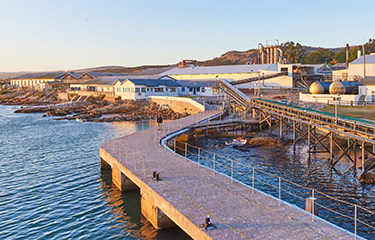
Cape Town, South Africa-based Saldanha Protein Group has launched a major maintenance program to enhance the performance of its fishmeal and fish canning operations ahead of the country’s fishing season in Q1 2024..
Saldanha Protein Group General Manager Marthin Potgieter told SeafoodSource that the ongoing maintenance program at its St. Helena Bay-based factory on the country’s west coast entails replacing one of the fishmeal plant’s cooking lines, as well as revamping the plant’s reverse osmosis process for purifying industrial water used at the plant, which should help reduce overall energy consumption.
“We scheduled the maintenance to coincide with the low season fishing period just to make sure that when the season starts, we are ready,” Potgieter said. “The maintenance project we are undertaking now will be finished by early January 2024 … and this will ensure the plant is available for maximum production through the year.”
Potgieter, a Cape Peninsula University of Technology mechanical engineering graduate who possesses expertise on these types of maintenance processes, said the routine upkeep “is critical on an annual basis – especially for manufacturing infrastructure – to ensure that as a fish processor, you utilize every opportunity to maximize performance and the factory is operating at its best in every fishing season.”
The factory is the first food-processing facility in South Africa to hold Hazard Analysis and Critical Control Points (HACCP) certification for health and quality, as well as an ISO 22000 certification, which is a food safety management credential verifying that an operation has the ability to meet customer, statutory, and regulatory demands.
The factory has the capacity to process more than 20 metric tons (MT) of raw fish per hour in its cannery, and more than 65 MT of raw fish in its fishmeal plant. Products the company produces at the factory include canned pilchards in tomato and hot chili sauce and smoke-flavored sardines in brine – mainly for consumption domestically and as exports to neighboring countries such as Botswana, Zimbabwe, and Namibia. Saldanha’s fishmeal, meanwhile, goes further abroad to markets such as the E.U.
Potgieter says Saldanha, which Cape Town-based Terrasan Group owns outright, is committed to 100 percent utilization of fish resources in support of domestic and global efforts related to sustainable seafood production.
“We comply to MarinTrust standards of traceability,” he said, referring to the MarinTrust Standard of Marine Ingredients Certification that supports processors of raw materials in the fishmeal and fish oil industry in employing responsible practices.
Some of these practices are required for South African fishing rights holders to qualify for the annual fishing quota allocation by the country’s Department of Environment, Forestry, and Fisheries through its total allowable catch (TAC) and total allowable effort strategies.
The department makes it mandatory for rights holders to provide detailed information such as “their current and previous involvement in the fishing sector, investment in the fishing sector, performance and compliance history … and their contribution to the country’s fisheries.”
“The slice of the cake [marine resources] may not be enough to satisfy the needs of everyone and, obviously, one wishes it could be increased for more raw material for fishmeal and fish oil producers, but we are doing our best to maximize the utilization of the resources that we already have,” Potgieter said.
The future for Saldanha Protein Group, Potgieter said, looks bright, and the focus going forward for the company is “to be the biggest producer of fishmeal and fish oil in South Africa through excellence in utilization of the marine resources allocated to us,” with the factory update just step on its path toward achieving those goals.
“We also want to operate and maintain manufacturing systems that support the sustainability of South Africa’s fishing industry,” he said.
Photo courtesy of Saldanha Protein Group
