






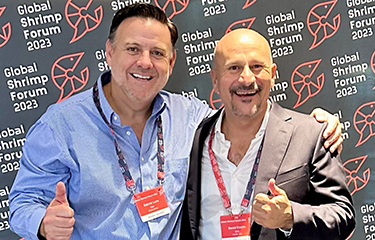
Gabriel Luna and David Castro have been dreaming and scheming about a global shrimp marketing campaign board for years. Now their dream is out in the open, and they’re hoping enough other industry representatives share their vision so that it can become a reality.
Formally announced at the Global Shrimp Forum in Utrecht, the Netherlands, on 6 September, the Global Shrimp Council is “an initiative with the intention to harmonize the interests of participants in this significant industry through a systemic vision,” Castro said at the time.
The primary goal of the council is to establish a producer-led promotional body to market and encourage shrimp consumption globally, according to Luna, the owner of Ecuadorian shrimp trading and insights firm Glunashrimp,
“The whole industry has been talking about this for years, about how long David and I have been talking about this as well,” Luna told SeafoodSource. “I'm sure there's some liver damage caused by how much we've talked about this campaign that should be done. But last year, we decided, you know what, if nobody else is going to do it, we have to do it.”
Luna said momentum is building behind the idea, with 25 companies now signed up, including representatives of large firms in Ecuador, India, and Vietnam, though he said names are not being released yet to provide more time to those on the fence or finalizing their decisions. He said at least 50 additional companies are considering joining, and that he expects still more to join once the council is set up and showing results.
“This is not a small commitment,” Luna said. “We want to start with between USD 8 million and USD 10 million [EUR 7.6 million and EUR 9.6 million], and that’s all going to come from donations. Our belief is that USD 3 million [EUR 2.9 million] gets us nowhere. This is not a USD 2 million [EUR 1.9 million] idea; This is a USD 10 million idea. There's a few steps to how we'll reach that and how we're going to use it, but the idea is big and the budget should be too.”
Luna said he has already hired Miguel Barcenas, the creator of the highly successful “Avocados from Mexico” promotional campaign, to create an outline for the council’s structure, though he said the final decision will be left up to the council itself. As for the council’s composition, he said those who join and donate will get to vote from options crafted and presented by Barcenas.
“It’s great so many people are excited about this idea, but if everybody chimes in with their own thoughts on the way to do it, that won’t work. That's how we got nowhere in the past,” Luna said. “What we need is to simplify the process, at least to get started. We need a manageable amount of people sitting around a table and able to decide on something. So the consultant will come up with a couple of options for structure, then the board will create statutes and regulations. And then we’ll get into developing strategies, talking with different marketing agencies, and then we’ll have the board vote which campaign to go with.”
Luna acknowledged the challenge of balancing varying – sometimes competing – interests of the sector. He said while those who get involved will have the final say, he wants the council to fairly and proportionately represent all facets of the industry.
“It’s going to be producer-oriented and -guided, but inclusive. Anyone who wants to be a part of it can be a part of it, but you have to pledge to support it,” he said. “We want all shrimp-producing countries to be involved. The guy from Honduras should be at the same table as the guy from Ecuador or Vietnam or India. And even if one guy from Ecuador is producing more shrimp than all of Central America combined, it’s fair he has more votes, but not 20 times more votes. The message and the effort has to be built around trust, inclusiveness, and balance. We need to build a platform where we can all trust each other and where everyone has the opportunity to give their opinions.”
The council will likely be paid for by a self-collected tithe on shrimp production, Luna said, though he said that decision will ultimately be made by the council.
“I’m thinking something like producers pledging to set aside USD 0.01 [EUR 0.01] for every pound of shrimp they sell for the council. That’s not that much, but in the big picture, it can add up to a lot of money,” he said. “How we are going to collect the money is the most difficult part, but that will be outlined in the options given to the council for its decision.”
Luna said talks are advancing with the National Fisheries Institute, the trade association representing the U.S. seafood industry, on housing the council to give assurance to the council’s participants that the funding will be sequestered by a third party and allocated appropriately as determined by the council.
“The NFI is the perfect third party. It gives the participants a reliable partner and somebody who is not a producer who can transparently hold the funds, manage the funds, and wire that money to wherever it needs to be wired based on the council's instructions,” Luna said.
NFI Chief Strategy Officer Gavin Gibbons previously told SeafoodSource his organization is open to the idea of playing host to the council. In a 2 October update, he said NFI has not yet made a decision.
“We’re looking at some strategic planning now so I’m not sure exactly when that decision will be made,” he said.
Luna and Castro are leading the effort to create the council now, but eventually, they hope to step back from their current roles. They hope when they do, the council is strong enough to continue on its own, and wise enough to trust the marketing experts hired to run the campaign.
“We’re pushing to keep the momentum, to make sure nobody loses interest. But ultimately, we’re just trying to give it a heartbeat, and then we’re happy to serve on the board or whatever. We look forward to it happening, and it's going to be worth it when we see the first ad on Instagram, TV, or hear it on the radio,” Luna said. “We’re all shrimp farmers and we know what we want, but we’re not sure how to achieve it. We’re going to need to hire the right people and make sure it’s run correctly. Whatever gets decided, the fun part is we all get to watch these marketing experts take our passion and bring it to a larger audience. We’ve had three or four conversations with marketing guys, and they blow your mind with their ideas and their strategy. It makes absolute sense to trust a third-party marketing person to guide us. I would urge everyone involved in the council to make sure we find the right balance on the council, have the council get the marketing team together, and then just enough we have enough funding so they can get the job done right.”
Castro emphasized the urgency of the initiative to those on the fence about joining.
“We can’t continue to discuss this for another decade. We need to present a workable option for the council, which may not be the perfect option, but once we get it going, we can continue to improve it,” he said. “The point is, this is going to benefit everyone around the [shrimp] world, at least a little bit, and we need to get going on this as soon as possible so we don’t get bogged down, as that’s how previous efforts have failed. I think that as long as we keep this idea moving forward, and we'll start seeing the results.”
Castro and Luna both said it’s their belief the marketing campaign should initially focus on the U.S.
“The idea is we’re going to start in the U.S. and then take it to Europe, Asia, and wherever else it is needed,” Luna said.
Castro, the CEO of Los Mochis, Sinaloa, México-based Manta Bay and a 23-year veteran of the shrimp industry, said the council would be a pre-competitive initiative, and would not eliminate fair competition between shrimp producers.
“There will be competitiveness. There will be some fights – some have already happened,” Castro said. “It’s nice, I’m considered neutral because Mexico produces a lot but it’s not exporting that much. So I don’t have my heart with the Ecuadorians, with the Indians, or whomever. My goal is to get more people to buy and eat shrimp. And that starts with getting it in more people’s heads and countering some of the misinformation that’s out there, like shrimp have high cholesterol, was debunked 20 years ago but which a lot of the public still believes.”
Castro said the council will also help to solve larger issues present in the shrimp sector.
“We’re not in crisis, but we’re in pre-crisis. We're at a crucial point where many experts think there's too much production – although I don't think there's too much production, to be honest. I think that what really is happening around the world is that importers are trying to decrease their inventory, because holding costs are more expensive. And of course we all know what's going on with interest rates. But when you continue production at the same level, and when importers are trying to decrease their inventory, they're not as hungry to buy whatever you're producing, which usually you produced 12 months ahead. But right now, we’re producing four months ahead. So that creates a lag in demand,” Castro said. “The council is about changing the model of the business from 12 months’ inventory to four months’ inventory or three months’ inventory. So that's very important to understand.”
In recent months, Allan Cooper, the business and value creation director at Vitapro, a South America-based feed producer, and Sandro Coglitore, the general manager of the Ecuadorian shrimp firm Omarsa, have become vocal backers of the initiative. Castro said a key figure in the movement to consolidate support behind the council idea has been Willem van der Pijl, the founder of Shrimp Insights and the creator of the Global Shrimp Forum, where the initiative was formally launched.
“Willem has not only given us the platform that we asked for, but he has been critical in bringing together producers from India, Indonesia, South Asia, and other producing countries. Everyone trusts him and he knows their culture,” Castro said. “What is happening here is that this shows that the industry is maturing. We are all getting together to make improvements to our industry. And it’s great to see that happen.”
Castro said the effort has been time-consuming and exhausting, but he remains confident it will be worth the pain.
“I do it because I’m very thankful for what shrimp has given me. I love the industry and I believe in its sustainability,” he said. “the ideal outcome here is for the council to create benefits in terms of promotion and consumption so that we have a solid, sustainable industry for the future.”
Photo courtesy of Gabriel Luna
