



Italy’s Lombardy region is world-renowned for its beauty, food, and wine, and Calvisius Caviar wants to maximize the attractiveness of its home base by marketing its sturgeon and caviar farm as a tourist destination.
Founded in 1977, Calvisius Caviar has grown into the largest caviar producer in Europe, surpassing 30 metric tons annually. But, with a major shift underway in its customer base, the company is looking to get younger consumers interested in caviar through immersive experiences at its two farms in Northern Italy.
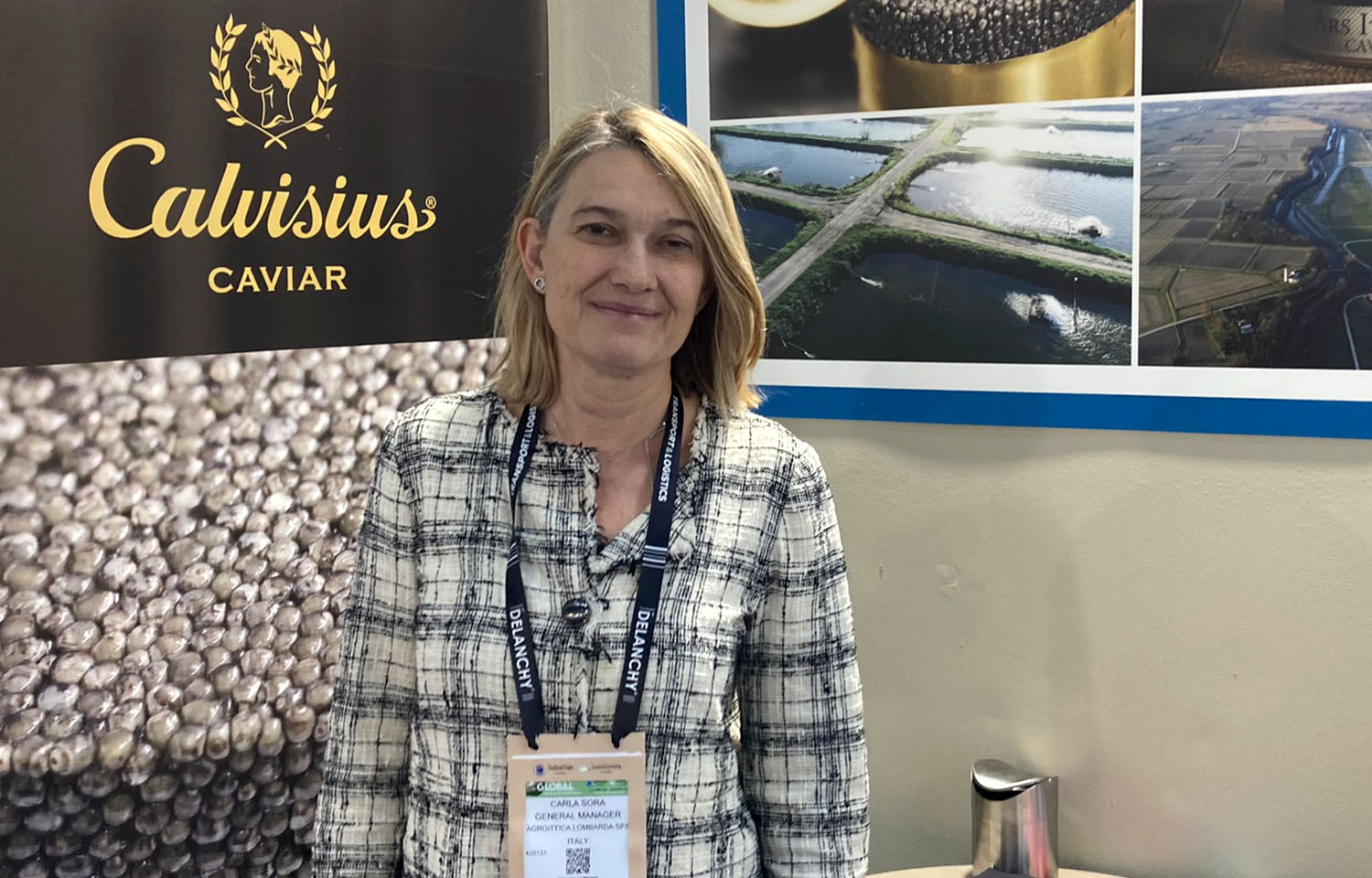
“In the past, our customers were airlines, but now it's totally changed. Now, the airlines buy less, and they mostly buy Chinese [caviar] for the price,” Calvisius Caviar Director General Carla Sora told SeafoodSource at the 2024 Seafood Expo Global. “We are more focused on tourism and on chef-based marketing initiatives.”
Calvisius Caviar raises six species of sturgeon at farms in Calizano and Parco Ticino, near Brescia, Lake Garda, and Franciacorta, which is famous for its metodo classico wine, Italy’s version of champagne.
“We get a lot of tourists who are already into food and wine, and the numbers are increasing a lot recently, so we are working to become a destination for them during their travels,” Sora said.
The company has invested in its infrastructure so it can better accommodate visitors, including the development of a restaurant, and it has created a hospitality program that includes demonstrations of caviar extraction and preparation.
“People are willing to spend more money on experiences since the pandemic. They want to get to understand and appreciate [our] product and the process behind how it is made,” Sora said. “This is the future for us, and I’m really satisfied with this choice for our company.”
Sora said the key target demographic for Calvisius Caviar is millennial consumers.
“In the past, caviar was thought to belong just to very rich people, like an old man with a big car. Now, it has totally changed,” Sora said. “The most important thing for us now is to understand the younger attitude. Millennials are very interested in caviar, and we have the opportunity to approach this new generation in new ways with caviar. A lot of them come to visit us, and they want to know our history and our methods. We are working on a different approach for them.”
Top of mind for younger caviar enthusiasts is sustainability, Sora said.
“Sustainability is something that young people really want. ‘Sustainable’ is the right word for the future of the caviar market,” she said. “With that in mind, it's very important for us that the people can come and visit and see our sturgeon and how we breed them and take care of them because we started with sustainability a long time ago; it is in our DNA.”
Calvisius Caviar is committed to maintaining a very high level of welfare for its fish, which are raised in glacier-fed water, given high-quality aquafeed, and given lots of space to swim, Sora said. Additionally, the company has committed to a circular aquaculture model and waste-minimization efforts, among other initiatives, according to Sora.
“We have a very good reputation because of our quality, and that quality is due to our sustainability efforts,” she said.
To improve the accessibility of the company’s caviar, which is sold under the Ars Italica brand, Calvisius Caviar recently launched 10-gram tins that sell for EUR 15 to EUR 20 (USD 16 to USD 22), depending on the caviar type – a stark departure from its typical sales point, which is EUR 2,000 (USD 2,160) per kilogram.
“It’s a small unit, but it gets more people to try the product because you don't have to spend a lot of money on it,” Sora said. “You can have a wonderful 10 grams of caviar and the flute of champagne and have a perfect happy hour.”
Sora said she believes these small tins will help maintain the caviar market’s global growth trajectory, which she said had been robust until the Covid pandemic but has since cooled. Prices for caviar rose due to inflation pushing up costs, but Sora predicted pricing will be more stable over the next year.
“The caviar market is still growing worldwide but less so in the last two years,” she said. “In Europe, consumption is down, but it’s still strong in the U.S. and the Middle East.”
In addition to its tourism initiatives, Calvisius Caviar remains committed to its longstanding chef outreach program, which stretches from Italy to France, the U.S., Japan, and Australia and includes a partnership with the renowned chef Paul Bocuse.
“It’s vital that chefs know the product, so we do events with them where we are featured. We sponsor cultural events they’re participating in. They can put our caviar on the menu. It’s a great way to position our brand at a high level of culture,” Sora said. “The chefs are our partners, not just our customers.”
Sora said she wasn’t worried about the growing volumes of cheaper Chinese caviar coming into the marketplace.
“Caviar is a niche – we are talking about a very small market – and there are niches within that,” she said. “Chinese are more focused on quantity, and they use hybrid species that we absolutely don't use. Chinese producers have helped a lot to open the market. But, we see after trying the Chinese caviar, people seek out better quality and other origins.”
