
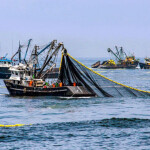


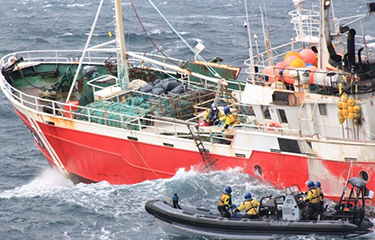
Ireland is taking a harder line on E.U. vessels entering its waters, with the Irish navy recently detaining a Spanish trawler, the Pesorsa Dos, for fishing offenses in Irish waters, including leaving nets in the water longer than time permitted under E.U. rules.
After the deal on Brexit, which according to Irish fishing groups resulted in Ireland ceding 40 percent of its E.U. fishing quota to the U.K., there are signs that Ireland is taking a more nationalistic approach to its fisheries management.
Irish Fish Producers Organisation (IFPO) CEO Aodh O’Donnell said his organization “welcomes increased activity by our Navy in protecting our valuable fish stocks, despite the fact that we have concerns about whether they have sufficient resources for this task.”
“It’s in the interests of the Irish fishing industry that Ireland’s marine resources are sustainably managed and protected, particularly in the context of the small fishing quotas that we have in our own rich coastal waters,” he said.
Ireland is expected to be more vigilant after losing out in Brexit, said Spanish fishery representative Ramon Manuel Muniz, president of the Asociación Española de Titulados Náutico-Pesqueros (Aeitinape). Several Aeitinape members unload their trawlers at the Irish port of Castletownbere, from where its fish is transported to Spain.
Michael Collins, an Irish member of parliament for the Castletownbere region, recently called on Ireland’s navy to be better resourced to track and seize vessels fishing illegally in Ireland’s exclusive economic zone. He suggested the Irish navy is incapable of adequately patrolling Ireland’s exclusive economic zone due to understaffing and lack of resources.
In recent years, fishery ministers of both Ireland and Spain have lobbied the European Commission against some of its proposed fisheries reforms. At a Council of Fisheries Ministers of the E.U. in September 2022, Spain Fishery Minister Luis Planas joined with the Irish and French delegations to push to allow the continuance of bottom trawling in 41 of 87 sensitive areas of the northeast Atlantic mapped for protection by the E.C., according to La Voz de Galicia.
While there have been no accusations of widespread illegal fishing lobbed by Ireland against Spain, a traditionally large Spanish presence in waters off the south of Ireland has caused issues in the past. The Pesorsa Dos was previously detained in 2020 for infringement of Irish fishing rules. Other E.U. countries have run afoul of Irish regulators; In 2015, the Dutch supertrawler Annelies Zlena – formerly the Irish-owned Atlantic Dawn – was held and its captain fined by an Irish court for illegal discharge of by catch.
Ciaran Doherty, chairman of the Killybegs Fishermen Organisation, said Ireland’s European Union membership has been bad for Irish fishermen. Besides the quota giveaways to Britain, Brussels has been unable or unwilling to stand up to Norway, he said. Doherty told Ireland’s parliament in January the E.U. has broken a promise of a burden-sharing agreement among member-states and Irish fishermen had been “thrown under the bus” by the E.U. as a result.
The E.U. is currently negotiating Norwegian access to Irish waters and quotas for fish caught in Ireland’s EEZ. The IFPO’s O’Donnell has claimed the E.U. has not demanded Norway offer Irish fishermen reciprocal access to its seas. Doherty accused Norway of “disgraceful” overfishing of mackerel at the same time Irish trawlers are required to tie up nine months of the year.
“In the last seven years, despite having inflated quotas, Norway has overfished blue whiting by an average of over 10 percent a year,” O’Donnell said. “In fact, during this period, they overshot their quota by almost 200,000 metric tons. This is an irresponsible and unacceptable utilization of a valuable resource."
Ireland lost a quarter of the economic value of its fishery stocks in the Brexit settlement, and the country’s fishing organizations are determined not to see more of its marine resources traded away, according to John Lynch, chair of the Irish South and East Fish Producers Organisation. Lynch said Irish fishermen are asking the E.U. to give them a quota to fish tuna while also swapping Irish quota in certain species for access to quota currently held by France and Spain.
Otherwise, he claimed, the Irish fleet is facing decommissioning, having already been reduced from 330 to 120 vessels between 2006 and 2020 due to a shrinking of its quotas under the E.U.’s common fisheries policy – though E.U. subsidies have also helped pay for a modernization of some Irish vessels. And Irish vessels – including the Atlantic Dawn – have received access to West African waters under the E.U.’s various fishing agreements with third countries.
Irish environmentalists have also criticized the E.U.’s approach to the Irish fishing sector.
While not agreeing with the fishermen on much, Irish environmentalists meanwhile share their frustration with the E.U.’s common fishery policy.
Irish Wildlife Trust Ecologist Pádraic Fogarty described the E.U.’s common fisheries policy as “disastrous from an ecological standpoint.” A reform in 2013 was a drastic improvement, “on paper, but it hasn't been enforced,” according to Fogarty.
“So while there was some improvement early on, this has stalled,” he said.
Fogarty sees much more turbulence ahead as the E.C.’s inability to enforce its rules runs into legal trouble, and conflicts with an E.U. plan to designate 30 percent of its waters as marine protected areas.
“We see legal action is underway regarding enforcement. The CFP also makes it near-impossible to create meaningful MPAs and that needs to be overcome,” Fogarty said. “So many of the issues stem from bottom-trawling. If we stopped this alone, we would restore many commercial fish populations, restore the sea floor, reduce discarding, and protect carbon stores.”
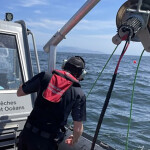
Photo courtesy of Irish Navy Service
