





Ireland’s fleet-decommissioning scheme for whitefish vessels has thus far made offers to 57 vessel-owners and has received acceptances from 20. But a spokesperson for fisheries and aquaculture state agency Bord Iascaigh Mhara (BIM), which is overseeing the scheme, said BIM needs more participation in the program in order to successfully rebalance fish quotas following post-Brexit agreements.
The EUR 75 million (USD 79.2 million) Brexit Permanent Cessation Scheme – similar to a separate decommissioning program initiated in 2008 – seeks to retire a third of Ireland’s whitefish fleet, or around 60 vessels. Thus far, there have been 64 applications to the program, of which 57 vessels were found to be eligible, according to The Fishing Daily. But just 20 vessels have entered the program thus far, with three trawlers have already been dismantled and 17 queued to be scrapped.
Vessel owners receive between EUR 200,000 to EUR 1.4 million (USD 211,000 to USD 1.5 million) for entering the program, depending on the size of the vessel and other factors. The plan targets the voluntary decommissioning of vessels with total capacity of up to 8,000 gross tons and 21,000 kilowatts, offering owners a premium of up to EUR 12,000 (USD 12,700) per gross ton and crew members up to EUR 50,000 (USD 52,800) each.
The Irish South and West Fish Producer's Organisation and the Irish Fish Producers Organisation are among the fishing trade groups that have voiced anger over the scheme. IFPO CEO Aodh O’Donnell said Ireland’s fleet has struggled after losing fishing quotas due to Brexit, forcing Irish fish producers out of business.
Donnell said doesn’t expect more than 30 vessel owners to sign up for the scheme under its current terms.
"It appears that the offer is not enough for some of the fishermen,” he said. “The criteria attached to the scheme is not attractive and the state [is] making it complicated. If 60 vessels don’t exit the sector, the rebalancing of quotas will be more difficult, as the remaining fleet will be left chasing a reduced quota of fish to catch."
Despite the lower-than-expected uptake, Ireland Minister for the Marine Charlie McConalogue told The Fishing Daily the voluntary scheme won’t be changed.
Cara Rawdon is one vessel owner who has accepted the terms of the deal. His Greencastle-based vessel, the Catherine R, a steel trawler constructed in 2005, was scrapped in February 2023.
“The main reason is that I felt that there is so much bureaucracy now attached to the fishing industry and how we fish, I feel that it's way over the top,” Rawdon said. "It’s like seeing your home being torn apart. I saved the money to buy her and make her safe for the crew. It was a very difficult decision because not only had I to decide my own future I also had to think of my crew. It’s a very hard decision to make to end a lifetime of fishing."
BIM is also overseeing several other programs launched out of recommendations from the Irish government’s Seafood Sector Taskforce in its final report, delivered in 2021.
Its EUR 265 million (USD 280 million) Brexit Adjustment Reserve (BAR) includes a number of programs designed to develop and restructure Ireland’s seafood sector to ensure “a profitable and sustainable seafood industry providing jobs and economic activity in coastal communities dependent on fishing.”
Its EUR 45 million (USD 47.5 million) Seafood Processors Scheme has thus far funded 21 projects worth EUR 22 million (USD 23.2 million) for improvements and innovation in seafood processing.
And its EUR 25 million (USD 26.4 million) Brexit Blue Economy Enterprise Scheme seeks to “rejuvenate businesses in coastal communities around Ireland, helping them to adapt, restructure, and reskill in the post Brexit landscape.” BIM has thus far awarded approximately EUR 3.5 million (USD 3.7 million) through the program to businesses ranging from mobile seafood trucks to sea salt businesses.
“The seafood sector has shown immense resilience and strength in its ability to adapt to changing marketplaces and socio-political impacts,” BIM CEO Caroline Bocquel said in a press release. “BIM is working closely with industry and other stakeholders to develop supports that allow businesses to be agile and take advantage of new market opportunities.”
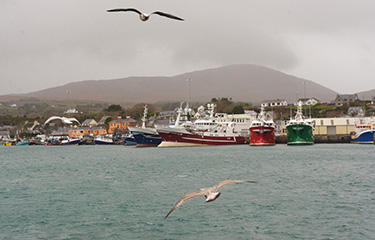
Photo courtesy of Bord Iascaigh Mhara
