





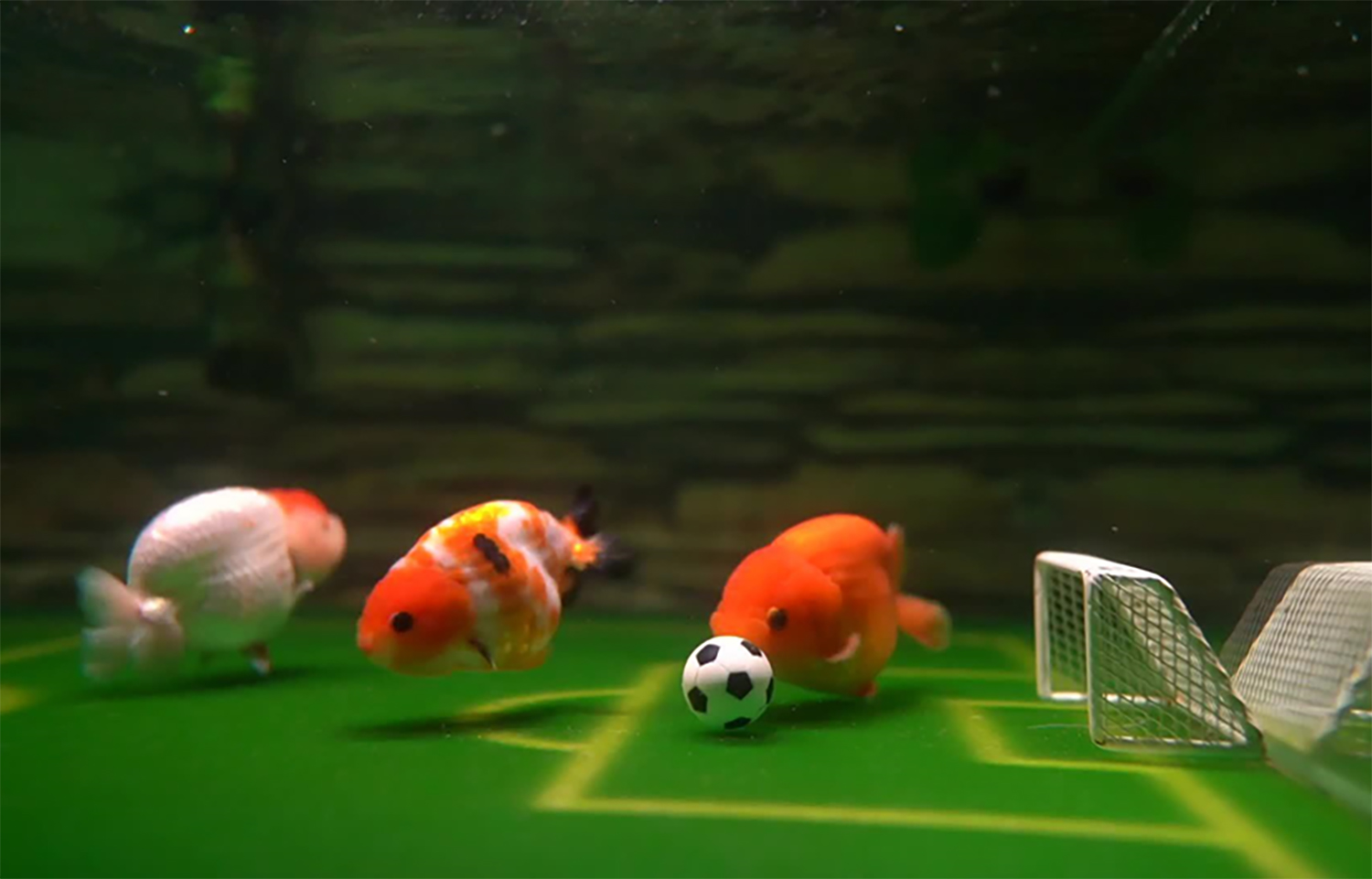
Nearly four years ago, a Chinese man posted a YouTube video that was soon picked up by larger media outlets showing how he trained his Ranchu goldfish to play soccer.
Though the video was released just a handful of months into the Covid-19 pandemic, it has recently become a trending topic in Chile – not because of the recently completed Copa America soccer tournament, during which Chile crashed out in the group stage, but because an animal defense NGO is using it as evidence that fish are sentient beings.
Ignacia Uribe, founder and CEO of animal rights and vegan activist group Fundación Veg, was called in to testify before the Chilean Lower House of Congress’ fisheries committee regarding the fishing bill currently under negotiation in the nation’s legislature.
“You all may ask, ‘How conscious can a fish be?’” Uribe asked Chilean legislators. “The truth is that they’re more than numbers, more than tons; each fish is an individual, with its own personality, thoughts, interests, and memory. Within the same species, there are shy and bold fish. There are fish that have learned to play soccer, do tricks, and even use tools.”
Inspired by her testimony, Deputy Jorge Brito proposed adding to the legislation that fish be considered sentient animals. His proposed initiative would “respect the physical and mental state” of marine animals, defining sentient animals as “capable of having experiences and reacting to external stimuli consciously,” so they should be subject to “moral consideration and respect.”
Though Brito found the argument moving, it was largely met with disapproval and calls for the bill to focus on making other, more essential, improvements to the country’s fishing industry.
Alejandro Pérez, a marine biologist and academic at Chile’s Universidad Católica, said that the law’s focus should be on effective extraction techniques, how to add value to extracted species, and how to understand and minimize the impact generated by fishing.
“There is a humanization [in Uribe’s and Brito’s arguments] that does not make much sense, which leads to ridicule of the feelings of animals,” Pérez told BioBioChile.
In a post on social media platform X, Congressman Sergio Bobadilla said that Brito had “probably been advised by other sentient beings such as … Pikachu [and] the dinosaur” and accused Brito of “copy-pasting” the text from Fundación Veg.
Bobadilla himself had been one of three legislators previously accused of copying and pasting text from a document that the Chilean National Fisheries Society (Sonapesca) presented in May to a package of indications, or suggestions, for the new fishing law.
According to an exposé by investigative journalism site Ciper, 211 of the 276 indications were very similar to text from Sonapesca.
Since Chile President Gabriel Boric took office in March 2022, he has sought to replace the country’s existing fishing laws while also strengthening environmental stewardship in the ocean.
“In terms of fisheries and aquaculture, we will fulfill our commitment to advance in a new law, which will be free of corruption and the result of an open and transparent debate – one that delivers clear, fair, and sustainable rules both at an industrial and artisanal level,” Boric said in his first address to the nation in June 2022.
Two years later, the plan is to establish a separate law for both the fisheries and aquaculture industries, which are currently governed by the same law.
Neither side in the negotiations seems to be content with how the negotiations are progressing.
Chile’s salmon-farming industry has complained it has not been sufficiently taken into consideration by government officials when it comes to defining the new aquaculture law.
As for the fisheries law, criticism has intensified against such legislators as Bobadilla and Brito.
“The copy-paste of Deputy Bobadilla and now the controversy over sentient aquatic animals, caused by the indications of deputy Brito, lead to a lack of in-depth discussion about the implications and details of the fishing law,” Marco Moreno, a faculty member of Universidad Central’s School of Government, told BioBio Chile. “This can result in public policies that are flawed and, therefore, potentially ineffective.”
Brito has since reformulated his original motion to consider fish sentient beings but still said he believes Bobadilla and others are derailing talks.
“Something smells bad in the fisheries committee,” Deputy Brito told Radio Universidad de Chile. “We cannot allow the work of the fisheries committee – which is looking to define a new fishing law made with clean hands, which vindicates artisanal fishing and Chile's sovereignty in the sea – to be soiled by the actions of some parliamentarians led by Deputy Bobadilla.”
