





Chile’s Environment Superintendency, SMA, has initiated the process of charging Puerto Varas, Chile-based Australis Seafoods with overproduction at several of its salmon farms.
The environmental authority accused Australis of 85,000 metric tons (MT) of overproduction between 2014 and 2022, and the company now faces a total fine equivalent of up to CLP 178 billion (USD 225 million, EUR 205 million), Diario Financiero (DF) reported.
Australis admitted to some overproduction via self-reports to the SMA acknowledging the company surpassed permitted production limits at 33 salmon grow-out centers. On 25 April, in response to both the self-reported violations and its own investigations, SMA filed 21 sanctioning procedures against Australis, including 52 serious infractions for overproduction and five minor charges for other environmental breaches it said took place between 2014 and 2022.
“This is a complex process, which seeks to gather the greatest amount of information to see if a self-report is accepted or not, and after which the respective sanctioning process follows,” SMA Superintendent Marie Claude Plumer said in a press release.
With a company that admits violations, the SMA conducts an analysis of information provided by the infringing company’s self-reporting to ensure its veracity. It also mandates a compliance and improvement program and requires the company to accept the punishment it receives, Plumer said.
In a statement sent to SeafoodSource, Australis said it was confident it would not face harsh SMA sanctions. Australis referred to the SMA’s 2018 auto-reporting guide, which “allows the offender to opt for the benefit of an exemption or reduction of the fine that would be applicable with respect to the offense(s) that are the subject of the self-report.” In other words, the SMA incentivizes self-reporting of violations by waiving all fines or offering significant reductions in fines for companies turning themselves in for overproduction.
Additionally, Australis initiated the process on SMA-required compliance programs on the same day it provided its overproduction reports to the agency.
“We are reassured with the phases that have been completed, and we are certain that self-reporting was the right path to take to ensure compliance with Chilean environmental regulations,” Australis told SeafoodSource in a statement. “As a company controlled by a responsible foreign investor, we know that self-reporting will have a negative impact in the short term, but we hope that justice sanctions those responsible considering the damage that third parties have generated to the company.”
Australis may end up paying much more to support the USD 1.22 billion (EUR 1.13 billion) lawsuit it filed in March 2023 against Isidoro Quiroga, the company’s former owner, whom it has accused of withholding information regarding the overproduction while he was selling the firm to Chinese foodservice giant Joyvio in 2018. Joyvio blamed Quiroga for the two SMA investigations initiated before Australis self-reported any overproduction. Those two farms were responsible for 12,000 MT of overproduction, with Buckle Bay, inside the Magallanes Region’s Kawésqar National Reserve, being the center with the highest excess production at 4,105 MT or 95 percent above the authorized limit.
In a public statement, Australis’s law firm BES Abogados said that Quiroga, two of his children, and executives “from within his iron circle … hatched a criminal plan with which they committed crimes and seriously damaged the company's assets.”
Quiroga and his team planned the overproduction knowing it would infringe environmental regulations that exposed Australis to sanctions, the law firm said.
"The facts reveal a criminal plan with a systematic reiteration of the crime of dishonest management, which according to the law calls for an increase in penalties, for which the defendants risk prison terms of between 15 and 20 years,” BES Attorney César Ramos said.
The inflated harvest volumes, achieved through “serious, repeated breaches of environmental regulations,” increased the company’s price to Joyvio, Ramos alleged.
In response to the lawsuit, Quiroga called the accusations “falsehoods and slander.” He has insisted that Joyvio was aware of the overproduction before the sale and that Joyvio executives encouraged Australis to continue or even increase production levels further once it took over.
In a prepared statement, the Chilean Salmon Council, which represents AquaChile, Australis, Cermaq, Mowi, and Salmones Aysén, said it regrets the negative attention the case is bringing to the country’s USD 6 billion (EUR 5.5 billion) salmon sector but that it trusts the judicial system to come to a fair decision.
“We are facing a commercial controversy derived from the sale of a company in the private sphere and which is now being analyzed in the competent arbitration and judicial venues,” it said in a statement sent to SeafoodSource. “We hope that the institutional framework will operate and that this controversy will have the best and quickest solution. Business values and trust are vital for the sustainable development of our country, and it is essential that all companies comply with the current regulatory framework to protect salmon farming in the long term.”
The council said that Australis and General Manager Andrés Lyon are doing the right thing by making themselves available to the authority to work together, “but the high and systemic levels of overproduction self-denounced by the company … must not be repeated in the salmon farming industry in Chile – the Salmon Council is deeply committed to this.”
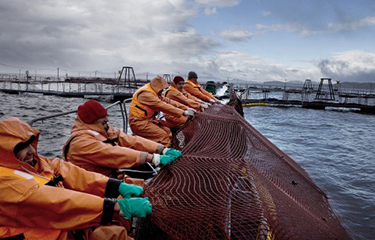
Photo courtesy of Australis Seafoods
