


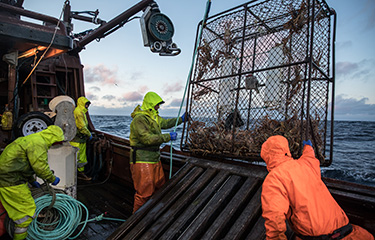
The U.S. state of Alaska is planning to reopen the red king crab fishery on 15 October, the first harvesters will have a quota in two years.
The historically lucrative crab fishery, which runs in the winter months in Bristol Bay, was canceled in 2021 after a bottom-trawl survey by the National Marine Fisheries Service revealed the stock was not robust enough to support a fishery. The red king crab stock had been on a downward trend for multiple years, and the last year of fishing in 2020 featured a quota of just 2.6 million pounds – down from the 3.8-million-pound quota available in 2019.
Now, the Alaska Department of Fish and Game (ADFG) has announced that 2.15 million pounds of red king crab will be available in a season that will run from 15 October, 2023, to 15 January, 2024. A total of 1.935 million pounds will be available via individual fishing quota, and 215,000 pounds will be available via community development quota.
Despite the recovery of the red king crab population, the Bering Sea snow crab fishery will remain closed. The stock, according to the ADFG, is still below the necessary regulatory threshold to open the fishery. Nonetheless, fishermen in the region welcomed the reopening of the red king crab fishery.
“It’s a start in the right direction. I’m glad it’s opening. It will help pay some bills and most of all, it will help our crew out,” Glenn Castro, captain of the FV Pinnacle, said in an Alaska Bering Sea Crabbers (ABSC) press release.
“It’s nice that we get to put gear in the water and go fishing again,” Oystein Lone, the captain and owner of two vessels – the FV Confidence and the FV Pacific Mariner – said. “It’s a needed lifeline for us to keep our businesses afloat. It also keeps our crew making a wage to support their families.”
The positive news is tempered by the reality of the small quota, third-generation crab fisherman Gabrial Prout said.
The red king crab fishery's closure had a significant impact on the seafood industry in Alaska. After the second year of closures, Alaska’s U.S. senators, Lisa Murkowski and Dan Sullivan and Washington’s senators, Patty Murray and Maria Cantwell, pushed for the U.S. Department of Commerce to fast-track a federal fishery disaster declaration for the 2022-2023 Bristol Bay red king crab and 2021-2022 Bristol Bay red king crab seasons. U.S. Secretary of Commerce Gina Raimondo approved the declarations on 16 December, 2022, and an omnibus bill passed later that month carried funding to relieve harvesters hit by the closures.
“The reopening of the Bering Sea king crab fishery should bring some much-needed financial relief to the vessel owners and crew of the industry, but it also highlights the impacts of the previous two years of closures,” Prout said. “The size of the fleet participating will be smaller due to financial constraints. The impacts the fleet and the stock continue to face highlights the need for state and federal managers to implement better management strategies to help protect the health of the crab population and those that rely on it. We’ve got to take steps to build resilience in this fishery for the crab, the fishermen, and the communities.”
Since the closures were announced, a fierce debate has raged over the effectiveness of fisheries management in Alaska and the potential impact trawl fishing is having on crab stocks.
The Alaska Bering Sea Crabbers submitted an emergency petition to the North Pacific Fishery Management Council calling for a partial, seasonal trawling ban, due to crab being in a “vulnerable soft shell state of molting and mating.” The pollock fishing industry pushed back, claiming no scientific evidence indicated it was doing harm to crab species. The ABSC petition was ultimately denied by NOAA Fisheries.
While the red king crab stock has recovered enough to host a fishery, ABSC is still adamant that certain areas should be off limits to pollock trawls to help the stock recover.
“Hopefully, the North Pacific Fishery Management Council will make some moves to further protect the Red King Crab Savings Area in the near future to help king crab stocks continue to rebound,” Lone said. “We need to make sure midwater trawling for pollock stays out of that area if it is being fished on the bottom hurting crab stocks and disturbing habitat or use enforceable technology to keep the gear truly midwater. Until we know what is happening with this gear, everything needs to be done to protect crab stocks.”
The ADFG also announced Bering Sea tanner crab will also be open. Western Bering Sea tanner crab received a quota of 1.32 million pounds, while Eastern Bering Sea tanner crab received a quota of 760,000 pounds, for a combined total of 2.08 million pounds – a slight increase over last year’s combined total of 2.01 million pounds.
Snow crab, meanwhile, remains in poor status – though ABSC said that there are “signs of life” in the presence of increased numbers of juvenile crab. Once numbering in the billions, snow crab disappeared from the region virtually overnight – garnering widespread media attention. Researchers blamed the crash on a mysterious mortality event that could be related to temperature shifts – but a lack of scientific surveys in 2020 due to the Covid-19 pandemic has left the event a mystery.
Photo courtesy of Corey Arnold
