

Class-action lawsuits have been filed against Bumble Bee Foods and Conagra Brands over sustainability claims they made for their seafood products. The separate complaints, filed in federal district courts in the U.S. states of Illinois and California, each ask for at least USD 5 million (EUR 4.7 million) in damages.
The complaints also heavily criticize the Marine Stewardship Council, alleging it “blatantly violates its own standards and puts the very ecosystem MSC feigns to protect in serious danger.”
Plaintiffs Abdallah Nasser and John Bohen contend the “Sustainability Promise” found on each of Bumble Bee’s product labels – including canned pouched Wild Caught Pink Salmon and Sockeye Salmon and pouched Wild Caught Applewood Smoke Tuna – “deceives and misleads reasonable consumers into believing the products are sourced from sustainable fishing practices.”
“Bumble Bee turns a blind eye to the unsustainable fishing practices used in sourcing its products and boldly uses the Sustainability Promise with the [MSC] Blue Tick as proof of sustainable fishing methods,” the plaintiffs said.
Bumble Bee knew or should have known that “MSC hands out this certification to those who use industrial fishing methods that injure marine life as well as ocean habitats with destructive fishing. MSC also allows its members to obtain their certification with a paid membership, creating a potential conflict of interest,” the plaintiffs said.
Despite the MSC certification, Bumble Bee sources its products using fishing practices that indiscriminately harm ocean ecosystems, the complaint alleges.
The lawsuit alleges San Diego, California, U.S.A.-based Bumble Bee, which is owned by Kaohsiung, Taiwan-based FCF Co., engages in “the suffocation and crushing of dolphins caught in fishing nets that are then hauled onto fishing boats while severely injured or dead; the torturously slow death of endangered sea turtles after getting caught on large hooks meant for tuna; the trapping of whales by fishing gear, causing deep wounds and intense suffering; and the extortion of migrants working on fishing boats, who are forced to labor relentlessly for long hours with little food and minimal sleep, under the threat of being beaten or thrown overboard.”
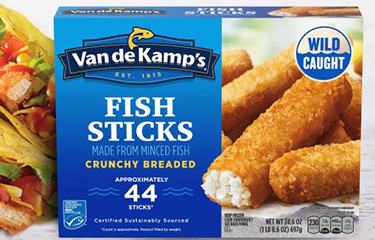
In the complaint against Chicago, Illinois, U.S.A.-based Conagra, the maker of Van de Kamp’s and Mrs. Paul’s seafood products, plaintiffs also allege that MSC-certified fisheries “do not provide these promised protections and, instead, engage in the following conduct, which indisputably defies its promise of sustainability: the suffocation and crushing of sea lions, sharks, and whales caught in fishing nets that are then hauled onto fishing boats while severely injured or dead; the excessive capturing or harming of non-targeted prohibited species, such as snow crabs, and contributing to the failure of the populations.”
Some of Conagra’s products are harvested in the Bering Sea by Russian fisheries that use pelagic midwater trawls, the plaintiffs contend.
“Russian pollock fisheries do not have an effective measure in place to protect endangered species, such as Steller sea lions and albatross,” the plaintiffs said. Pollock trawl fisheries in the Bering Sea also frequently catch snow crab as bycatch, which they ultimately discard, according to the plaintiffs.
“Due to the use of pelagic trawls, these discarded crabs are estimated to have an 80 percent mortality rate,” Nassar and Bohen said. “No reasonable consumer would believe the products to be ‘sustainable’ if they knew of these fishing practices utilized in sourcing the products.”
In a similar lawsuit filed in U.S. Superior Court for the District of Columbia in 2022, the nonprofit group Global Labor Justice-International Labor Rights Forum alleged that Bumble Bee and FCF “have a long history of engaging in and/or allowing unfair and dangerous labor practices in the commercial fishing of the seafood that ends up in Bumble Bee products.”
“Bumble Bee’s supply chain not only falls short of international laws and standards regarding fair labor practices, but also employs fishing methods that are inherently dangerous for workers,” the organization said. "These failures have resulted in documented instances of forced labor, human trafficking, and numerous other violations of worker safety.”
FCF’s supply chain comes from fishing methods and regions recognized by U.S. government agencies as high risk for forced labor and other abuses, GLJ-ILRF alleged.
However, Bumble Bee "adamantly disagrees with the allegations made in the lawsuit and will defend ourselves,” the San Diego, California, U.S.A.-based tuna firm said in a statement to SeafoodSource at the time. “We continue to work within our supply chain, with others in the tuna industry and through the Seafood Task Force to make the responsible recruitment and treatment of all workers an ongoing top priority." Bumble Bee did not respond to requests from SeafoodSource for comment on the new lawsuit.
In May 2020, U.S. Customs and Border Protection’s Office of Trade placed a Withhold Release Order (WRO) on the Taiwanese-flagged Yu Long 2, and in February 2020, the Taiwan-flagged Tunago 61 was given a WRO, though it was revoked on 31 March by the CBP after it obtained evidence tuna produced by the vessel was not caught using forced labor conditions. At the time, the vessels were suppliers to FCF Co, which purchased Bumble Bee Foods in January 2020.
In reports titled , “Choppy Waters” and “Seabound: The Journey to Modern Slavery on the High Seas,” Greenpeace Southeast Asia linked FCF to labor abuses including deception, wage-withholding, excessive overtime, and physical abuse.
In a July 2021 interview with SeafoodSource, Bumble Bee Seafood Senior Vice President of Global Corporate and Social Responsibility Leslie Hushka said the company was working with the operators of the vessel supplying its tuna to insure adequate health and safety conditions onboard.
Numerous lawsuits have been filed in recent years against seafood purveyors making sustainability claims, with defendants including Mowi, Aldi, and Gorton’s.
In a SeafoodSource op-ed, Katten Muchin Rosenman Partner Christopher A. Cole said the lawsuits center around the definition of “sustainable.”
“If a supplier cannot rely on an industry consensus certification such as BAP, Marine Stewardship Council, or any number of other reputable certifiers, can any company ever safely make the claim without fear of litigation?” he wrote.
Photo courtesy of Conagra
