






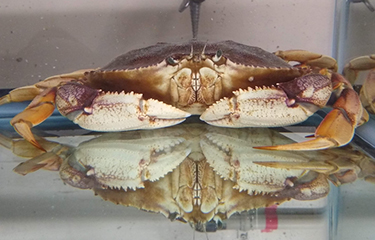
The Dungeness crab season in the north of the U.S. state of California will face additional limits on 15 May in response to whale sightings in local waters.
The California Department of Fish and Wildlife already closed most of the state’s waters to Dungeness crab fishing on 15 April to prevent interactions with migrating humpback whales. Now, fishers in zones 1 and 2 – stretching between the state’s boarder with Oregon and Point Arena, California – will face a 30-fathom constraint, according to the CDFW.
"As [the whales] are returning, they're obviously hungry. They're foraging for bait fish, anchovies, sardines, krill. It just puts them in a potential overlap with the commercial fishery gear and at risk of entanglement," CDFW Senior Environmental Scientist and Supervisor for the Whales Safe Fisheries Project Ryan Bartling told KRCR.
In 2022, the fishery dealt with several entanglements of endangered humpback whales, and state regulations adopted in 2020 require the removal of crab-fishing lines from the water to protect against interference with blue and humpback whales and sea turtles, all of which are listed under the Endangered Species Act. Nevertheless, in April 2023, a gray whale was found entangled in commercial crab gear in Northern California waters and three humpback whales were confirmed entangled in Monterey Bay — one entangled in spot prawn gear and the other two in unidentified gear, according to Oceana, which called for the state to take more extreme action to cut down on entanglements.
“As migrating whales return to the California coast, we have a responsibility to ensure they can swim and feed without the risk of becoming entangled in fishing gear, which too often has deadly consequences,” Oceana California Campaign Director and Senior Scientist Geoff Shester said. “While we applaud the California Department of Fish and Wildlife director and the California Dungeness Crab Fishing Gear Working Group for their dedicated efforts to protect whales, Oceana is concerned that these depth restrictions do not go far enough to prevent entanglements as more and more whales will continue arriving before the Northern California crabbing season ends. The decision to leave the fishery open is extremely risky, not only for the whales but also for future crab fishing opportunities off the entire state as federal laws may require stricter regulations on the fishery. Humpback whales in particular are at risk of becoming entangled in vertical fishing lines as they frequently feed in shallow waters where the fishery is still allowed, and scientists recently observed anchovies — a primary food source — to be widespread in that area. We need to be more precautionary if California is serious about reversing the unfortunate trend of high numbers of whale entanglements that we’ve seen in recent years.”
The early closure of California’s Dungeness crab fishery is another blow to local fishermen, following the closure of the spring salmon season. California crabbers Bob Maharry and Dick Ogg told Bay Nature the double whammy is having a compound impact on local fishermen.
“I just talked to one of my crew members, and he’s down to his last dollar,” Ogg said.
Maharry and Ogg said they were already suffering as a result of repeated delays of the opening of this year’s Dungeness crab season, and low prices once it began. Lower demand put the per-pound rate for the crabs at under USD 3.00 (EUR 2.76), Ogg said.
Nevertheless, Ogg said he supported the closure of the fishery to protect whales. He said he was happy to hear the humpback whale population is enjoying annual growth of 7 to 8 percent.
“As the population gets bigger and bigger and bigger, the likelihood of interaction increases significantly,” he said. “We’ve got to be cognizant of where the animals are and how to limit interaction.”
As of 12 May, California fishermen had caught 9,304 metric tons (MT) of Dungeness crab valued at USD 53.5 million (EUR 49.3 million), while landings in the U.S. state of Oregon totaled 13,671 MT at a value of USD 77.5 million (EUR 71.4 million), and landings in the U.S. state of Washington hit 10,794 MT at a value of USD 64.3 million (EUR 59.3 million). Prices have risen as the season has gone on and ranged between USD 3.26 and USD 3.84 (EUR 3.00 and EUR 3.54) per pound ex-vessel in April and USD 4.41 and USD 4.96 (EUR 4.06 and EUR 4.57) thus far in May, according to the Pacific Fisheries Information Network. The robust figures put the U.S. West Coast Dungeness crab fishery on track for one of its best-ever seasons by volume.
However, that news was tempered by researchers from the University of Toronto – Scarborough, who published a study that found Dungeness crabs are losing their sense of smell as a result of ocean acidification caused by climate change. The study, “Ocean acidification alters foraging behaviour in Dungeness crab through impairment of the olfactory pathway,” was published 9 May in Global Change Biology.
“This is the first study to look at the physiological effects of ocean acidification on the sense of smell in crabs,” study author Cosima Porteus said in a press release. “Losing their sense of smell seems to be climate related, so this might partially explain some of the decline in their numbers. If crabs are having trouble finding food, it stands to reason females won’t have as much energy to produce eggs.”
Photo courtesy of University of Toronto – Scarborough
