






Dealing with an inflation-ravaged global economy, Vietnamese seafood exporters have not received what they expected to be a major boost from the reopening of China thus far in 2023.
After achieving an all-time record value of USD 11 billion (EUR 10.2 billion) in 2022, Vietnam’s seafood exports have stalled thus far in 2023. In February, Vietnam shipped seafood worth USD 610 million (EUR 565.8 million), up 33.4 percent from January. The country’s industry trade group, Vietnam Association of Seafood Exporters and Producers (VASEP), warned, however, that the increase should not be considered as a sign of growth, as the monthly total was still down 3.6 percent year-on-year.
In the first two months of 2023, Vietnam’s seafood export value was 29.1 percent lower year-on-year at USD 1.06 billion (EUR 983.2 million). Shrimp sales had fallen 37 percent to USD 350.1 million (EUR 324.7 million), pangasius sales plummeted 38 percent to USD 239.8 million (EUR 222.4 million), and tuna sales dropped 27 percent to USD 112.8 million (EUR 104.6 million), 27 percent lower year-on-year, according to Vietnam Customs.
Sales to Japan were down 10 percent to USD 186.4 million (EUR 172.8 million); sales to the U.S. sank 55.3 percent, to USD 154.5 million (EUR 143.3 million); South Korean sales dived 14.5 percent, to USD 104.1 million (EUR 96.5 million); U.K. sales slid 15.1 percent, to USD 37.2 million (EUR 34.5 million); German sales were down 21.1 percent, to USD 26.1 million (EUR 24.2 million); sales to the Netherlands were halved to USD 21.4 million (EUR 19.8 million); and sales to Canada fell 66.8 percent, to USD 19.9 million (EUR 18.4 million).
But the data that many in Vietnam’s seafood industry were most anticipating, and which proved most disappointing, were Vietnam’s seafood sales to China, which dropped 10.8 percent in the first two months of 2023 to USD 126.4 million (EUR 117.2 million).
Vietnam’s leading pangasius exporter, Vinh Hoan, saw its sales value from China fall 3 percent year-on-year to VND 70 billion (USD 2.96 million, EUR 2.75 million) in February.
The data came as a surprise, as China had eliminated its strict pandemic-related import restrictions earlier this year. In 2022, China was Vietnam’s top trading partner, with a total bilateral trade value of USD 175.6 billion (EUR 162.8 billion), up 5.9 percent from 2021. China (including Hong Kong) was the second-largest buyer of seafood from Vietnam last year, after the U.S., with the sales value surging 59 percent to USD 1.8 billion (EUR 1.7 billion).
In response, on 8 March, Vietnam’s Ministry of Agriculture and Rural Development and VASEP conducted a seminar with Chinese officials and trading firms to discuss the augmentation of trade in seafood and other agricultural products to China, especially to China’s Guangxi province. The meeting was a follow-up to a separate seminar held in January by the Guangxi Department of Commerce and Vietnam’s Ministry of Industry and Trade.
Several major land border crossings between Vietnam and China are located in Guangxi, and trade activities through those crossings has been on a steady incline for two decades. Of all Chinese provinces, Guangxi ranks only behind Guangdong and Zhanjiang in its imports of Vietnamese seafood. In 2022, Vietnam exported 28,400 metric tons (MT) of seafood to Guangxi, worth nearly USD 190 million (EUR 176.2 million). Vietnam was the top international supplier of seafood for Guangxi, accounting for 69 percent of the province’s seafood imports in terms of volume and 75 percent in terms of value, according to VASEP Deputy General Secretary Nguyen Hoai Nam.
To boost trade, a seafood-trading center specializing in Vietnamese products will be opened in Fangchenggang city, according to China-Vietnam Business Association in Guangxi Vice President Su Wanguang. The center will host Chinese buyers and Vietnamese suppliers to foster better business relationships.
Additionally, the municipal government of Fangchenggang recently finished construction of the first phase of a 600-acre cold-storage facility with a 200,000 MT capacity, primarily dedicated to seafood. Work on the second phase of the project, a 1,000-acre property with a 600,000 MT capacity, is now underway.
China requires manufacturers of food exported to China to register with China Customs (GACC) via the China Imported Food Enterprise Registration (CIFER) program.
In 2022, GACC approved just 38 out of 68 CIFER applications submitted by Vietnamese companies, and has not even processed 162 applications for extensions, according to Vietnam National Agro-Forestry-Fisheries Quality Assurance Department Director Nguyen Nhu Tiep. He called on GACC to speed up its processing of the applications.
Vietnam’s Deputy Minister of Agriculture Tran Thanh Nam suggested the two sides hold a trade promotion event in China’s Dongxing City in Guangxi as early as possible to facilitate bilateral business-to-business ties. A senior delegation from his ministry is scheduled to visit China’s Guangxi and Yunnan provinces this month to further facilitate bilateral trade.
Nam also called for the establishment of a Vietnam-China agriculture product business club under one of his ministry’s projects to provide better market information and more frequent policy updates.
“There are positive signs for trading between the two countries to rise following China’s recent reopening policy," Nam said. "Businesses should obtain this opportunity to boost bilateral trading activities while authorities from both sides should work to clear any hurdle facing the companies.”
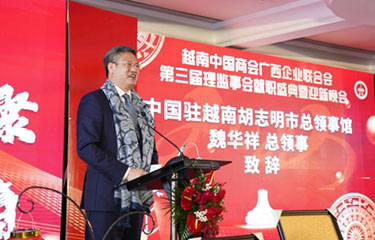
Photo courtesy of China Consulate General in Ho Chi Minh City
