






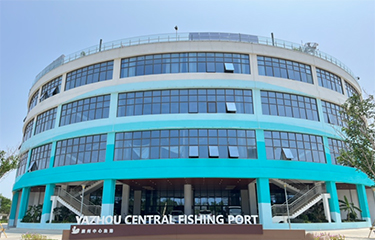
The opening in late April of a large sea leisure facility on the island of Hainan could be a sign China’s seafood market is rebounding.
The state-owned China Railway Construction Group built the Yazhou Central Fishing Port, what some have termed Hainan’s “largest sea leisure center.” The facility includes a 29,647-square-meter seafood trading center with a hotel, a shopping street, and restaurants featuring fresh seafood in the popular tourist city of Sanya.
Timed to open for the weeklong May holiday and operated by the local government, the imposing new structure has tested the market for seafood and consumer spending at a time when domestic tourism has returned to some semblance of normalcy.
The new sea leisure center opened when seafood imports, in terms of volume, have surged this year in China. In the first quarter, China’s imports of chilled and frozen Atlantic salmon jumped 53 percent, half of it from Norway.
“The price of Atlantic salmon imported by China has risen year on year, especially in March,” said Vanessa Jiang, supply chain manager at the China Supply and Marketing Agricultural Production Wholesale Market Holding Co. Ltd. (CAWM) West Coast Market in Qingdao.
Jiang told SeafoodSource she sees signs of restocking by Chinese importers who held off on purchasing during the pandemic due to weak demand and fears of possible product detention at ports. For example, imports of frozen warmwater shrimp hit a five-year high in monthly measurements in March, according to Jiang, with over 100,000 metric tons arriving at Chinese ports. In total, 81 percent of the imported volume came from Ecuador, which supplied 83,000 metric tons imported.
That restocking is a direct result of demand, which Qingdao-based importer Joe Qiao told SeafoodSource is steady but not spectacular.
“Sales are solid, but consumers remain worried about the economy,” said Qiao, head of Qingdao-based Meichu Foods, which focuses on frozen imports and sells under the Wo Ai Yu brand.
Structural demand for seafood will remain strong in China, Qiao predicted, due to a falloff in local supply.
“China is short on seafood; It was number one for farming fish, but now, this has peaked and is going down,” Qiao said.
For that reason, Qiao traveled to Seafood Expo Global (SEG) in Barcelona, Spain, in April, to look for more suppliers who can partner with his firm to expand sales in China.
“We are looking for suppliers to develop the Chinese market together,” he said. “Financing is very expensive in China, so we want a supplier who can help us expand. We’re looking for all kinds of products: salmon, cod, mackerel, etcetera.”
There are, however, signs of weaker demand driving an unequal recovery. The feeble state of China’s economic recuperation is hindering demand for pangasius, according to Jiang.
“There are three months of reserves to be eaten through” before pangasius imports will return to levels seen before the pandemic, she said.
That suggests slower demand at the lower end of the market given pangasius has long been a staple of the mass consumer market in China, used by catering chains and in frozen meals popular with low-wage workers.
Recent economic data also suggests lessened pricing power in China, with the consumer price index weak compared to the rampant inflation seen in Western economies. China’s CPI rose only 0.7 percent in March. Seafood prices dropped 0.2 percent year over year while rising 1.3 percent month over month.
The data appears to concur with what Jinyue Dong, chief China economist at Spanish banking group BBVA, emphasized in a recent research note as “atypical deflation,” with prices slipping even as GDP growth picks up.
While China’s GDP growth hit 4.5 percent for the first quarter of this year – above the 3.2 percent predicted by BBVA – compared to 2.9 percent in the last quarter of 2022, the government’s priming of the economy has largely focused on state-owned enterprises rather than consumers and smaller businesses, explained Dong.
That relative lack of government support for private businesses resulted in the pandemic seriously harming or destroying many of the smaller-sized importers who experienced the harsh effects of restrictions and border checks, according to Didier Boon, head of East China Seas, a seafood trading firm in Beijing.
“[Private companies] couldn’t pay suppliers. They weren’t able to make orders in case the shipments were seized at the port,” Boon told SeafoodSource. “State-owned companies didn’t have the same problem; They, in any case, had the ability to survive.”
With many of his former Chinese clients now out of business, Boon is focusing on a range of dry and canned seafood products, as well as catering supplies for Asian restaurants in Europe, the U.S., and Latin America.
In terms of future growth, Qiao sees two trends driving the Chinese seafood market. At the higher end of the market, Chinese supermarket chains are increasingly keen to increase their trade in imported seafood, which they identify as a route to higher profit margins. At the lower end of the market, Chinese processors will continue to emphasize value-added products for the domestic market in place of exports, he said.
“Local companies are chasing higher margins, so they’re focused on seafood meals and convenience products,” he said.
Chinese seafood companies are also trying to add value in the domestic market because export demand remains constrained by inflation in the E.U. and the U.K. where, in contrast to China, prices continue to climb.
Photo courtesy of China Railway Construction Group
