






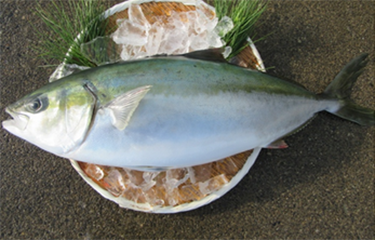
The popularity of “burihara,” a yellowtail crossbreed originally developed in 2017 by Kindai University in Hagashi-Osaka, has begun to skyrocket in Japan, with supermarkets and sushi stores drastically increasing their sales of the product nationwide.
Burihara, which is the offspring of a female “buri,” or yellowtail (Seriola quinqueradiata), and a male “hiramasa,” or yellowtail amberjack (Seriola lalandi), is the byproduct of an agreement six years ago to promote sustainable aquaculture and marine products. The arrangement between Beisia, a supermarket chain with 130 stores; and Shoku En Co., a company affiliated with Kindai University, quickly led to the university developing the crossbreed.
Soon after development, Beisia began to offer burihira in its stores, starting with 1,000 fish in 2018 and increasing to 15,000 in 2019, 20,000 in 2020, and 50,000 in 2021. This year, Beisia is further expanding the sales volume to 80,000 fish.
“By actively selling fish species raised … using artificial seedlings, we hope to contribute to environmentally friendly initiatives such as reducing food loss and securing marine resources,” Beisia said.
Buri is fatty, with a rich umami flavor. However, its meat is soft, and the dark muscle portion of the fish tends to discolor quickly. Hiramasa, meanwhile, is lean, has a light taste with a crisp texture, and is resistant to discoloration. The crossbred burihira combines the rich taste of buri with the crispness and color retention of hiramasa.
Though such crosses occasionally occur in nature, they are typically too rare for commercialization. The university, capitalizing on the unique flavor profiles of both parent fish, has registered the name “Burihara” as a brand.
This is not the first time Kindai has experimented with fish production. In fact, the university is famous for developing a closed-cycle bluefin tuna production process.
As the university, also referred to as Kinki University, raises juveniles from eggs in its nursery, the production does not deplete the stock of wild juveniles. This is not as much of a concern for yellowtail as it is for bluefin since the number of “mojako,” or juvenile yellowtail, is usually at healthy levels. However, a rare shortage last year resulted in reduced stocking of net pens and lower harvests this year.
Nevertheless, burihira production has expanded using artificial seedling technology, and the newest twist on burihira is the use of a natural antioxidant in the fish feed used to sustain the crossbreed: acerola.
A popular ingredient in Japanese beverages, acerola provides tartness similar to cranberries or sour cherries while also having a strong antioxidant effect. Acerola pomace is a processing byproduct of the ingredient, and it contains large amounts of vitamins C and E, among other nutritious compounds.
Tokyo-based Nichirei Foods is the world’s leading dealer in acerola products, and the company started joint research with Kindai University to use the acerola pomace in fish feed to improve the aftertaste of cultured fish and maintain its quality. When fed to fish, it also delays discoloration of the meat.
Beisia trialed sales of acerola yellowtail in January 2021 and of acerola red sea bream in October 2021. Full-scale sales of the latter started in February 2022, and from January 2023 until now, Beisia and Nichirei extended this to acerola burihira.
The supermarket chain sold the product, which the store fully titled “Acerola burihira born in Kindai,” in “saku” blocks or sashimi slices. A “saku” loin block weighing 100 grams sold for JPY 537 (USD 3.81, EUR 3.49). Six slices of sashimi sold for JPY 429 (USD 3.05, EUR 2.79), and a six-piece sushi set sold for JPY 645 (USD 4.58, EUR 4.19).
Sushi stores have also featured the crossbreed.
Kura Sushi, based in Saki City, Osaka Prefecture, was the only conveyor-belt sushi chain to sell burihira when it first introduced the fish on a limited basis in November 2022. After its initial success, it began to feature burihira in all of its stores nationwide from January through February of this year, extending the volume and period of the offering.
The product has also been available for home deliveries, with the country’s largest delivery sushi company, Tokyo-based Gin no Sara, first using the product as a limited-time offering in 2022. The company secured enough raw fish for 20,000 nigiri sushi and started handling them at stores nationwide in September but became inundated with orders, causing several stores to sell out before the end of November.
Photo courtesy of Beisia Co.
