






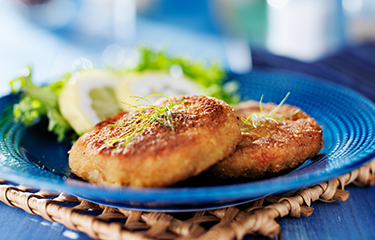
High prices have pushed down demand for pasteurized crabmeat in the United States.
Rob Kragh, the vice president of category management at Chicken of the Sea Frozen Foods, said at the National Fisheries Institute’s Global Seafood Market Conference, held from 17 to 19 January in Palm Springs, California, U.S.A., that high prices have influenced demand “and really slowed it down.”
“Consumers started looking at some of these prices and started making alternative choices,” he said. “Major restaurant chains, while they'll have crab meat or crab cakes on their menu, they're not promoting it, which can increase movement two to three times, which is massive. And people in large restaurant chains, they're working farther in advance, so crabmeat is not going to be really promoted until pricing is to a point where it makes sense for them. Once it makes sense, then restaurant chains will look at it again.”
Crabmeat imports were up 38.8 percent in 2022 through June, but by November, they were down 3 percent year-over-year.
“We were pretty excited about crabmeat imports in the first half of the year. People were going back to the store, Covid was getting a little lighter. We thought people are going to go into restaurants. Everyone was importing crabmeat as fast as they [could],” Kragh said. “Then what happened on October? Imports were down 50 percent … Imports starts slowing down and we're canceling or slowing down the production overseas.”
The price of jumbo red crab meat from China soared to USD 55 (EUR 51) per pound in the middle of 2021 and remained at around USD 20 (EUR 18) per pound through 2022, while jumbo blue crab meat from Southeast Asia rose as high as USD 45 (EUR 41) per pound at the height of the market in December 2021 and January 2022 and has arced back down to USD 25 (EUR 23), according to Urner Barry data shared by the GSMC shellfish panel. Claw meat hit USD 17 (EUR 16) per pound in December 2021 but has slid down to USD 9 (EUR 8).
“We're competing for high-end dollars, and the going right now for premium items is a little tough,” Kragh said. “Also being a high-dollar item, when you start looking at interest rates, it can really touch on crab on crabmeat. If you’re looking at 7 or 8 percent interest rates on a product that sits around for an extra one, two, three months, all of a sudden a lot of that profitability for that importer is going to go out the window and mistakes are going to become more costly.”
Additionally, there’s a time lag on crabmeat coming from Asia that doesn’t necessarily affect other high-dollar seafood species popular in the United States, according to Kragh.
“With crabmeat. I got three weeks of reducing product. I’ve got to get it on to a container, which at times since last year has been difficult. I’ve got to get a ship that can get it. I’ve got to get that ship to bring it here to the U.S. and hopefully my ship doesn't have to transfer to Singapore or some other place and get delayed there. And then I got to get into L.A. or New Jersey. I’ve got to get it out of the port, and ports are a little slow getting containers out. I got to find space in a cold storage and find one of my carriers who's willing to pick it up, get an appointment and get out of the port. And then I’ve got to ship it someplace. So all of a sudden my time lag … we're looking at three weeks to six weeks,” he said.
Kragh called the current yo-yoing of prices and availability “a little frightening.”
“It's going to take a little more time for crabmeat to get un-hungover. We need some balance here. we have a habit of this business, because it's high dollars, of slowing down fast because our problems get costly, and with higher interest rates our problems are getting more costly,” he said. “You’re going to see importers pushing their customers for better projections and better forecasts. I expect we’ll see the importer and the customer work a little closer together.”
Despite the current lag in demand and instability in the market, Kragh said he’s optimistic the market is at its nadir and will soon improve.
“I still think we're in a somewhat of a margin imbalance,” Kragh said. “We're eventually going to hit a bottom and then … will bounce up a little bit. I think we found that equilibrium point here.”
Troy Turkin, the chief operating officer of Weston, Florida, U.S.A.-based Supreme Crab and Seafood, agreed with Kragh’s diagnosis of the current state of the crabmeat market.
“When we started getting into 2022 there were a lot of containers that were being held up and we didn't even get some of the deliveries until the next month, with all the other containers [we had ordered]. So we ended up having a pretty high inventory here in the U.S. right at nearly the peak of [pricing]," Turkin said. "Since then, [the price] has been coming down dramatically. I think we're getting pretty close to back to normal now.”
But Turkin said more speedbumps could be in store for the crabmeat market in 2023.
“Unfortunately, crab over in Indonesia, at least right now, are not as plentiful,” he said. “Buying has started picking up a lot within the last 10 days and raw material costs have actually gone up. I don't want to put fear in anybody's mind, but realistically speaking, by summertime there's a chance of having a shortage.”
Indonesia makes up 42 percent of the global crabmeat supply, which is down from 54 percent in 2020 but still significant, Turkel said. The rest of the supply is split between Venezuela (14 percent), China (10 percent), Philippines (10 percent), Vietnam (9 percent), India (7 percent), Mexico (3 percent), and smaller producers such as Sri Lanka, Thailand, and Tunisia.
Due to a decline in demand and difficult economic conditions, between 30,000 and 50,000 crab fishermen have stopped fishing, Turkin said.
“So if demand in the U.S., which has been sluggish, does start to increase more consistently what's going to happen is, there's not going to be enough people to go ahead and produce it, because it might take six months to get workers back in and trained and really be efficient,” he said.
Photo courtesy of Joshua Resnick/Shutterstock
