





Choshi, Japan-based seafood trader Iida Suisan, which mainly deals in sardines and mackerel, is considering a move into processing as environmental changes continue to cause catch variability.
Iida Suisan sells about 80,000 metric tons (MT) of fish per year – about half in Japan and half overseas – and the majority of its sales are bulk fish packed by other local processors. Most of its products are sourced locally, as Choshi is the country’s top fishing port by volume, and the majority of the port’s catch is made up of lower-value species like sardines, mackerel, and horse mackerel.
Hikari Iida, who works in the company’s sales department, is the daughter of the owner and founder, Hirohiko Iida. She told SeafoodSource that her father set up his own company in 2006 after Yahachi Suisan, the Sendai-based fishery trading company he had been working at, closed.
That previous company did the packing, but the new company, Iida Suisan Sales Manager Yuki Omori told SeafoodSource, has largely been trading in frozen fish, with sardines making up the bulk of its sales.
Iida Suisan exports container loads of frozen sardines to Southeast Asian countries such as Thailand, Malaysia, and Vietnam for canning as oil sardines. It also ships sardines to Australia for use as feed for farmed Southern bluefin tuna, and to South Korea for use as feed for olive flounder.
Sardine catches have increased dramatically, Iida said, possibly due to changes in the ocean environment related to climate change.
The prevalence of sardines is causing issues for Japanese fishermen, as sardines school higher up in the water column, and since the fishing nets are operated near the surface, the majority of the catch so far this year has been sardines. While mackerel are still present, they are moving deeper to avoid the sardines.
Japan imports mackerel from Norway while exporting its own mackerel. Omori said that’s because the Japanese prefer a larger size, so the smaller domestic mackerel are exported at low prices, while larger ones are imported and sold at higher prices.
“We’re not getting much mackerel this year, but when we do, we ship a lot of that to Africa,” Omori said. “It’s popular because it’s cheap and the quality of the mackerel packed in Choshi is good.”
While typically Africa is a large market for Iida Suisan’s mackerel, the poor mackerel catch this year is causing even the small domestic mackerel to be priced higher than imports from Norway. As a result, and because of higher shipping costs related to Covid-19, Africa has been priced out of mackerel. Since Africa is far from Japan, the shipping costs are high and the price is no longer suitable for Africa.
The warmer water has also resulted in landings of fish the company previously rarely saw at Choshi’s docks.
"We’ve also been getting some unusual fish, like chibiki [golden redbait, Emmelichthys struhsakeri], which are usually found off Okinawa,” Iida said. “We’re also getting a lot of tachiuo [largehead hairtail, Trichiurus lepturus] this year — that’s a fish that is not usually caught, but we’ve been getting it steadily this year. They were brought up again today, too.”
The company sells the new species, but has had to find different markets for them as inflation in seafood pricing has reduced the domestic market.
“We sell tachiuo, and it’s an expensive fish, but since last December it’s all been going to export, because domestic customers can’t afford it,” Omori said.
All of the competing factors have led the company to start making plans to launch its own processing operation. While the company is currently mainly trading rather than processing, it recently added a new office building and a small processing facility to its existing freezer building.
“Considering that the trading business is subject to variability in the catch, we’d like to get into the processing side as well – not to take business from the existing local processors, but by developing new products,” Iida said.
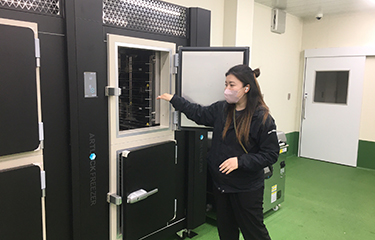
The company does have some advantages with its equipment, especially in its freezing technology, Iida said. The company installed a “3D freezer,” a blast freezer with several multidirectional fans capable of quickly lowering the temperature to minus-40 degrees Celsius.
Staff members are also testing the processing of yari ika (spear squid, Loligo bleekeri) and sorting of raw sardines by size and freshness. The company said a promising product under development is semi-dressed (de-scaled, guts and gills removed) splendid alfonsino.
“It’s a famous fish for this area,” Iida said. “So little by little, we’re developing products using this and sending samples to potential buyers to get feedback.”
Photo by Chris Loew/SeafoodSource
