






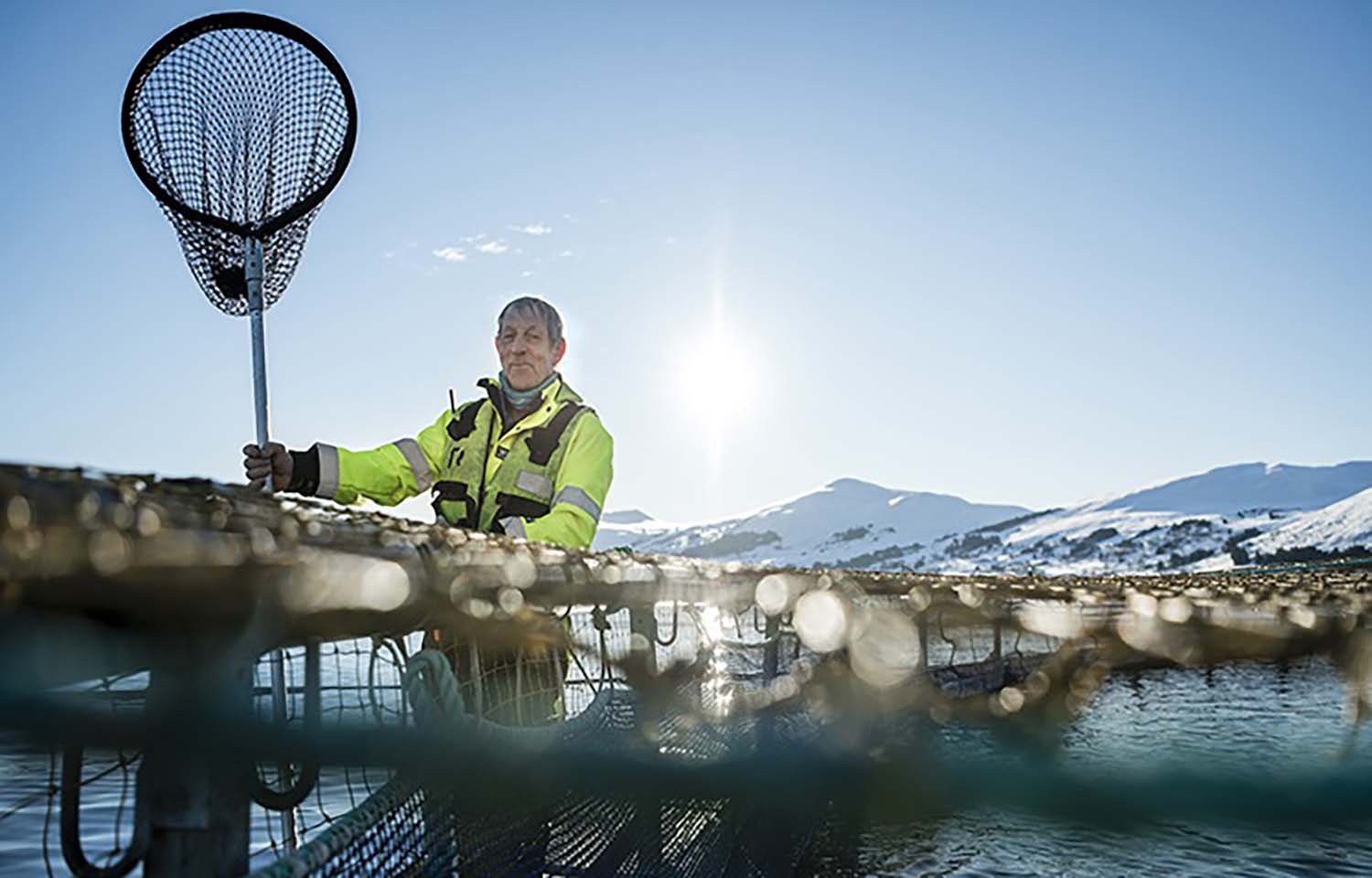
Winter sores, severe string jellyfish incidents, and an unusually cold and stormy winter led to a challenging Q1 2024 for Mowi Norway, though the company’s other farming areas recorded much better performances, according to Mowi CEO Ivan Vindheim.
Delivering the salmon company’s quarterly results in Bergen, Norway, on 8 May 2024, Vindheim said Mowi Norway faced much tougher environmental conditions than the group’s largest production region typically does.
“This impacted both our price performance and cost performance significantly in the quarter in the form of a higher share of so-called ‘production fish,’ in addition to lower average harvest weights,” he said.
Mowi’s other farming geographies, conversely, experienced good biology in the first quarter, and Vindheim said there continued to be strong demand and prices for Mowi’s salmon in Europe.
“Regrettably, though, we still see soft prices for salmon in the American region after a promising start to the new year,” Vindheim said. “It looks like the cost-of-living crisis has a greater impact on the U.S. market than other markets.”
Mowi has been through periods of price divergence between the American and European salmon markets before, Vindheim said.
"History will repeat itself, with a price convergence once the dust settles," he said. "It’s not a question of if; it’s a question of when."
Vindheim said Mowi is expecting a similar Q2 2024, with seasonally impacted low harvest volumes and high costs, including continued knock-on effects of Mowi Norway’s winter sores. With signs of improved biology and falling feed prices, production costs can be expected to come down some time in the second half of this year, Vindheim said.
Vindheim expressed optimisim Q2 2024and coming winters will bring improved biological conditions to Mowi's salmon in Norway.
“For next winter, we’re now vaccinating all our fish in Norway with a new and more effective [winter sore] vaccine, which is an important preemptive measure,” he said. “We are also taking further preventative measures at sea, and we are also looking at upgrading our capacity on land. Hopefully, this winter was an example of a perfect storm and a low point in terms of winter sores for Mowi Norway.”
Mowi harvested 96,500 metric tons (MT) of salmon in Q1 2024, leaving a seasonally record-high biomass in the sea at the period’s end. This, combined with improved biological performance in Mowi Norway thus far in Q2 2024, has the group still on course to achieve a record target production of 500,000 MT by the end of the year. If realized, this would correspond to an increase of 5.3 percent year over year.
“That means, once again, our growth rate will surpass that of the industry by a large margin,” Vindheim said.
Both Mowi Consumer Products and Mowi Feed delivered a good quarter, according to Vindheim.
"On balance, we landed on our feet after a quarter which will go down in history as one of our more challenging quarters," Vindheim said.
Mowi recorded revenues of EUR 1.13 billion (USD 1.2 billion), down 2 percent from the corresponding period of 2023. Higher costs and lower achieved prices pushed Mowi's operational earnings before interest and taxes (EBIT) down 38 percent year over year to EUR 200.5 million (USD 215.5 million).
Mowi Norway produced 54,711 MT of gutted-weight salmon in the three-month period, compared to 65,627 MT in Q1 2023. Operations in Scotland contributed 14,205 MT, Chile at 12,546 MT, Canada at 8,796 MT, the Faroes at 2,627 MT, and Iceland (Arctic Fish) at 2,531 MT, and Ireland at 1,078 MT.
The group’s secondary processing business, Mowi Consumer Products, recorded an operational EBIT of EUR 24.4 million (USD 26.2 million) and operating revenue of EUR 896.5 million (USD 963.6 million). The division sold 55,335 MT of products in the quarter, but the segment’s earnings were reduced due to a more challenging U.S. market and tighter margins in Europe.
Mowi Feed recorded Q1 2024 sales of 97,918 MT and an operational EBIT of EUR 1.7 million (USD 1.8 million). Its revenues for the period totaled EUR 197.4 million (USD 212.2 million). Reduced volumes in Norway – due to the unusually cold winter – were more than offset by higher volumes in Feed Scotland, including volumes to Mowi Ireland, the Faroes, and Iceland.
Peru's first anchoveta season, which commenced with a “higher than normal” quota of 2.7 million MT and good yields thus far, will help the company achieve better fish oil and fishmeal prices, Vindheim said.
