

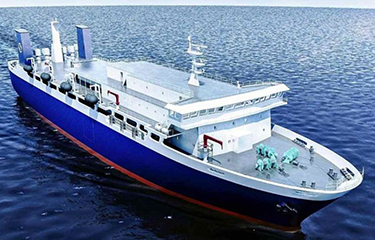
Tokyo, Japan-based Kyodo Senpaku is set to replace its aging mothership with a new model, signaling Japan’s continued commitment to whaling.
Kyodo Senpaku the only company in the world still employing the mothership system of whaling. The system uses more agile ships to hunt for whales, which then transfer carcasses onto a mothership for freezing and storage instead of bringing them to land-based storage facilities. Kyodo Senpaku’s soon-to-be-retired mothership, the Nishin Maru, returned from its final voyage on 4 November to its home port of Shimonoseki in the country’s southwest Yamaguchi Prefecture for a retirement ceremony, and on 7 November, the ship’s crew unloaded 2.1 metric tons (MT) of whale meat, which was auctioned off soon after.
The company’s replacement vessel, the Kangei Maru, still requires interior work but is slated to be ready by March, giving the company a buffer of time before the 2024 whaling season kicks off two months later in May.
Kyodo Senpaku originally carried out contractual whaling in Antarctica for the Japanese Institute of Cetacean Research from 1987 to 2018, ostensibly for scientific research purposes.
However, after Japan pulled out of the International Whaling Commission (IWC) in December 2018 due to disagreements on the future of the whaling industry, the company rebranded as a full-blown commercial whaling corporation, and Japanese authorities stated that its fleet would be allowed to conduct commercial hunts solely within its own exclusive economic zone (EEZ), rather than in the Antarctic and North Atlantic as it had been doing prior.
The mothership method of whaling was conducive for distant-water whaling in remote Antarctica, but some question whether hunting for the current smaller quota of whales allowed within Japan’s EEZ will produce enough revenue to justify the construction of a large new vessel. Considering this, Kyodo Senpaku’s investment in a new mothership may hint that the company expects a potential uptick in future whaling allowed by the government.
The Japanese government could go about this in a few ways, including issuing quotas for larger fin whales. As these are less abundant than other whales, such as the Bryde’s and sei whales that are more commonly hunted within Japan’s EEZ, allowing hunts for this species would heavily depend on scientific stock assessments. The larger size of the Kangei Maru may indicate the company is hoping the government grants hunts for larger species in the future.
The range of the Kangei Maru is also sufficient to reach the Antarctic, which keeps this option open for Kyodo Senpaku if the Japanese government decides to eventually allow these types of long-distance ventures again.
“We want to contribute to food security in Japan, and we thought it would be useful in times of food crisis; so, we designed it so that it can go to the Southern Ocean,” Kyodo Senpaku President Hideki Tokoro said.
Securing governmental approval to hunt for larger species and conduct long-distance hunts is one challenge, but another for Kyodo Senpaku is securing demand in an era when many Japanese citizens have never eaten the product.
Through marketing efforts, including the use of social media influencers who can target younger Japanese consumers and selling whale meat in Osaka and Tokyo through vending machines, the company hopes to boost consumption, despite pushback from environmental groups like Whale and Dolphin Conservation.
Whale meat accounted for as much as 45 percent of Japanese meat consumption in the years immediately following World War II, but in 2022, the amount sold totaled 1,000 MT.
If Kyodo Senpaku is to turn a profit with its new vessel, the company needs to drum up demand, which would, in turn, increase the sales price of whale meat. According to a Yomiuri Shimbun report, the average wholesale price of whale meat in 2020 was JPY 711 (USD 4.72, EUR 4.34) per kilogram due to low sales numbers. However, in 2021, it slightly exceeded the JPY 1,200 (USD 7.97, EUR 7.32) level that the Japanese Fisheries Agency has suggested is the breakeven point for the industry.
Besides Kyodo Senpaku, there are four other whaling companies in Japan, all of which focus on smaller whale species they can haul onto a catcher vessel and carry back to base stations for processing. These companies are attempting to continue operations in an industry that has slowly petered out throughout the world. The only countries still actively engaged in commercial whaling are Japan, Norway, and Iceland, though permanent bans on the practice are under consideration in the latter country.
Photo courtesy of Kyodo Senpaku Kaisha
