






The Namibian government has opened a fresh round of bidding on its quota of monkfish, with officials putting 600 metric tons (MT) up for sale to raise revenue that would go toward financing the country’s federal budget – despite the mixed performance of its fishing quota auction program since it was implemented three years ago.
Namibia introduced its fishing quota auction scheme in 2020 shortly after the infamous cash-for-quota corruption case, popularly known as the “Fishrot” scandal – that occurred between 2014 and 2019 – became publicized.
The scandal involved several Namibian government officials allegedly receiving millions of dollars in payoffs from Icelandic fish-processing company Samherji in exchange for fishing rights initially allocated to Namibia’s state-owned fisheries company, the National Fishing Corporation of Namibia (FISHCOR).
After the emergence of the scandal, the Namibian government instituted what it deemed to be a more transparent process in the quota auction program, which specifies that local operating companies are entitled to 40 percent of sold government quotas.
However, since 2020, the program has faltered as the government continues to struggle to regain the confidence of seafood industry investors.
During the first auction in August 2020, just 1.3 percent of government-held fishing rights and quotas were sold, with the Namibian Ministry of Fisheries and Mineral Resources attributing the dismal performance to the participation of bidders who were not “necessarily existing in the fishing industry with most, if not all, not owning vessels.”
“In the future, punitive measures will be introduced including requirements for payment guarantees or bid securities before participation in the auction,” Finance Minister Iipumbu Shiimi said at the time.
The government also ascribed the poor performance to short timelines associated with payments and for harvesting the quota.
Learning from previous mistakes, Namibia's subsequent auctions have fared better. In 2021, the country held six auctions for government-held fishing quotas, generating NAD 567 million (USD 29.9 million, EUR 27.8 million) for the country’s exchequer.
“Such an outcome confirms auctioning as a good mechanism to facilitate price discovery in the sector and allocate natural resources to the market,” Shiimi and Namibian Fisheries and Marine Resources Minister Derek Klazen said in a joint statement at the time.
This most recent round of monkfish bidding is the second auction conducted by the Namibian government this year, following the March 2023 horse mackerel sale of 28,500 MT that raised NAD 52.3 million (USD 2.76 million, EUR 2.57 million) for the country’s treasury.
The outcome of 2023’s monkfish bidding, which opened on 4 September and closed on 15 September, will become public at the end of September, according to a joint statement from the Ministry of Fisheries and Marine Resources and the Ministry of Finance and Public Enterprises.
The latter ministry will determine and allocate the quota, with the highest bidders prioritized until the government sells the entire 600 MT, which is less than the 1,000 MT Namibia put on sale in the previous monkfish auction held in July 2022. Only bids quoting the lowest clearing price of NAD 1,000 (USD 52, EUR 49) per MT will undergo governmental consideration.
Successful bidders will pay the full amount of their accepted bid and receive an award notification from the Ministry of Finance and Public Enterprises upon their bid’s finalization.
“Successful bidders who fail to settle the amount payable as per the bid allotment will forfeit the bid security deposit advanced to participate in the auction or the bank will be liable for the amount on which they issued the bank guarantee,” a Ministry of Finance statement said in an attempt to thwart speculative bids that bogged down previous auctions.
Other stipulations surrounding Namibia’s quota auction program include both local and foreign bidders who submit successful bids complying with statutory regulations, such as ensuring that fishing vessels licensed in accordance with the government of Namibia are the ones conducting monkfish harvesting.
Additionally, Namibian citizens must comprise at least 90 percent of the crew aboard the fishing vessels of successful bidders, as part of the government’s effort to create more job opportunities for locals.
The auction precedes the country’s next fishing season that commences at the end of September 2023 and ends on 30 April, 2024, according to the Ministry of Fisheries and Marine Resources.
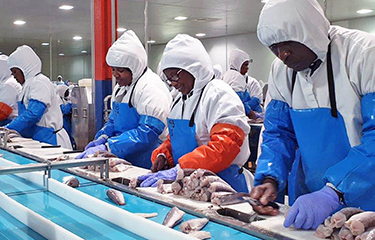
Photo courtesy of the Marine Stewardship Council
