



Nigeria is working to increase both the quality and quantity of its seafood exports, especially those destined for E.U. and U.S. markets, where sales of some of the African country’s fish products are currently restricted.
To accomplish this, Nigeria – Africa’s most-populous country, with over 220 million people – is planning to boost its domestic fish production by reviving and revamping the country’s One-State-One-Product (OSOP) program.
The OSOP program is modeled on Japan’s One Village One Product initiative, which was launched in 1980. It aims to empower local governments by adopting one non-oil product in each of the country’s 36 states that would then undergo enhanced development down its value chain. The program is designed to entice foreign importers to invest in diversifying the country's economy, thereby reducing its economic dependency on oil exports. The program also hopes to enhance competitiveness and foster socioeconomic inclusion by supporting artisanal production.
Nigeria has identified fisheries and seafood products in the states of Adama, Akwa Ibom, Bayelsa, and Lagos as ideal for the OSOP program.
“[The program] is carefully selected to prepare the exporters of seafood to take advantage of the increasing demand and market share for [their products within] the international market,” Nigeria Export Promotion Council (NEPC) Director-General Ezra Yakusak said.
The NEPC, which is a federal government agency with the responsibility of promoting non-oil exports in Nigeria, hopes that through the OSOP program, the country can improve the quality of its seafood production and overcome plongstanding hurdles to aquaculture development such as a lack of financing, high input costs, and low quality of fish seed.
In partnership with the Nigerian Federal Department of Fisheries, NEPC has been training fish farmers, processors, marketers, and exporters on how to address concerns raised by food safety authorities in the U.S. and the E.U., with the goal of producing seafood that meets their standards.
In 2018, the U.S. Food Safety and Inspection Service (FSIS) suspended imports of catfish and other fish products from Nigeria after the West African country’s fisheries department failed to fully supply information requested in the FSIS self-reporting tool prior to its due date. The tool is used to obtain information from foreign countries demonstrating their documented food safety inspection systems achieve a level of public health protection equivalent to the FSIS inspection system’s standards.
“Consequently, Nigerian catfish farmers and processors lost the market opportunity for smoked and packaged catfish,” the FSIS stated at the time.
NEPC has been working closely with seafood value chain players to address the issues raised by the FSIS on catfish exports to the U.S., as well as constraints currently placed on increasing Nigeria’s share of seafood exports to the E.U.
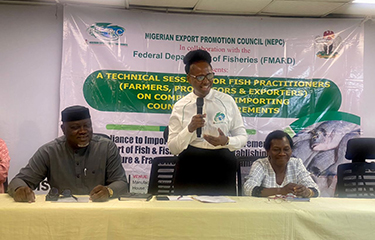
In late July, NEPC’s Product Development Department, working with Nigeria's Federal Department of Fisheries, organized a technical session for all “fish practitioners” in Nigeria to band together to address “the identified constraints militating against the export of fish and fishery products from Nigeria to the E.U. and U.S.A.”
The export restrictions placed on Nigeria’s seafood to the E.U. and U.S. solely concern catfish and smoked fish, but other seafood such as shrimp and wild-caught fish, though allowed, are also under stringent regulations from both markets.
Nigeria’s fish production, the largest in West Africa, averages 1 million metric tons (MT) a year, 75 percent of which – or 759,800 MT – stems from aquaculture. Only 10 percent of domestic fish production is exported.
Production lags behind Nigeria’s average annual seafood consumption, estimated at 1.77 million MT in 2022.
A report from the Economic Community of West African States (ECOWAS), a regional political and economic union comprising representatives from 15 countries in West Africa, including Nigeria, projects the country’s consumption to increase to 1.79 million MT in 2023 and 1.83 million MT in 2024.
Nigeria, with its per-capita seafood consumption of 13.3 kilograms annually, is already one of the top seafood importers in West Africa, importing approximately 484,000 MT of seafood in 2022.
The Netherlands is the top non-ECOWAS seafood seller to Nigeria, comprising 24 percent of seafood imports in this category, ahead of the Faroe Islands, with 11 percent; Chile, with 11 percent; Ireland, with 10 percent; and Japan, with 8 percent. Other non-ECOWAS seafood markets supplying Nigeria with fish and fish products include Mauritania, with 6 percent; Russia, with 5 percent; Norway, with 5 percent; and China, with 4 percent.
Photo courtesy of the Nigerian Export Promotion Council
