





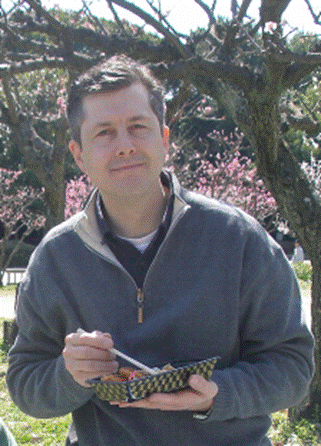
Norwegian Seafood Council (NSC) Director for Japan and South Korea Johan Kvalheim talked to SeafoodSource about two campaigns for airflown fish he has been involved in since he took up the post in December 2020. For airflown mackerel, the NSC worked with the Tokyo-based importer, JALUX, in a campaign called “Mackerel Nouveau,” a play on the fresh Beaujolais Nouveau wine so popular in Japan. Additionally, the Aeon supermarket chain will be selling airflown skrei (Norwegian Arctic cod) this year at 60 of its 350 locations across Japan from 20 January. Depending on sales trends, the Chiba, Japan-based chain plans to import 15 to 20 metric tons in the first year. Kvalheim worked with the Norwegian Embassy and Bergen, Norway-based supplier Lerøy Seafood to set up the deal.
SeafoodSource: What is Saba Nouveau, and what is the campaign surrounding it about?
Kvalheim: This is the fresh mackerel that we introduced to Japan in 2021. Saba Nouveau is the brand. That is owned by JALUX. When we talk about it in general, it’s about the fresh mackerel from Norway – airfreighted fresh mackerel. That’s joint marketing that we did together with JALUX in 2021, we had the first mackerel arriving. And then we had it again last year in September, and we had the second launch of Saba Nouveau.
This is fresh mackerel, and by far – 99 point something percent – of all the mackerel going into Japan is frozen. So this is a little niche – a good story.
So they are the ones that go every year ... and one of these guys, he was looking at it fresh and he said, “Why don’t they sell it as fresh?”
And then the Norwegian’s said, “No, that’s going to be too expensive, because you have airfreight instead of cargo freight.” But the concept was that this is available only for a limited time. The fresh mackerel caught in the prime season is only available for a month or two months and then it’s gone.
SeafoodSource: What market segment is the target of the airflown mackerel?
Kvalheim: They are going into the high-end retailers. You have a different product for a limited time and you charge a higher price to cover the cost of freight. So it is a higher-priced product, but that’s what we’re seeing in mackerel in Japan. Mackerel is seen as reasonably priced, especially now, when everything’s getting expensive. Mackerel has a very favorable price, but at the same time there is a market for someone who wants to have an upscale mackerel product. And that is the niche that the Saba Nouveau, the fresh mackerel from Norway, is coming into.
And we see it also in the canned products. You have regular canned mackerel products, and you have high-end canned products. If you have more money, you’re willing to pay a higher price for a product and better story, then you pay it.
SeafoodSource: What was the NSC’s role in setting up the skrei promotion?
Kvalheim: Aeon was in contact with us when I came [on] in 2021, and they were looking for new species or new stories from Norway. They had seen the “Saba Nouveau” and they really liked the concept, and they were wondering if there were other stories from Norway that could make them differentiated in the market.
Then I introduced them to the skrei – the story of the skrei. And this is probably one of our best-hidden secrets, except for in Europe. So I told them how this fishery is managed, the long history we have, and also how we have launched the skrei in Spain, France, and in the U.K. I had one of the quotes from the U.K. that this was the “Rolls Royce of cod.” I think that was one of the things that were like, “Wow! We should try it.”
SeafoodSource: So Aeon wasn’t just looking for a good product at a good price, but a story it could tell?
Kvalheim: Yeah, it was the story, and it was a product that was different to what they normally have in their portfolio. But I told them this story in the fall of ’21 and then, of course, the proof is the pudding, so we needed to show them the product. So, last year in March, we invited them for lunch at the [Norwegian] ambassador’s residence to taste the skrei. And we managed to get a skrei to Japan, and they tasted it, and they were very impressed by the quality.
After tasting it, and after knowing more about the product, they said, “This is something we want to try. We’re going to launch that in 2023.”
The challenge is to make sure that we have efficient logistics. That’s why Lerøy was brought on board on this. The project, financially, is not driven by the [Norwegian] Seafood Council, because we don’t have a budget for cod in Japan. So, we needed to have a partner on board, and that was Lerøy saying, “We’ll go in and do joint marketing.” So, in joint marketing with the NSC, we finance up to 50 percent of the project, the same as we did with JALUX for their Saba Nouveau. We can go up to a maximum of 50 percent, and then the exporter/distributor has to take the rest of the investment on their shoulders.
So with them on board, we knew that we had the logistics in place. Lerøy is one of the biggest suppliers of salmon to Aeon, so that’s why it was natural for them to also supply the skrei. And then from March last year to January this year, it was all about planning and logistics: making sure that we have the material in place, translation of all the material that we have made for Europe, making them available also in Japan.
So after this launch, I know that other exporters and other importers have started to buy skrei from Norway also, and that’s the whole point. Aeon is national, they are big ones, and they have an impact on the market. Together with their PR team, we made it a high visibility launch in Japan that generated a lot of interest from other distributors and importers, and hopefully this will be a good success so that we continue on next year, and the next year then. If this year is good, then hopefully we will get a budget from the Seafood Council, so that we can do a generic promotion of skrei into Japan.
We have set aside a budget for joint marketing, so any exporters that want to launch a product, that want to do activities, if they finance above 50 percent themselves, we can go in and finance the rest. But we don’t have a generic marketing budget in Japan.
SeafoodSource: Japanese consumers are probably familiar with Pacific cod. How does skrei compare?
Kvalheim: It doesn’t compare! First of all, the Pacific cod is Gadus macrocephalus, and we have Gadus morhua. The fibers in the muscles are different, so you have a different texture on the fish. The skrei is famous for its flaking. It’s the flaking and the texture of the flakes that is really unique. That is something quite extraordinary. And for us, that is what really made a difference in the first tasting session we had with them at the embassy. We only needed to serve to them skrei fried in a pan, and you put your fork on top of the piece, and then you have the nice flaking – the nice small flake.
The skrei is different to many other cod because they are migrating from the Barents Sea. They’re coming all the way from the Barents Sea, swimming with only one purpose: to get a date! The muscle is quite firm. It is a unique product. This firmness in the muscle gives them the good flaking.
And I think that was what Aeon saw when they tasted it also. They went out afterwards and bought Pacific cod and tested it at home – they didn’t tell us until after a couple of weeks – and they said, “We tested the Norwegian skrei against the Pacific cod, and we couldn’t compare them.”
So, that was very important to not talk about skrei as a cod, because cod in Japan is immediately associated with something cheap and in a soup, and the skrei should not be in a soup. It should be in the oven or it should be in the frying pan to get the flake. If you put it in a soup, the flaking is there but it disappears in the soup, so it’s more difficult to find it.
Photo courtesy of Johan Kvalheim/Twitter
