



Editor's note: A paragraph on communications between U.S. companies and The Outlaw Ocean and SeafoodSource has been adjusted to further specify the correspondence with the companies named in the report.
The Outlaw Ocean Project, which released a report in October revealing how seafood processed with Uyghur labor is making it into the U.S. seafood supply chain, has released a video highlighting how it gathered its information.
The video highlights the efforts that Outlaw Ocean Project investigators and private investigators hired in China went through to accumulate evidence of Uyghur labor and forced labor being used by Chinese processing companies. It also documents evidence of companies in China fishing illegally in North Korean waters, in violation of United Nations sanctions.
The video focuses on the Chishan Group, a major Chinese seafood firm responsible for producing as much as 17 percent of processed squid imported by the U.S. from China. The Outlaw Ocean Project said it gathered extensive evidence the company is using Uyghur labor at its processing facilities. Under the U.S.’s Uyghur Forced Labor Protection Act (UFLPA), goods produced using Uyghur labor are not allowed to be imported into the country.
Evidence presented in the video also indicates the company is also sourcing seafood from vessels fishing illegally in North Korean waters, and exposes the Chishan Group’s ties to vessels alleged to have used forced labor. Much of the evidence was gathered by the Outlaw Ocean Project from existing media, some of which came from the companies under the Chishan Group.
“You log onto the Rongcheng Haibo website, the first picture you see is of a vessel that was tracked fishing in North Korean waters in the last five years,” Outlaw Ocean Project Open Source Investigations Editor Joe Galvin said in the video. The vessel in question, the Lu Rong Yuan Yu 809, is a squid jigger that as of 29 November is still feature on the company’s front page.
“It’s the first thing you see on the website,” Galvin said.
Another piece of evidence is a newsletter from the company reporting on the Chinese government’s assistance with its labor struggles through the acquisition of Uyghur workers from Xinjiang province.
“The Chishan Group released newsletters in which it described severe bottlenecks at its seafood processing plants in Shandong,” Outlaw Ocean Project Research and Investigations Editor Daniel Murphy said in the video. “The solution, which was offered to Chishan Group by Shandong government officials, was to start bringing workers from Xinjiang.”
The importation of workers from Xinjiang is also further documented through internal staff newsletters.
“The issue of labor transfer of Xinjiang was extensively discussed, there was celebrations for the first arrival of Xinjiang workers with photos of the Xinjiang workers arriving,” Galvin said. “There was discussion about the dietary needs of these Muslim workers, predominantly Muslim workers. So it was all very openly discussed in Chishan’s own corporate literature.”
Chinese state media also publicly lauded the labor transfers, Urbina said.
“In China, the labor transfer program is branded as a form of poverty alleviation, so state-controlled news outlets report on it pretty widely and openly, often painting a rosy picture of grateful workers and patriotic corporations,” Urbina said in the video.
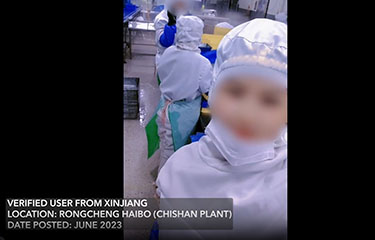
The Outlaw Ocean Project further documented the presence of Uyghur labor in Chishan Group’s processing plants by using social media, specifically the platform Douyin – the Chinese counterpart to TikTok.
“We really wanted to verify in 2023 that there were still Uyghur workers at these factories, and in order to do that we turned to social media,” Murphy said.
Videos taken by workers showed them on the processing floor, with logos and other information visible enough that The Outlaw Ocean Project could tie them directly to the Chishan Group. Other videos, from workers walking outside the processing plants, could be matched with satellite imagery of the area to confirm that the workers took the videos at some of Chishan’s facilities.
Despite the extensive evidence in their own corporate materials, Chishan Group subsidiaries Rongcheng Haibo Seafood Co. and Shandong Haidu Ocean Product Co. denied illegally employing Uyghur laborers. But echoing other Chinese critics of the Outlaw Ocean report, the China Aquatic Products Processing and Marketing Alliance (CAPPMA), which represents China’s seafood industry, refuted the conclusions of the Outlaw Ocean report.
“The report, without any factual basis, speculates that employing Uyghur workers is equivalent to forced labor and encourages companies in the U.S. and E.U. to boycott seafood from related Chinese processing plants which have been falsely alleged. This is highly irresponsible,” CAPPMA said. “The continuous spread of the news has resulted in some buyers ceasing shipments from Chinese processing plants. This not only directly jeopardizes the normal operation of Chinese processing plants, affecting the interests of partners, but also severely disrupts the global seafood supply chain.”
U.S. entities that sourced seafood from those firms have yet to respond to The Outlaw Ocean Project’s inquiries for more information. Both Sysco and Performance Food Group – broadline distributors that ship seafood to hundreds of thousands of customers across the U.S. – sourced seafood from a Newark, New Jersey, U.S.A.-based importer, Ruggiero Seafood, connected with both Rongcheng Haibo and Shandong Haidu.
Based on communications between Outlaw Ocean and the companies, Performance Food Group has yet to respond to any requests for comment. Similar requests for comment from SeafoodSource were also unanswered.
Sysco, meanwhile, responded to Outlaw Ocean regarding its discoveries, but only addressed claims related to High Liner Foods, which has since ceased doing business with the seafood companies identified as using Uyghur labor. In Outlaw Ocean's discussions with the company, Sysco does not mention Ruggiero Seafood, and requests from SeafoodSource to Sysco for comment on the matter have been unanswered.
According to the project’s discussions with Ruggiero Seafood, it contacted the company on both 10 January, 2023 and 15 June, 2023 about its potential importation of seafood from Rongcheng Haibo and Shandong Haidu for its Fisherman’s Pride brand, and was unanswered. A Ruggiero Seafood representative did not respond to SeafoodSource's request for comment in time to be included in the publication of this article.
Other major U.S. retailers implicated as sourcing seafood from Chishan Group also have yet to respond to requests for more information. Kroger, which operates more than 2,700 grocery stores, was implicated in the report for contracting with an importer trading with Shandong Haidu. The Outlaw Ocean Project contacted Kroger Director of Media Relations Erin Rolfes five separate times – on 10 January, 20 March, 23 June, 23 August, and 25 September – requesting comment on its investigation, with no response. A similar email from SeafoodSource to Rolfes did not receive an answer.
Kroger’s supplier, Hanover, Maryland, U.S.A.-based Rhee Bros Inc., which sells seafood under the Wild Sea Brand, did not respond to requests for comment. It was contacted by The Outlaw Ocean Project on both 10 January via both email and certified mail, and then again on and 15 June by email. It has yet to respond, and a similar email to its publicized email addresses by SeafoodSource has also been unanswered.
Sainsbury’s, in the United Kingdom, is reportedly connected to Lyon’s Seafoods, which in turn sources from Shandong Haidu. Sainsbury’s responded to The Outlaw Ocean Project saying it is actively investigating its sourcing in the wake of the report.
“All of our suppliers have to meet our high ethical and worker welfare standards. If we have any reason to believe there is a situation within our supply chains which is in breach of those standards we take immediate action,” a Sainsbury’s spokesperson told SeafoodSource. “We are working together with our suppliers and wider industry partners to understand the situation and take the most responsible and appropriate next steps.”
The Outlaw Ocean Project’s reporting has led to several companies cutting ties with the Chinese companies implicated in using Uyghur labor. High Liner Foods has ceased doing business with the seafood companies identified as using Yughur labor; Albertsons dropped its High Liner-sourced products reportedly associated with Uyghur labor; Nissui subsidiary Cité Marine commissioned an audit and ceased its sourcing from a factory named in the report; and Cape May, New Jersey, U.S.A.-based Lund’s Fisheries cut ties with a Chinese supplier implicated in the report.
U.S. elected officials have also responded to the report. U.S. Rep. Raul M. Grijalva (D-Arizona) and U.S. Rep. Jared Huffman (D-California) have called on the U.S. Customs and Border Patrol agency to use the authority of the UFLPA to investigate the report and enforce the law. U.S. Rep. Chris Smith (R-New Jersey) has made a similar request.
Urbina said the Chishan Group’s use of Uyghur labor is not unique in China’s manufacturing sector.
“What we found in our investigation was that many seafood companies are tied to a wide variety of similar problems with forced labor or illegal fishing,” he said. “And, truth be told, the pervasiveness of these problems is why the global seafood industry likely will have to assess how it monitors its supply chains, especially when these supply chains route through China.”
Image courtesy The Outlaw Ocean Project
