






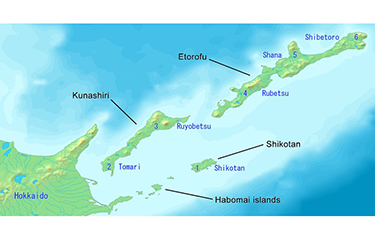
After placing new sanctions on Russia, Japan now has to deal with its northern neighbor refusing to schedule annual negotiations for fishing access in territorial waters around the southern Kuril Islands.
Though the two countries recently completed a deal for fishing access for parts of each other’s exclusive economic zones (EEZs), Russia has ruled out any talks on access to waters around the disputed islands so long as Japan continues to take what it calls hostile measures.
The dispute over the southern Kuril Islands dates back decades. In the closing days of World War II, the Soviet Union occupied and annexed the southern Kuril Islands, which lie northeast of Hokkaido. Japan does not recognize this loss of territory and continues to claim what it calls the “Northern Islands.” Japan and the Soviet Union ended their formal state of war with the Soviet–Japanese Joint Declaration of 1956, but did not sign a peace treaty due to the conflicting claims.
Japan gained concessions on the issue by promising development aid. In 1998, the countries signed the “Agreement between the Government of Japan and the Government of the Russian Federation on some matters of cooperation in the field of fishing operations for marine living resources” under which Japan pays for fishing access to waters around the islands of Etorofu, Kunashiri, and Shikotan, and the Habomai group of islets.
Russia suspended this pact on 7 June, 2021, because Tokyo had stopped providing payments and technical support to the Sakhalin-2 oil and gas project. Japan argued the project and the fishing agreement were not directly linked, and said the text of the fishing agreement does not mention the project. But Russia views them as a package deal.
On 30 June, 2022, the Sakhalin-2 project was reorganized by Russia under a new company. Japanese investors Mitsubishi and Mitsui decided to participate in the new entity, and in late August 2022, the Russian government approved their participation. Japanese power companies also continue to buy power from the venture . The Japanese government has encouraged continued cooperation with Russia on energy, as it has a significant dependence on Russian oil and gas. In 2020, 51.6 percent of the Sakhalin-2 project’s liquefied natural gas (LNG) exports went to Japan, and Russia is the source for about 9 percent of Japan’s LNG.
Japan has since resumed its payments and cooperation, which would seem to resolve the issue, but the Russian side has not budged on setting a date for the fishery negotiations due to Japanese sanctions against Russia following its invasion of Ukraine.
The last formal negotiations between the two countries were held on 12 December, 2021, to set terms for the 2022 season. At that time, a total quota of 2,177 metric tons (MT) was approved. The agreement allowed access to the Russian controlled waters for 31 Japanese vessels in exchange for “cooperation funds” amounting to JPY 1.1 million (USD 8,576, EUR 7,837) and provision of JPY 31.1 million (USD 242,424, EUR 221,618) worth of equipment.
The agreed seasons and quotas by species were: Alaska pollock gillnetting from 1 January to 15 March, 955 MT; arabesque greenling from 16 September to year-end, 777 MT; octopus in January and again from 16 October to year-end, 213 MT; others 232 MT. If a similar agreement were in place for 2023, Japanese fishermen would already be fishing for pollock and octopus.
On 19 January, 2023, in response to continued urging from the Japanese Ministry of Foreign Affairs, Russia informed Japan that it was unable to provide a date to hold the talks. On 23 January, Japan again urged Russia to restart talks, but in response, the Russian Foreign Ministry once again declined.
"In the context of the anti-Russian measures taken by the Japanese government, which obviously run counter to the spirit and letter of the 1998 agreement on strengthening and developing good neighborliness, the Russian side has informed Tokyo that it could not agree on holding intergovernmental consultations on the implementation of this agreement," it said.
As a result, Japan will not have access to the waters around the islands for the foreseeable future. In the meantime, Japan continues to import both energy and seafood from Russia. Because the U.S. and E.U. have banned crab imported from Russia, more is ending up in Japan at low prices. This in turn has largely eliminated Japanese demand for snow crab from Alaska and the Canadian maritime provinces.
The year-end is Japan’s biggest time for snow crab consumption, as many families enjoy a crab hotpot during the holiday. Between October through December 2022, Japan imported 4,685,242 kilograms of frozen snow crab, according to Japan Customs data. The sources, in order by quantity, were Russia with 3,098,579 kilograms, Canada with 1,281,757 kilograms, the U.S. with 104,394 kilograms, South Korea with 95,068 kilograms, Norway with 98,806 kilograms, and Greenland with 6,638 kilograms.
So, in this period, imports from Canada were about 41 percent of those from Russia. A year earlier they were about 60 percent of imports from Russia. The change in statistics bears out that the Japanese are taking advantage of low prices on Russian crab, to the detriment of the Canadian crabbers. However, imports from the U.S. actually rose compared with 2021.
In the period October through December 2023, Japan imported a total of 4,840,558 kilograms of frozen snow crab. Of that total, Russia provided 2,211,965 kilograms, Canada 1,327,751 kilograms, the U.S. 882,629 kilograms, South Korea 108,820 kilograms, Norway 283,320 kilograms, and Greenland sent 3,492 kilograms.
Image courtesy of Wikimedia Commons
