






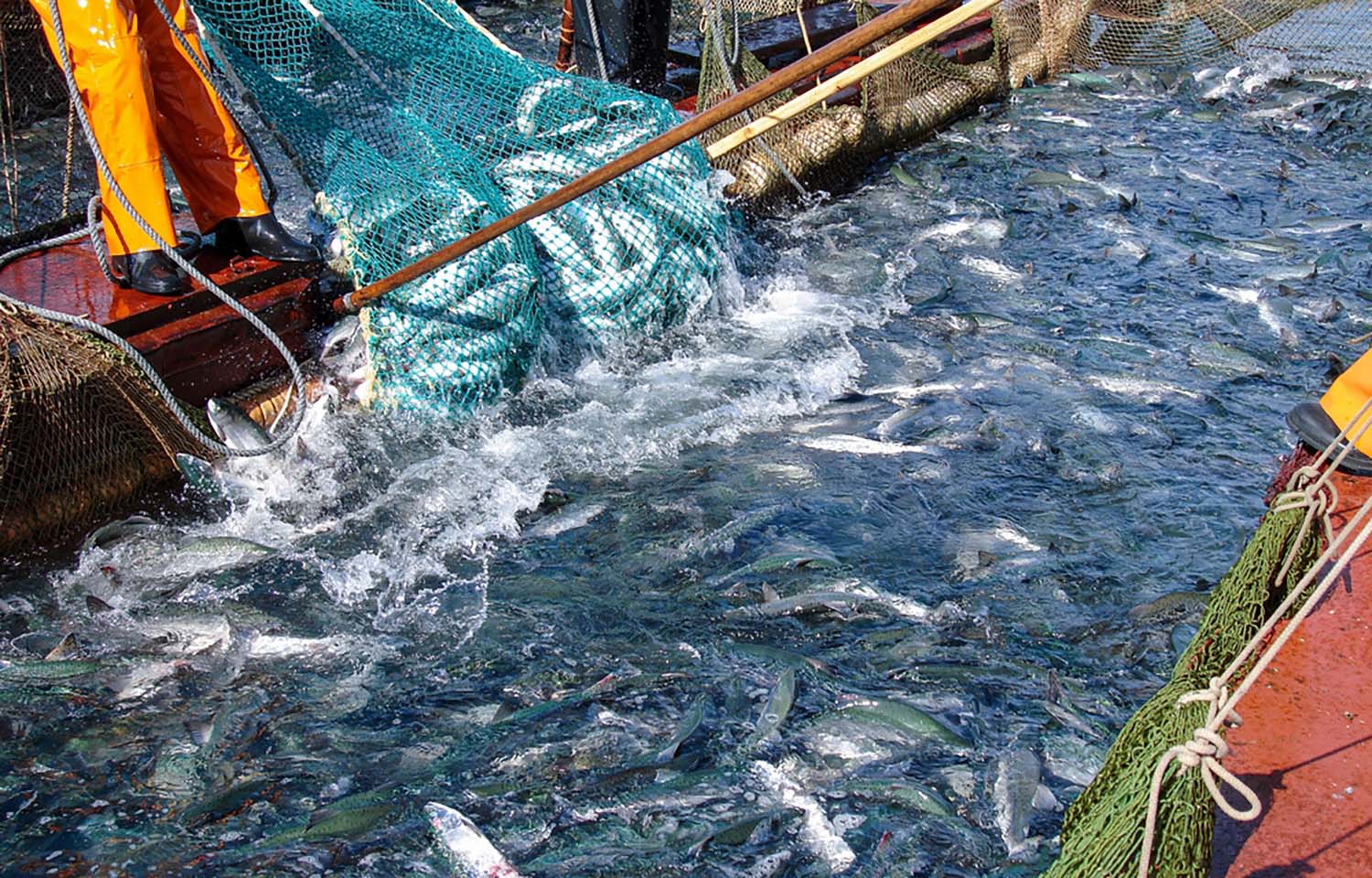
The global supply of salmonids increased 7 percent year over year in 2023 to 5.2 million metric tons (MT) whole fish equivalent (WFE), with Kontali Senior Financial Analyst Filip Szczesny attributing the rise to solid wild catch in North America and Russia, rather than larger aquaculture volumes.
According to Szczesny farmed salmonid production actually slipped by around 1 percent last year, and despite regional variances, the total Atlantic salmon harvest fell by 2 percent, ending up at less than 2.8 million MT WFE. By country farmed production decreases were seen in Norway, the Faroe Islands, the U.K., and Canada, while Chile was the industry’s only real “positive player” in 2023.
“Norway – the biggest production region – had a decrease of 2.5 percent, while Chile had an increase of 2 percent. But, this didn’t really compensate for the decrease in Norway and other regions,” Szczesny said. “It’s also worth mentioning that Canada saw a significant 17 percent decrease.”
The Canadian drop was mainly due to political issues and nonprofit opposition to salmon farming, he said.
“That [backlash] has been going on for several years now, especially on the west coast of Canada. It’s a jurisdiction where it’s hard to do salmon farming, and this is why we’ve had such a big decrease,” Szczesny said.
Chile, though, saw more favorable conditions and posted a solid harvest in 2023. Citing Kontali’s newly released “Salmon World 2024” report, Szczesny pointed out that Chile’s value chain has steadily grown and improved in recent years, especially regarding the ongrowing and processing stages.
This analysis found the South American country produced 752,000 MT of HOG Atlantic salmon last year, along with 284,000 MT of coho salmon and 56,000 MT of trout. It also determined that the nation’s value chain – incorporating hatchery, ongrowing, transport, processing and sales, and distribution to markets – was worth USD 7.15 billion (EUR 6.7 billion) in 2023.
That trend has not seemed to carry over into 2024.
Chile’s Q1 2024 harvest volume fell 13.6 percent year over year to 160,100 MT, and Kontali has now reduced its harvest forecasts for the remaining three quarters of 2024. It is projecting 171,500 MT in Q2, which would be a 6 percent drop year over year, 199,200 MT in Q3, which would be a 2 percent drop, and 193,700 MT in Q4, which would be a 5 percent drop. Algae blooms at the start of this year have majorly affected production, according to Kontali, along with ongoing negative “run-rate,” which has seen the number of smolt released in Chile decrease.
A total salmonid harvest of 724,500 MT is projected for the full year in Chile, which would be a dip of 5.4 percent on 2023’s total volume.
Meanwhile, more changes are expected in Norway’s value chain moving forward, Szczesny said. Specifically, Kontali is expecting to see less value creation in the at-sea grow-out stage of Norwegian salmon farming, as this is the only stage affected by the country’s aquaculture resource rental tax. However, there should be more value creation in the smolt portion of the value chain moving forward, according to Szczesny.
“We’re actually seeing a little bit of that already. Comparing 2022 to 2023, the smolt growth in value creation is higher and increasing more than the average for the last five years,” he said. “That’s due to the tax, which creates incentives to have less value creation in that area. But, it’s not all about incentives. It’s also important for farmers to get this right and to know what the actual value creation is in the smolt area of the business. This hasn’t been as important before, but it is now.”
Szczesny said harvest weights and increasing losses have been stubbornly persistent in the global salmon-farming industry since 2022. That year’s total production stood at just over 2.86 million MT, falling from 2021’s nearly 2.9 million MT. The decline in supply continued last year, dipping to just under 2.8 million MT.
This year’s projected aquaculture harvest, according to Kontali, is expected to rise slightly, totaling a smidge over 2.83 million MT, which would represent a 1 percent increase year over year.
Reduced harvests occurring so far this year in Norway and Chile, though, could lead to a dip in the 2024 harvest, according to Kontali.
The Norwegian seafood data provider does anticipate increased harvests for the Faroe Islands and Iceland but believes these won’t make up for the declines elsewhere.
