



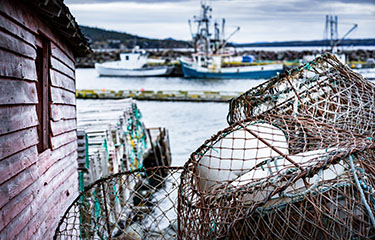
Canada’s snow crab fishing season is formally underway, but you couldn’t tell from a peek at the docks in the province of Newfoundland and Labrador.
A feud between the Fish Food and Allied Workers Union (FFAW), representing fishermen; and the Association of Seafood Producers (ASP), representing processors; erupted into the open in April 2023, when the province’s Standard Fish Price-Setting Panel set a minimum price of CAD 2.20 (USD 1.63, EUR 1.49) per pound. FFAW leadership called for a strike, and thus far, there hasn’t been any snow crab fishing this season in the province.
FFAW President Greg Pretty said in a 3 May statement the fishers his union represents are being pressured to fish “at prices that are uneconomical to most owner-operators.”
FFAW’s leadership agreed at a meeting on Tuesday, 2 May to stand firm on their demand for a higher minimum price, asking for the provincial government to take action to “transparently set the prices paid to harvesters based on actual market, yield, and sales information.”
For its part, the ASP has called on the province’s fishers to begin fishing at the rate set through the agreed-upon formal process.
“I would like to reiterate that every day that goes by is another day of lost opportunity, compounding the competitive position of harvesters, plant workers, and producers, to extract value from the crab fishery,” ASP Executive Director Jeff Loder said in a 2 May statement.
Snow crab fishermen in the Gulf of Saint Lawrence had landed more than 60 percent of their total allowable catch, those in the Southern Maritimes Region had caught more than 16 percent of their TAC, and those in the Northern Maritimes Region had landed 74 percent of their TAC as of 5 May, receiving a price of CAD 2.25 (USD 1.68, EUR 1.52). Those regions have a TAC of around 44,000 metric tons (MT), while Newfoundland and Labrador has a TAC above 54,000 MT, with not a single pound harvested thus far in the province.
“The longer the fishery is delayed, the greater impact it has on the premium product Newfoundland seafood is known for,” Loder said. “As the season progresses, the risk increases of exposure to softshell crab, briny tasting meat, and eventually new hardshell. We do not want Newfoundland product to be associated with inferior product versus the Maritimes and Gulf. Nor do producers want to curtail purchases due to these issues.”
Loder alluded to threats made to Newfoundland fishers who want to commence fishing.
“We have been informed that there are harvesters who want to begin fishing, however, they have not begun for reasons that should cause Newfoundlanders and Labradorians great concern,” Loder said. “Producers will always respect the decision of harvesters to not fish, a right enshrined in legislation, based on their individual business situation. Which is why when we hear those individual decisions are being impacted by fear, intimidation, and harassment, we feel an obligation to address the issue.”
The ASP represents 22 snow crab-processing facilities, each employing between 150 and 650 seasonal workers. Loder said those workers were suffering as a result of the lack of incoming crab.
“The economic impact of the delay in the snow crab fishery is significant. Not only does it affect plant workers, but also graders, equipment, packaging, and delivery companies, as well as local convenience stores, grocers, and restaurants,” he said. “The fishery is a catalyst for economic growth in which rural communities rely on.”
Previously, Loder said the ASP is willing to work with FFAW and the Canadian government to “[work on ways] we can maximize the value of the fishery through quality, trip limits, and structured purchases.”
“However, ASP will not discuss a minimum price outside the legal process that has been established,” he said on 24 April.
Pretty said the “bottom-of-the-barrel” price is not sustainable for the 10,000 fishermen FFAW represents. He called Loder “whiny and petulant.”
“We have a mounting crisis on our hands,” he said.
On 3 May, Newfoundland and Labrador Fisheries Minister Derrick Bragg called for a secret ballot vote among snow crab harvesters to gauge their consensus on whether they wanted to begin fishing.
"I'd love nothing more than to see the markets go up and see a spike in this fishery, but I fear as time goes on we may lose the season. We can't afford to lose the season,” he told the CBC.
"Minister Bragg is directly undermining the elected leadership of the union, and it's clear he has absolutely no handle on the crisis facing this industry, let alone the basic laws governing his portfolio," Pretty said in response. "Instead of stepping in as a provincial regulator to change rules surrounding processing licenses and the flawed price setting process, Minister Bragg continues to be a spectator."
Many processing plant workers represented by the union have exhausted their unemployment benefits, according to FFAW-Unifor Union Local Secretary Beverley Gough Dyke, who also works at an Ocean Choice International processing plant in Triton, Canada.
“There’s a few more that have two weeks, four weeks, or just six weeks left,” she told Saltwire. “A lot of them, she said, are the younger workers who are low on the seniority list at the plant. “I’m seriously worried about them.”
The fight between FFAW and ASP has extended into the province’s lobster fishery, as lobster buyers initiated two buying stoppages, first on 1 May and then again on 4 May. The buying freeze remained in effect as of 5 May, according to VOCM. The ASP has not commented on the move.
“Lobster buyers have initiated a second stoppage, just days after the first when increased market demand and reduced supply led to higher market prices, and as a result a higher price paid to harvesters based on the long-standing formula,” Pretty said. “It’s clear that lobster buyers are exerting their control over harvesters, the province, and [Canada’s] Department of Labor in their refusal to buy product instead of submitting for a price reconsideration at the panel, proving there is no justification in their actions aside from a coordinated attempt to further hurt the inshore, owner-operator fishery. The refusal of companies to buy lobster has the crab crisis stamped all over it.”
Pretty called for the opening of the market to outside buyers, including those with valid licenses from Nova Scotia, New Brunswick, or the U.S. state of Maine, at the minimum per-pound price set by the panel of CAD 14.37 (USD 10.73, EUR 9.74).
“We need outside buyers,” he said. “We need more competition. We need to give harvesters every available opportunity to sell their catch if our own provincial buyers refuse to engage in ethical business practices.”
Photo courtesy of Ramon Cliff/Shutterstock
