





Eight U.K. seafood companies exhibited at this year’s edition of the Japan International Seafood and Technology Expo, according to Seafish, a U.K. public body that supports the country’s seafood sector.
The expo, held from 23 to 25 August, took place at the Tokyo Big Sight exhibition center, featuring nearly 1,000 exhibitors and about 25,000 total visitors. The U.K. seafood pavilion co-located with Seafood from Scotland pavilion through a joint effort of Seafish and Seafood Scotland, the national trade and marketing body for Scottish seafood.
Japan is a net importer of seafood and as its domestic production continues to fall, the East Asian nation is increasingly becoming a lucrative market for U.K. seafood producers to target. U.K. seafood sold in Japan includes farmed Atlantic salmon, mackerel, langoustines, brown crab, whelk, and European blue lobster.
Salmon accounted for 56 percent of all seafood exports from Scotland in 2022, and thus far in the current year, the total is higher, with sales to Asia also increasing. For the U.K. as a whole, salmon comprised 33 percent of the country’s overall seafood exports, jumping to 41 percent with smoked and processed salmon included. The 2022 total for Scottish salmon products sold amounted to GBP 705 million in trade value (USD 896 million, EUR 824 million).
Denholm Seafoods and Lunar Freezing both exhibited at this year’s expo. Denholm Seafoods, which recently embarked upon an expansion of its processing facility in Peterhead, produces a wide range of products, such as herring, Atlantic mackerel, and blue whiting. Lunar Freezing, also based in Peterhead, displayed a similar lineup, along with haddock and smoked salmon.
Mackerel is one of the U.K.’s top seafood exports to Japan, with Denholm and Lunar Freezing participating in the intercountry exchange. In 2022, the U.K. exported GBP 9.7 million (USD 12.3 million, EUR 11.3 million) worth of seafood to Japan, GBP 5 million [JPY 929 million, USD 6.3 million, EUR 5.8 million] of which was mackerel.
Other U.K. exhibitors were Edward Jenkinson, a family-owned shellfish merchant based in Scarborough, England, and The Lobster Pot, located at Church Bay on the Isle of Anglesey in Wales. Both promoted exports of European blue lobster and brown crab at the expo.
Macduff Shellfish, based in Mintlaw, Scotland, Europe’s largest processor of wild shellfish, displayed wild scallops, langoustines, crab, and whelk in raw, cooked, fresh, and frozen forms.
Venture Seafoods, based in Bridlington, England displayed lobsters, whelk, and brown crab – a species that is becoming more popular in Japan.
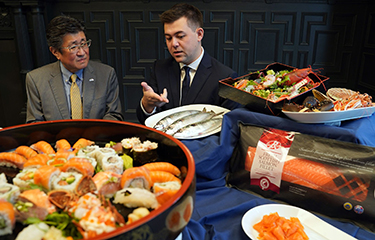
Glyvrar, Faroe Islands-headquartered Bakkafrost, which operates salmon-farming sites across the west coast of Scotland through its acquisition of the Scottish Salmon Company in 2019, also had a presence at the expo. In July, the company hosted Tadashi Fujiwara, the consul general of Japan, along with representatives of Seafood Scotland, at its Edinburgh office. Adam Wing, the head of trade marketing for the U.K., Middle East, and Asian markets at Seafood Scotland, invited Fujiwara and Japan’s Cultural Diplomat Sora Sato to sample Scottish seafood prepared in Japanese style by the Edinburgh restaurant Harajuku Kitchen.
At the event, Bakkafrost representatives discussed with Fujiwara and Sato the importance of the Japanese seafood market to the Scottish seafood industry, a relationship that helped the latter market haul in an average of GBP 16 million (JPY 2.9 billion, USD 20.3 million, EUR 18.7 million) annually before the pandemic. They also talked about how Japanese consumers perceive Scottish seafood products.
“Scotland’s reputation for producing high-quality sustainable seafood is one of the key reasons that demand for Scottish seafood continues to increase in Japan,” Fujiwara said. “I am confident that with support from Seafood Scotland, Scottish exporters will enjoy greater access to the discerning Japanese market.”
Photo courtesy of Seafish
