






Government reports coming out of Japan highlight trends of falling wild-caught and farm fishery production, with some numbers hitting record lows throughout the country.
Japan’s Ministry of Agriculture, Forestry, and Fisheries (MAFF) released its Fisheries White Paper earlier this summer and the report – which covers trends in production, import-export changes, and consumer behavior – covers the fiscal year ending March 2022. Another MAFF report titled “2022 Fisheries and Aquaculture Production Statistics” also offered insight into last year’s production and price details.
Both reports indicate Japan’s total wild fish catch fell 7.5 percent in 2022 compared to the year prior, hitting a record low of 3.85 million metric tons (MT).
Three species that experienced record low catches included Pacific saury, Pacific flying squid, and octopus.
The saury catch in 2022 totaled 18,400 MT, down 8.4 percent from the previous year but down a staggering 96.8 percent from the record level set in 1930.
The average wholesale landed price of the long, thin species was JPY 581 (USD 4.01, EUR 3.66) per kilogram in 2022 after peaking at JPY 627 (USD 4.33, EUR 3.95) the previous year. Saury has gone from a cheap staple in Japan to a rarity in the last decade.
Japanese flying squid landings fell to a record low catch of 29,700 MT, down 8.3 percent from the previous year but, similar to saury, down 95.6 percent from its peak in 1968. Prices rose 40 percent to a new high of JPY 823 (USD 5.69, EUR 5.18) per kilogram.
Octopus landings, meanwhile, totaled a record low 22,200 MT.
While landings of high-volume, low-priced fish like mackerel, Pacific saury, and Pacific flying squid were poor, sardines were plentiful and cheap.
The trend of sardine landings over the last decade has been the inverse of saury, as warming water temperatures have led to sardine proliferation.
In 2022, sardine catch was down 4.2 percent to 613,200 MT, while prices rose slightly from the previous year’s JPY 41 (USD 0.28, EUR 0.26) to nearly JPY 45 (USD 0.31, EUR 0.28), which is still historically low.
Import-export volumes, meanwhile, stayed relatively stagnant, but higher prices drove up the value totals of both.
In 2022, the import volume of marine products increased by 0.9 percent from the previous year to 2.22 million MT, while import value increased by 28.6 percent to JPY 2.07 trillion (USD 143.1 billion, EUR 131.8 billion).
The top imports by value were salmon/trout (accounting for 13.4 percent of imports), bonito/tuna (11.2 percent), and shrimp (10.7 percent), followed by squid (3.7 percent), crab (3.6 percent), and cod, a category which includes pollock (3.4 percent).
Japan’s export volume fell 3.8 percent, while the value rose by 28.5 percent to 387.3 billion yen (USD 26.7 billion, EUR 24.7 billion).
Scallops and yellowtail were the top items by value, accounting for 23.5 and 9.4 percent, respectively, followed by pearls (6.1 percent), mackerel (4.9 percent), sea cucumber (4.8 percent), and bonito/tuna (4.6 percent).
As for consumer behavior findings, after a brief upward trend during Covid-19 shutdowns of eating at home, household purchases of seafood decreased again in 2021 and 2022, falling by 15 percent in 2022 to 19.5 kilograms per person. By value, it fell by 6 percent from 2021 to JPY 40,200 (USD 277.38, EUR 257.28) per household per year.
Higher prices due to inflation and a weak yen, along with a partial return to office work for many professionals, are likely factors behind the steep fall.
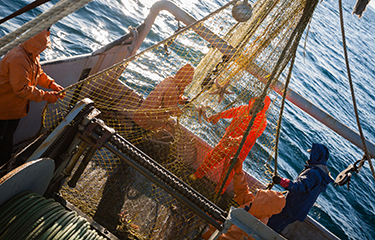
Photo courtesy of DoublePHOTO studio/Shutterstock
