



The U.K. government complemented its recent signing of lucrative deals with Norway and the E.U. for 2024 by announcing five post-Brexit fisheries management plans (FMPs) that outline how the government will collaborate with the fishing industry and other stakeholders to sustainably manage its fisheries in the long term.
The primary goal of the new plans, which mainly cover U.K. stocks of crab, lobster, king scallop, and sea bass, is to improve the economic viability of key commercial fishing stocks through measures such as increasing minimum conservation reference sizes (MCRSs) and introducing seasonal or area closures to protect juvenile and spawning stocks.
Though the FMPs focus on achieving long-term sustainability, there are several short-term measures that the plans have prioritized. These include introducing new or increased MCRSs for crawfish, brill, lemon sole, and turbot; establishing an engine restriction for fishing vessels using flyseine fishing nets; accelerating work to address the effects that mobile bottom-trawl nets have on the ocean seabed, particularly in the U.K. scallop fishery; and fostering collaboration with stakeholders to develop an action plan that results in the sustainable harvesting of cuttlefish, among other goals.
U.K. Fisheries Minister Mark Spencer confirmed the FMPs are a result of direct dialogue with the fishing industry over many months and that they will help to “deliver sustainable stocks and a modern and profitable fishing industry for the future.”
National Federation of Fishermen’s Organizations (NFFO) CEO Mike Cohen said fishers and the communities in which they work have more to lose than anyone if there is a lack of sustainable management. To Cohen, these plans represent a “genuinely ambitious attempt to do that important job better.”
“With knowledgeable stakeholders involved and good quality science at the heart of the process, FMPs are well-placed to sustain and grow our fishing fleet’s ability to keep providing affordable, healthy, low-carbon food,” he said.
Commenting on the king scallop and sea bass FMPs in particular, Welsh Minister for Rural Affairs Lesley Griffiths said the plans would “create a roadmap” for the future management of those fisheries in Welsh waters.
“The purpose of the FMPs is to manage fishing activity within sustainable limits, setting out the policies and measures required to reach and maintain our goal of sustainable king scallop and sea bass fisheries for future generations,” she said.
Responses relating to a sixth plan, which concerns the management of North Sea and Eastern Channel mixed flatfish, are still being received by the U.K. Department for Environment, Food, and Rural Affairs.
Alongside the publication of the first plans, the U.K. government also announced a further GBP 4 million (USD 5.1 million, EUR 4.6 million) to support projects within the country’s catching sector. The new funding is part of the ongoing GBP 100 million (USD 126.8 million, EUR 116.1 million) U.K. Seafood Fund, which already supports close to 200 projects nationwide.
This latest funding will be available to projects that fall into three categories directly impacting the catching sector: projects that improve energy efficiency and reduce emissions on vessels; projects that improve infrastructure at ports; and projects that improve the health, safety, and well-being of the workforce. Each category is eligible for different levels of funding.
The FMPs and announcement of further funding for domestic projects are just a few actions that comprise another busy year-end season for the U.K. government.
In addition to other deals signed for 2024, the government negotiated access to 420,000 metric tons (MT) of fishing opportunities with the E.U. and Norway, worth up to GBP 700 million (USD 887.5 million, EUR 812.9 million). This increased the total fishing opportunities secured for the U.K. fleet in 2024 within the main negotiating forums to 750,000 MT, worth around GBP 970 million (USD 1.2 billion, EUR 1.1 billion) when based on historic landing prices.
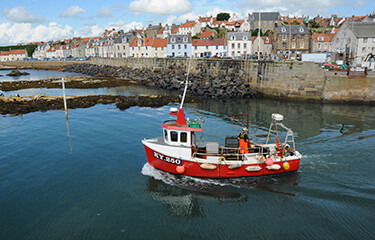
Photo courtesy of Peter Moulton/Shutterstock
