






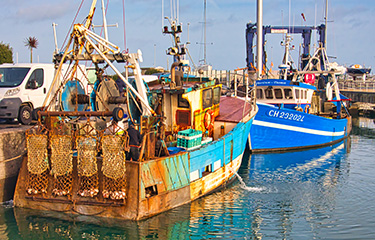
France, Ireland, and Denmark are among several nations around Europe that have implemented plans to decommission vessels due to increasingly strict E.U. fishing policies and the logistical consequences of Brexit.
Over the past few years, the E.U.’s diverse fishing fleet, which has vessels ranging from under 6 meters to over 75 meters, has steadily declined in terms of tonnage and engine power. The total number of vessels in the fleet fell between 2013 and 2021 to 74,635, a reduction of over 6,000 vessels.
Even though that number has decreased steadily, it still leaves the capacity of some fleet segments out of balance with their current fishing opportunities.
Under the E.U.’s Common Fisheries Policy, each member country has an obligation to ensure a “stable and enduring balance” between fishing capacity and fishing opportunities, and a fleet capacity ceiling is enshrined in E.U. law.
Complicating the matter, the E.U. transferred itself back 25 percent of its fishing rights in British waters after Britain’s decision to withdraw from the E.U., reworking fishing quotas and vessel capacities in the process. This has left nations, particularly Ireland, with limited quotas and too many vessels in its fleet.
In response, some E.U. member-states have adopted action plans to decommission vessels. Grant aid is available to help countries remain at or under their designated capacity ceiling, but any vessel scrapped has to leave the fleet permanently.
The rules are a double-edged sword for many fishermen.
Many fear that it threatens their livelihoods, their entire communities, and the supply chain as a whole. Others take a more pragmatic view, seeing a decommissioning scheme as a means to wipe out their debt and leave the economic and political woes of the industry behind.
In Ireland, more than one-third of the fishing fleet has applied to the government’s EUR 60 million (USD 56 million) decommissioning scheme, set up as part of a Brexit agreement.
“I am satisfied that I have now enabled all those who have chosen to apply for this scheme [the ability to] receive the full value of the scheme payment as guided by the Seafood Taskforce recommendation,” Ireland Minister of Fisheries Charlie McConalogue said after the Irish government introduced the initiative.
Meanwhile, in France, a EUR 60 million (USD 56 million) support scheme for fishermen affected by Brexit is also in place to fund the decommissioning of vessels. France is scrapping just 3 percent of its total tonnage, but shipowners who relied on fishing in U.K. waters have queued up to scrap their fishing boats, with 90 vessels expected to leave the fleet. Specific compensation depends on the tonnage of each vessel and redundancy payments for crew members.
Further woes for fishermen have come in the form of a new fisheries policy package making its way through the European Commission to protect marine ecosystems and promote a climate-neutral fisheries and aquaculture sector by 2050. Under the new policy, there are plans to ban bottom-trawl fishing in 30 percent of the waters controlled by E.U. member states by 2030. This has led to a series of recent protests by fishermen and fishing organizations.
“This package of measures from the European Commission is a point of no return for European fishing from which we believe it will be impossible to recover,” Europêche President and Cepesca Secretary General Javier Garat said in a release.
Photo courtesy of CatherineLProd/Shutterstock
