






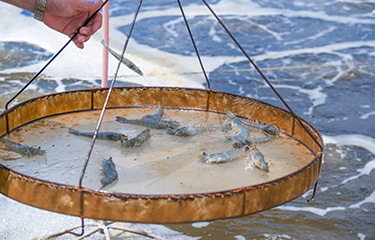
Lower demand from the United States and a shortage of larger-sized shrimp did not cool Vietnam’s shrimp exports in August 2022.
The country’s overall shrimp sales in August reached USD 398 million (EUR 402.7 million), up 41 percent year-on-year, according to the Vietnam Association of Seafood Exporters and Producers (VASEP). Through the first eight months of 2022, Vietnam’s shrimp exports are up 24 percent year-on-year in value, totaling more than USD 3 billion (EUR 3.04 billion).
VASEP said shrimp sales from Vietnam to the U.S. began slowing in May and dropped continuously from June to August.
In August, Vietnam sold USD 68 million (EUR 68.8 million) worth of shrimp to the U.S., down 27 percent from a year prior. The sales to the U.S. over January-August also fell 9 percent year-on-year to more than USD 619 million (EUR 626.7 million).
The decrease in Vietnam’s sales is in line with a broad decline in overall U.S. shrimp imports thus far in 2022. The U.S. imported a total of 148.9 million pounds in July 2022, or 67,557 metric tons (MT), down from 167.7 million pounds (76,080 MT) in July 2021. Nevertheless, the U.S. remained Vietnam’s top shrimp market, accounting for 20 percent of Vietnam’s exports by value.
In contrast with a drop in U.S. exports, Vietnam’s shrimp shipments to Japan skyrocketed 120 percent in August 2022, reaching USD 67 million (EUR 67.8 million) in value. Through the first eight months of 2022, Japan’s imports of Vietnamese shrimp were up 21 percent year-on-year to reach USD 463 million (EUR 468.9 million). The Japanese market growth has come as many Vietnam-based shrimp companies seek out markets with a preference for value-added products, a segment in which Vietnam industry players believe they hold an advantage over rivals from Ecuador and India, VASEP said. The country’s ability to supply deeply processed, high-quality shrimp has helped Vietnam become the top shrimp-exporting country to Japan, South Korea, the U.K., and Australia, the second-largest seller of shrimp in the E.U., and the fourth-largest supplier to the U.S., according to Fimex (Sao Ta) Chairman Ho Quoc Luc.
Thus far in 2022, Vietnam’s sales of processed shrimp has outpaced those of its fresh and frozen shrimp, VASEP said. Vannamei have accounted for 75 percent of Vietnam’s exports by value in 2022, with black tiger shrimp making up 14 percent of the total and wild-caught shrimp accounting for 11 percent. Vietnam’s wild-caught shrimp sales have soared 78 percent year-on-year in 2022, with its sales of vannamei up 21 percent and its black tiger shrimp sales up 11 percent. The year-over-year high growth is partially the result of weak figures from 2021, when the country’s industry was impeded by lockdowns implemented to curb a nationwide COVID-19 outbreak.
This year, the biggest challenge facing Vietnam’s shrimp companies has been the spread of disease, which as resulted in a significant drop in production, according to Luc.
“This difficulty will result in the high prices of raw materials for processing, the shortage of large-size shrimp, and the decrease in total production,” he told SeafoodSource..
Minh Phu Seafood CEO Le Van Quang agreed that Vietnam’s shrimp industry has had difficult raising shrimp to bigger sizes, which he also partially blamed on recent heavy rains, particularly in the Mekong Delta, home to many of the country’s commercial shrimp-aquaculture operations. Adverse weather conditions have resulted in the damage of 2,459 hectares of shrimp farms in in Soc Trang province alone thus far this year, accounting for 4.8 percent of its total shrimp farming area.
As a result, shrimp firms operating in the region are offering higher prices for large-size shrimp – both vannamei and black tiger – to ensure they have sufficient material for processing. And they’re being forced to increase prices in order to fulfill pre-signed export orders.
On 20 September, Soc Trang Province-based Tan Phat Seafood paid VND 225,000 (USD 9.50, EUR 9.60) per kilogram for 20-count shrimp, VND 185,000 (USD 7.80, EUR 7.90) per kilo for 25-count shrimp, VND 121,000 (USD 5.10, EUR 5.16) for 60-count shrimp, and VND 96,000 (USD 4.00, EUR 4.10) for 100-count shrimp, according to Zing News.
Viet Nam Clean Food, also based in Soc Trang, paid VND 260,000 (USD 10.98, EUR 11.11) per kilogram for 20-count shrimp, which its chairman Vo Van Phuc said was likely the highest price the company had ever paid. For 25-count shrimp, his company is now paying VND 10,000 (USD 0.42, EUR 0.43) more per kilo to solidify its supply. Phuc said the increase in pond prices for bigger size-shrimp in the Mekong Delta came as stockpiles of larger shrimp, especially 20-count shrimp, have run short in the U.S.
But increase in prices does not mean demand in global markets is on the rise, according to Quang of Minh Phu. In fact, he said export prices this year have not been higher than last year and demand is currently being dampened by high inflation in the U.S. and elsewhere.
Khanh Sung Seafood CEO Tran Van Tuan said the rate for shrimp of 20-count shrimp at his company was VND 250,000 (USD 10.56, EUR 10.70) per kilogram.
“This year, shrimp raised in the second crop grows at slow growth rates because of bad weather conditions and more rain. Given shrimp’s slow growth, there are not many large sizes available in the market," Tuan said.
For vannamei with non-antibiotic test results, the prices for 20-count shrimp on 20 September ranged from VND 265,000 to VND 278,000 (USD 11.19 to USD 11.74, EUR 11.33 to EUR 11.89) per kilogram, up by about VND 17,000 (USD 0.72, EUR 0.73) per kilogram from the week before.
Prices of black tiger shrimp also surged to between VND 360,000 and VND 370,000 (USD 15.20 to USD 15.60, EUR 15.40 to EUR 15.80) per kilogram, up from VND 330,000 (USD 13.95, EUR 14.12) per kilogram, due to a lack of supply. The shortage of large-sized shrimp was because farmers raising shrimp via the “extensive agriculture model,” which incorporates rice farming, have begun a new rice crop, local trader Le Van Dung said.
Photo courtesy of Son Truong/Shutterstock
