


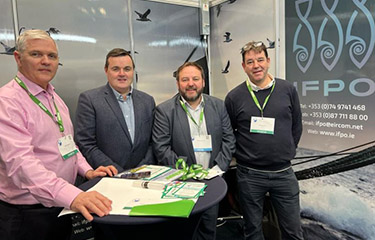
Irish Fish Producers Organization CEO Aodh O’Donnell has accused Iceland of deliberately pursuing a policy of overfishing over the past decade while it fixes a unilateral mackerel quota almost three times greater than that of Ireland.
Iceland is “plundering” mackerel stocks for use in fishmeal production as part of its effort to establish claims on stocks through self-allocated quotas, according to O’Donnell, who said 120,000 metric tons of mackerel was landed by Icelandic vessels in Norwegian ports for fishmeal production in the last quarter alone.
O’Donnell and other representatives of Ireland’s commercial fishing sector have previously made similar accusations against Norway, claiming Norway has “unilaterally secured” an enormous share of the total allowable catch (TAC) of mackerel, blue whiting, and herring, threatening their stocks in the Northeast Atlantic Ocean. According to the IFPO, blue whiting catch opportunities available to Norway in Irish waters amounted to 224,000 metric tons last year, “five times higher than the Irish quota in Irish waters.”
O’Donnell said the Faroe Islands, Iceland, and Norway are overfishing mackerel and whiting stocks by up to 40 percent in excess of the level suggested by scientific advice as sustainable, thus endangering the sustainability of the fisheries.
Iceland, the U.K., Norway, the E.U., the Faroe Islands, and Greenland are the coastal states that negotiate sharing the allocation of the Northeast Atlantic mackerel stocks. A decade ago, E.U. policymakers agreed all stocks would be fished at sustainable levels by 2020, which requires setting all catch limits no higher than the levels recommended in the best available scientific advice. But that has not yet happened, partially due to drawn-out political fights like what is occurring with the North Atlantic pelagic stocks.
Dúi Jóhannsson Landmark, a spokesperson for Iceland’s Ministry of Agriculture and Fisheries, defended his country’s actions.
“Iceland prides itself on its longstanding commitment to the sustainable management of fish populations within its maritime boundaries. Despite our best efforts and ongoing consultations in recent years, a consensus on a sharing agreement has not yet been reached among the coastal states,” Jóhannsson Landmark told SeafoodSource. “It's noteworthy to mention that a significant portion of the mackerel harvested by the Icelandic fishing industry is destined for human consumption, underscoring the importance of fully utilizing fish for human consumption for the domestic seafood industry.”
With negotiations underway in Brussels on fishing quotas for 2024 in E.U. waters – and for stocks shared with neighboring states like Norway and the U.K. – Norway State Secretary Vidar Ulriksen told Irish fishery organizations to focus their frustration on the European Union.
“As a principle, I do not comment on issues that are part of ongoing negotiations,” he told SeafoodSource. “However, it should be noted that the negotiations are structured so that Norway negotiates with the European Commission and not directly with Ireland. The allocation of the fish quotas that the E.U. gets from Norway through the annual bilateral agreements is mainly an internal EU decision.”
E.U. fishing lobby groups are pushing for quotas to be agreed upon among the various members of each fishery, rather than set unilaterally. A 10 October letter from the European Association of Fish Producers Associations (EAPO) to the European Commission calls for “strong E.U. action” against “other coastal states’ excessive, unjustified, unilateral quota and resulting overfishing.” The letter said the highest priority should be given to reaching an agreement on all-party sharing arrangements for mackerel, blue whiting, and Atlanto-Scandian herring, “based on genuine historic track records and interest as opposed to a flawed, one-dimensional zonal attachment concept.”
Environmentalists worry that climate change is exacerbating long-term fishery management tensions in Northern Europe. According to Irish ecologist Padraic Fogarty, warmer European waters due to climate change means that mackerel stocks have moved north, putting them in reach of the Icelandic fleet. The previous plentifulness of mackerel around the Irish coast is “a thing of the past,” he told SeafoodSource.
Jean-Christophe Vandevelde, manager of Northeast Atlantic ecosystem conservation and fisheries at The Pew Charitable Trusts, agreed with that assessment. He said the root of the current tension is the arrival of mackerel stocks moving northwards to the cooler waters around Iceland, prompting that country to start setting its own quotas in 2006.
Vandevelde said Brexit complicated matters because it prompted Norway and the Faroe Islands to disavow and renegotiate its stocks sharing agreements with the E.U., which had been based on the previous location of the stocks. The Irish fishing industry claims the country lost a quarter of the commercial value of its fishery in the E.U.’s Brexit settlement with Britain. Norway, in particular, has been “very tough” in negotiations for larger shares of the stocks, Vandevelde told SeafoodSource.
While Fogerty said he shares concerns over the Icelandic fishmeal industry targeting mackerel, he said the Irish industry’s tactic of highlighting Iceland’s use of mackerel for fishmeal production is hypocritical.
“It’s very easy to be cynical about the fishmeal sector in Ireland, where much of the blue whiting catch is being crushed into brown pellets for salmon feed,” he said.
Ireland has itself been accused of ignoring scientific advice in seeking higher quotas in the past, according to Vandevelde.
“The Irish minister, when he comes to Brussels, has always sought to secure the biggest possible TAC, which sometimes goes beyond the scientific advice,” said Vandevelde.
Photo courtesy of Irish Fish Producers Organization
