






Phillips Foods plans to broaden its product range to include snow crab and lobster following the acquisition of two seafood companies in Eastern Canada.
The Baltimore, Maryland, U.S.A.-based crabmeat specialist recently acquired the Pêcheries Bas-Caraquet Fisheries facility in Bas-Caraquet, New Brunswick, as well as the assets of South Shore Seafoods in a restructuring deal encompassing multiple plants in the province of Price Edward Island as well as holding tanks in Nova Scotia.
“The addition of these two entities in Canada will enable a significant expansion of the Phillips product portfolio, not only with frozen, fresh and pasteurized seafood proteins, but also with a future range of newly developed value-added seafood appetizers, soups, cakes, and entrées featuring lobster, snow crab, Jonah crab, scallops, and more,” Phillips Foods Founder and CEO Steve Phillips said in a press release. “As the market leader in crab, Phillips is perfectly positioned for this expansion of our product line into north Atlantic seafood. Our customer base is always on the lookout for new seafood products, and they count on us to deliver the best. These acquisitions will allow us to bring our same dedication to quality and product safety into a new area of the seafood market.”
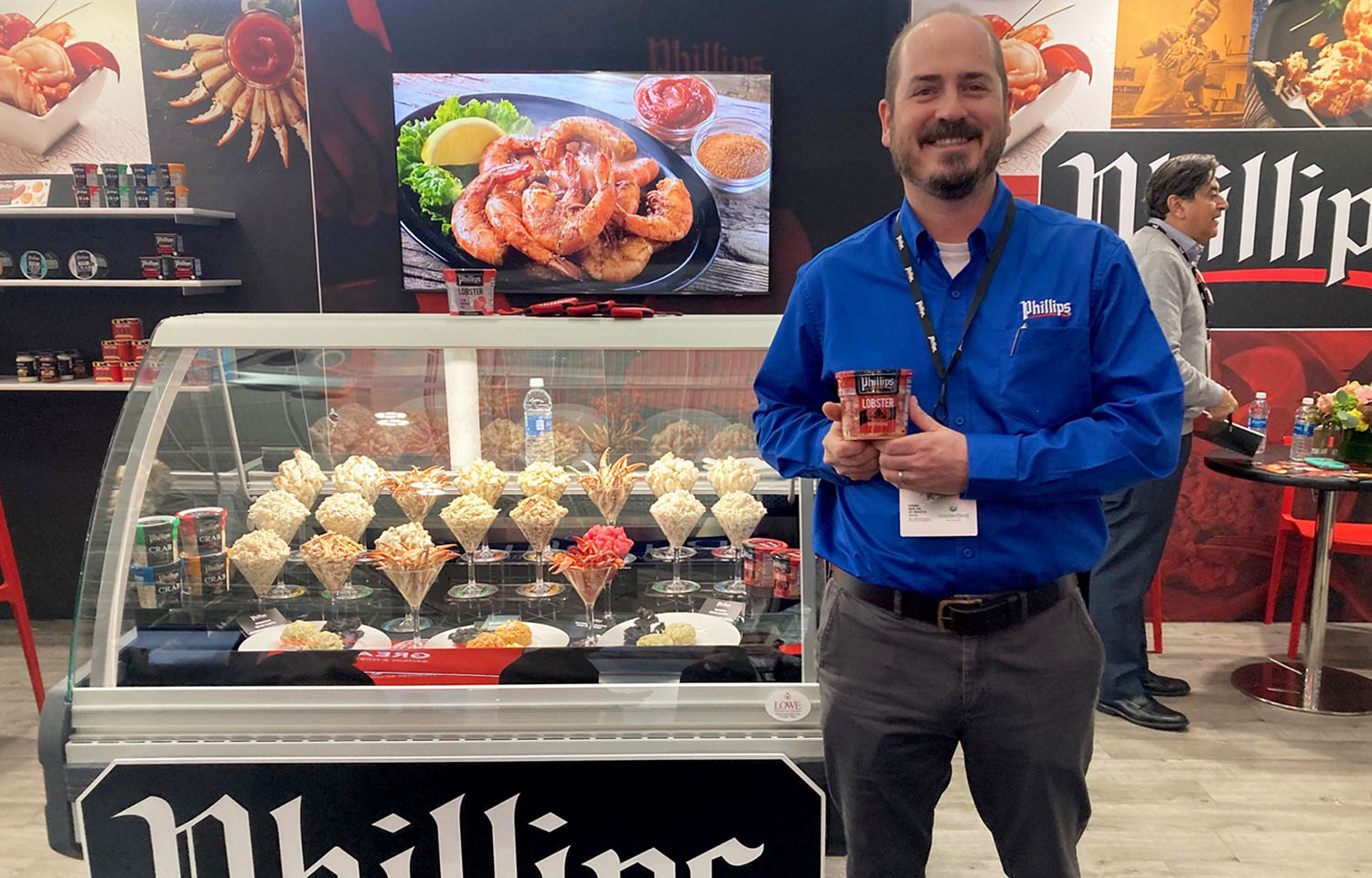
Brice Phillips is the vice president of sustainability and business development of Baltimore, Maryland, U.S.A.-based Phillips Foods, Inc. and Seafood Restaurants, a family-owned and -operated seafood company specializing in crab meat and crab cakes, as well as fish and shrimp value-added products. He spoke with SeafoodSource at the 2024 Seafood Expo North America about the significance of the company’s move into Canada.
SeafoodSource: Why did the company decide to expand into Canada?
Phillips: We have spent the last 25 years putting crab everywhere, from soups to empanadas, and putting them everywhere we can put them, and I think we've borderline saturated the market with crab, right? It's in every state. It's in every city. It's in pretty much every single retailer, every club store operator. And the only way for us to grow going forward is to gain access to other proteins. And when I say access, I don't mean just buying other things to make value out of products. I mean, gaining source-level access. When you have source-level access, you have the best possible cost. You control the quality. You control who you're buying it from. You're controlling all the processing of it.
When I look at Atlantic Canada, I see it almost the exact same as Southeast Asia. The only real difference is the size of the boats. You're still hauling up a crustacean off the bottom, that crustacean is going to be steamed, it’s going to be broken down into its various parts just like a crab. So for us, the similarities between these conditions and all these wonderful products that, in the last five years, have really shifted and have become the dominant force for us. It used to be 60 percent of the weight of our products by weight were crabmeat and 40 percent value-added, ever since the pandemic, that has gotten flipped upside down, because labor is harder to find, and if you do find it, it's more expensive. Chefs who before would never look at our crabcakes, who would just buy our crabmeat and make their own, they're having a hard time finding that that prep cook labor. And so buying a really high-end crab cake for them now – and some of these hand-wrapped value-added items – is a lot more enticing for them. The financial calculus for them buying a value-added product is greater than it's ever been. And so when we look forward about what we can do in Atlantic Canada, it's not just lobster. Lobster and snow crab are going to be where we start. But we have access to mussels, oysters in Prince Edwards Island, Jonah crab and scallops in the Bay of Fundy that are just wonderful. I'm super-excited to get access to those other proteins and put our Philips value-added twist on it. And I've got an amazing sales team here already in the U.S. who are just clamoring for new things to sell because really all I've had in the past is crab and tuna, and then some shrimp items that we buy from Indonesia and make into value-added items. But to be able to offer my sales team a much larger array of products to go sell, of course it's going to make them happy. We're going to become more important to our current customers, because we're going to be able to do more for them, and those partnerships will continue to grow stronger.
SeafoodSource: How are you going to manage the logistics of working with facilities in such rural or remote parts of Canada?
Phillips: Yeah, they're pretty far up there. But if you look at the spread in Atlantic Canada between the two places that we've bought, that's far closer than the distances between any of our factories in Asia. We're quite adept at moving product around and even from the bottom of Nova Scotia to the top of New Brunswick, you can still get there in a full driver day using standard trucks. Yes, there is going to be some moving around of product, and we haven't yet really determined if we are just going to pasteurize in one location or if are we going to do it in a few locations, or where we’re going to do value-added work – we're still working through all that. But we'll be able to do whatever we want up there. We have the facilities we need now. What attracted us to them – certainly the valuations are pretty good. We're happy with the deal. And for us, the plants are clean. We have holding facilities there. So if we want to do exports, if we want to buy in certain parts of the year and have those older products to process later for value-added, we can do that. In the one in Bas-Caraquet, it's a pretty wide-open plan that hasn't been open in a year or so. We're going to do snow crab up there, and we're going to probably start pasteurization there. So it's really an open slate. We're just hoping to be able to integrate with the staffs that are already there, overlay our accountability system over top of that, and then bring them into our culture.
SeafoodSource: Is snow crab a new species for Phillips? Why do you like it?
Phillips: Snow crab is new for us. I love eating it. I know a lot of people love eating it. I know retailers move an awful lot of it. I know, when I had buffets, we ran through an awful lot of it. We used to buy seven or eight containers a year for three buffets. So I know the customer sets out there. I see the poundage that gets caught every year. We've got some pretty smart sourcing folks up there. They're going to help us get the product into the plant. Our previous plant manager had already been processing snow crab there previously, and we have the quality control and plant manager expertise already there because we don't have that expertise, and we're really relying on the folks that are already there to help bring us along on that mission.
Starting out, we’re going to do our snow crab as traditional frozen sections. We've also explored potentially pasteurizing them in Asia too. It probably won't make it to the U.S. market because no one really cooks with snow crab here, it's largely just eaten out of the shell, but in Asia, there is a lot of cooking using snow crab meat. So we may send some stuff over there and see what our team can do. We're going to probably employ some high-pressure pasteurization to kind of help with some of the meat extraction out of the snow crab clusters. The high-pressure machine will also be usable in the future to help us shuck oysters and also provides a food safety benefit and allow us to have a nitrogen-frozen, high-pressure pasteurized, value-added-ready oyster that I can send down to my factory in Baltimore, and then top it with whatever I want to top it with and then push that out into retail.
SeafoodSource: You recently introduced a pasteurized lobster product. What are your plans with that?
Phillips: Pasteurized lobster is going to lead for us. Currently, we're doing five-ounce, eight-ounce, and 16-ounce plastic covers. Traditionally, we've done cans for foodservice and plastic cups for retail, but we're going to try to do everything in plastic. It makes it easy for us from a SKU standpoint – I don't have to maintain double the inventory just to surface two different business units. The five-ounce is great because it gives a much lower entry point for a retailer, while eight-ounce is probably going to be your traditional retailers pack, and 16-ounce will be a foodservice and club-operator pack. So that allows us to hit a variety of different price points and get the same product out to people.
Value-added is where we want to be. We started as restaurateurs. We understand what chefs are up against because our own chefs are up against it too. And so when we when we come up with value-added items, we're always thinking plate cost, we're always thinking piece cost. And we're thinking about that in the mind of a chef, because if I'm going to make a twin five-ounce lobster cake pack, that's going to be USD 40 (EUR 38). No chef is going to buy that. But if I can craft some two-ounce lobster sliders, maybe they can use that as a topper for a salad or some sliders on a bar menu. Or maybe they can put three on a platter with a vegetable and starch. We're always thinking in that way.
We think we can elevate the value-added game with pasteurized lobster, because we’ll be able to put lobster in areas where it wasn't able to be purchased before because of either shelf-life concerns or worries about selling through. With a pasteurized product, you get 18 months of shelf-life. We're hoping to create more demand and more focus on that area. We've generally always trafficked in very high-priced proteins, so moving into lobster, scallops, Jonah crab, and snow crab really makes sense for us.
SeafoodSource: Is there any market for Jonah crab products right now? What are your plans for that species?
Phillips: Not that I'm seeing right now. We're looking to try to create a market and maybe try to bring that to some buffets in the Southeast and see what they think, maybe as a cheaper alternative to some of the snow crab, which is going to be tough to find. Eastern Atlantic Canada just saw a huge quota cut, so there's going to be less and less product out there. I think the remaining stuff that's here in the U.S. is probably either all gone or is going to be gone soon. So some of these buffets that have lived off of Jonah crab for a long time are going to have to find another source. My restaurants included, we're going to have to find a better source, so controlling that on my own certainly helps my own restaurants. We're also looking to potentially send those frozen clusters to Asia for meat extraction and to be used and value-added – I think that's probably where it has its best-use case.
SeafoodSource: How many restaurants does Philips currently operate?
Phillips: Right now, we're down to one. We lost a few during the pandemic, unfortunately.
SeafoodSource: Do you run it as a standalone business or as a test kitchen of sorts?
Phillips: Both, actually. That restaurant in Baltimore has been there since 1980, and we have served millions of customers there – it’s a big draw for people who come to visit the city. We will take these new value-added ideas and I'll just slap them on the happy hour bar menu. And sometimes we'll run promos where we'll give them away for free if they're willing to fill out a little questionnaire for us. That gives us really keen insight into what an actual restaurant customer would want out of that product. It's different from doing a focus group where you're going to bring people into a food lab, which doesn’t resemble a restaurant setting. I want real restaurant guests who are willing to pay for the product to give me their feedback, because that will tell me how they will react if they're in another restaurant that is selling the products.
SeafoodSource: With the move away from running restaurants and toward expanding other parts of Phillips’ business, would you say the company is undergoing a major shift in the way it operates?
Phillips: The first generation of ownership, we perfected our craft pasteurization, perfected a lot of the factories that we have in Asia, converted three of our six crab factories to do value-added production, and been very innovative in the way we set up our oversight structure in Southeast Asia. We basically duplicated our corporate structure in Bangkok, with a president of operations, head of finance, technical, legal, and regulatory support, sales, and a full value-added kitchen that does all my R&D. We have the ability over there to bring customers in from Asia. For us, the biggest change was focusing the management of those plants and that production in Asia, as opposed to trying to manage that from the U.S.
Now that we all have that perfected, when we look at Atlantic Canada as a potential place for expansion, we want to overlay that same structure up there eventually. We're still seeing overseeing it now. Our Asian team will help oversee it as well in the very beginning. They'll send over some pasteurization experts and get the processing right. But eventually we’ll have a whole structure in Atlantic Canada similar to how we do it in Asia and then those two structures will report back to the home office to the ownership structure. So probably a CFO, a COO, director of sourcing, and R&D too.
SeafoodSource: Are you selling anything in Canada right now?
Phillips: Very little. We have some small customers here and there, but we would like to do more sales into Canada. It's a much smaller country than the U.S., obviously, but they eat a lot of their own seafood. We've had a lot of our importer friends up who have been very happy with what they saw on the pasteurized lobster. I think it could be a huge hit for retail, most likely in the five-ounce size. At one point during the height of the pandemic, at our highest price we were selling eight-ounce jumbo lump crab meat on the shelf of a retailer USD 39.99 (EUR 37.57) – that’s USD 80 (EUR 75.17) a pound. It was rolling at that rate. It was selling very well. But Canada has some of the different price pressures out there, so that five-ounce pack may work very well for them.
SeafoodSource: Do you have any concerns about getting into two fisheries that have had issues with right whale entanglements and stocks shifting due to global warming?
Phillips: We see all the data. We saw what happened to the snow crab up in Alaska. That's certainly a fear. But we also see the ban on Russian-origin products, which leave Eastern Canada to be the primary source of snow crab for the United States. Warming waters, yes, certainly I'm concerned about that, and that's not just a seafood issue, that's a that's a global issue. And I'd be lying to you if I told you that that looking around in Maine didn’t give me a little bit more pause. Eastern Canada's a little bit further up the coast and has a bit colder water. What makes me happy about being up there is the fisheries are very well-certified. Pretty much north of New Brunswick all the way through and around Prince Edward Island, that whole coast of the Gulf of Saint Lawrence, that’s all Marine Stewardship Council-certified, well-run and well-managed fisheries. And I really love the fishing culture there, just the way that these processing plants help the fishermen out with bait and things of that nature. They all work together pretty consistently day-in, day-out to make sure everyone succeeds.
SeafoodSource: Financially, how is the company doing right now?
Phillips: We don't really share figures because we’re a private company, but I’ll say this: We're having our best years ever not only from a sales perspective, but from an efficiency perspective. We have the leanest team we've ever had. We have the most-tenured team we've ever had. And we're super-happy with the deal structure we put in place for these new acquisitions in Canada. So when you couple all that together, I think that the timing is its absolute best right now to do this. Yes, there's been some volatility in the Canadian lobster fishery, and that was reflected in some of the valuations when we went out looking. So we're happy with the deals we made. I think we can at least double and hopefully triple the size of the company doing this project. And I have absolutely no fear that we're going to be able to put our controls and our systems in place and make it work.
