



Norwegian aquatech company Blue Lice has developed a preventive technology that captures up to 80,000 sea lice parasites a day before they reach fish in a net pen – an innovation the company said is responsible for extending production cycles, improving animal welfare, and boosting commercial returns across salmon farms.
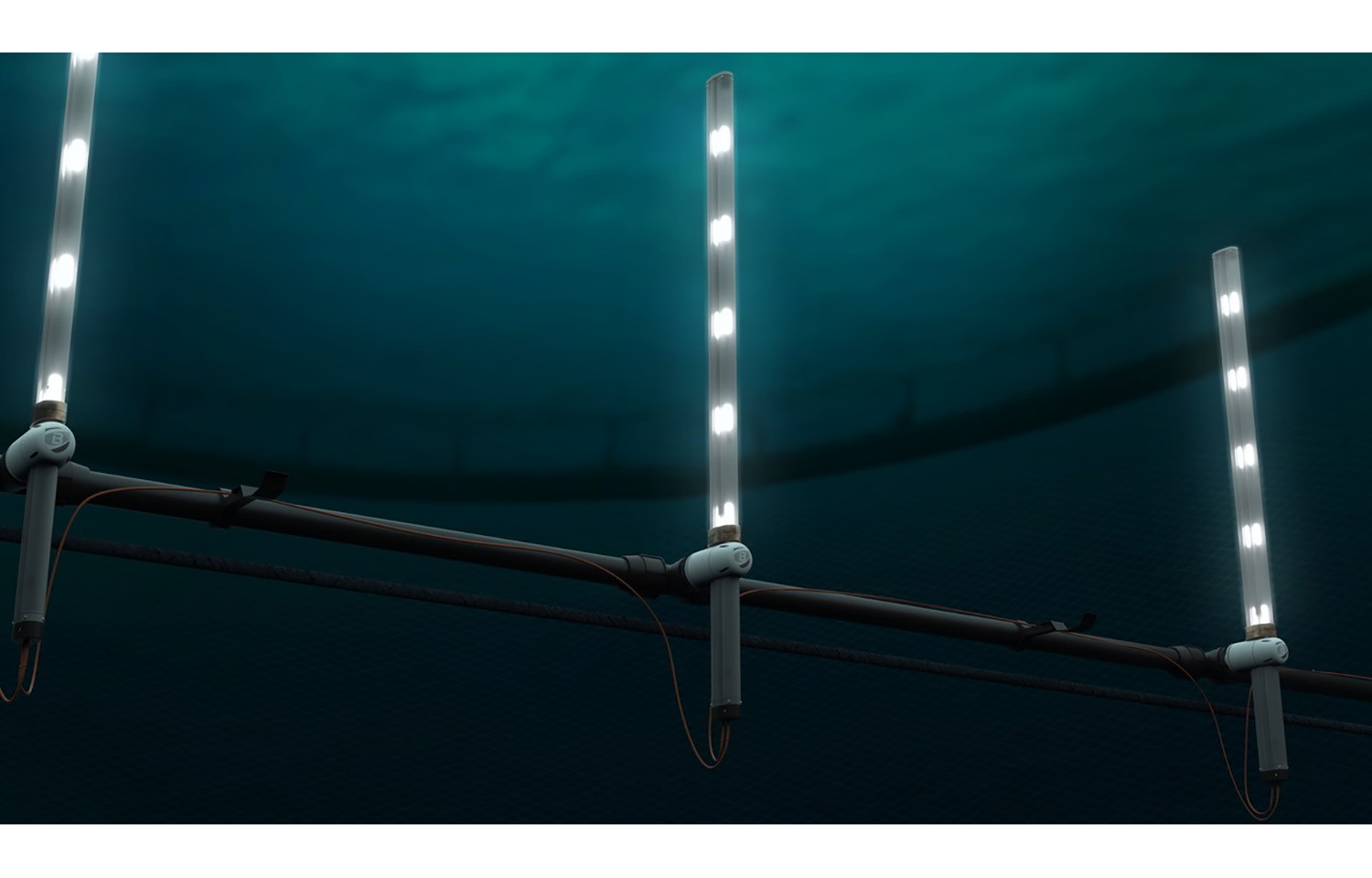
Unlike conventional treatments that tackle infestations after they’ve taken hold, Nærbø, Norway-based Blue Lice’s system intercepts lice at their planktonic stage using a combination of light and water flow traps that are attached to a farm’s mooring system away from pens.
The results, according to the firm, have included farms reporting an average of 22 extra weeks before a first treatment is needed, with some sites seeing fish growing larger than expected before harvest, resulting in improvements to both welfare and profitability.
“Since farms are dynamic, the value will vary, so that is why we have focused on how many more weeks we can give a farm before needing treatment as our main value driver. In addition to this, the farmers will have cost savings from fewer treatments,” Blue Lice CEO Karoline Sjødal Olsen said. “Over the last seven cycles of fish installed with Blue Lice, we have seen a reduction of treatments of 45 percent to 100 percent, depending on the farm and their sea lice pressure. A fish farmer would not believe [in the results from] just one cycle of fish at one of their fish farms because sea lice can vary year after year. That is why we needed over seven full cycles of fish to prove that our technology in every case has made the sea lice situation better.”
Even with these results, comparing Blue Lice’s results to other solutions is difficult as there are no other preventive innovations on the market that capture and measure sea lice, she said.
“We do an extensive analysis, where we compare [our results] to historical data, neighboring sites that should perform the same, and how many sea lice we are capturing in the filters,” Olsen said. “When we gathered more data, the fish farmers became more interested in the preventive technology.”
A lot of the data simply speaks for itself, she added, as Blue Lice estimates that its system results in reductions of more than 74 million lice larvae in just one week – benefiting not only its clients but neighboring farms, too.
Olsen told SeafoodSource the lice capture numbers are validated through droplet digital PCR (ddPCR) analysis, and Blue Lice is also testing out a camera that will continuously count the sea lice it is capturing, thereby gathering more data than has been possible by solely using ddPCR.
“We do not know yet if 80,000 sea lice a day is our maximum,” Olsen said, adding that the system continuously undergoes new work and has already improved from its original model. “Our first version of the Blue Lice has an uptime of 95 percent, which has been appreciated by fish farmers. The system needs cleaning approximately every six weeks, which takes a day, and you have to remove the filters every day. But, our new system, which we have launched this year, has automatic cleaning. This keeps the upkeep to a minimum.”
Looking ahead, Olsen said that there may be opportunities to combine Blue Lice’s approach with other emerging technologies to create integrated solutions; for instance, through machine learning, data captured by its new camera will enable the prediction of sea lice levels based on temperature, which can help fish farmers deploy other preventive solutions in order to mitigate future sea lice pressure.
The system can also be combined with controlling solutions such as lasers, she said, to alleviate sea lice pressure even further.
“We believe that Blue Lice will enable other controlling technologies, such as lasers, to work even better,” Olsen said. “That is because we are able to prevent a lot of the sea lice coming in, making it easier for other controlling technologies to hold the levels on the fish down. We also believe that when we are rolling out our technology to more farms, we will see a balancing effect on the sea lice pressure in the area, due to our technology capturing sea lice, thus reducing the ability for the sea lice to exponentially reproduce in the area.”
